Science1 publisher2 min readPublished
NASA's Mars to Table prize rewards complete food systems built to run on little crew time
NASA split $650,000 among five Mars to Table winners, led by a $300,000 design meant to produce half the food for 15 astronauts over 513 days on Mars. The entries are design concepts judged partly on how little crew time they need, so that 50% is a target until someone builds and measures it.
The Scientist · Science desk
What happened
- NASA picked five Mars to Table winners from 113 submissions by teams in 33 countries and 28 U.S. states, and split $650,000 among them.
- Where the earlier Deep Space Food Challenge sought individual food production methods, Mars to Table asked for complete systems serving varied meals with limited crew time.
- Teams designed for a 15-person crew living on the Martian surface for 500 sols, about 513 Earth days.
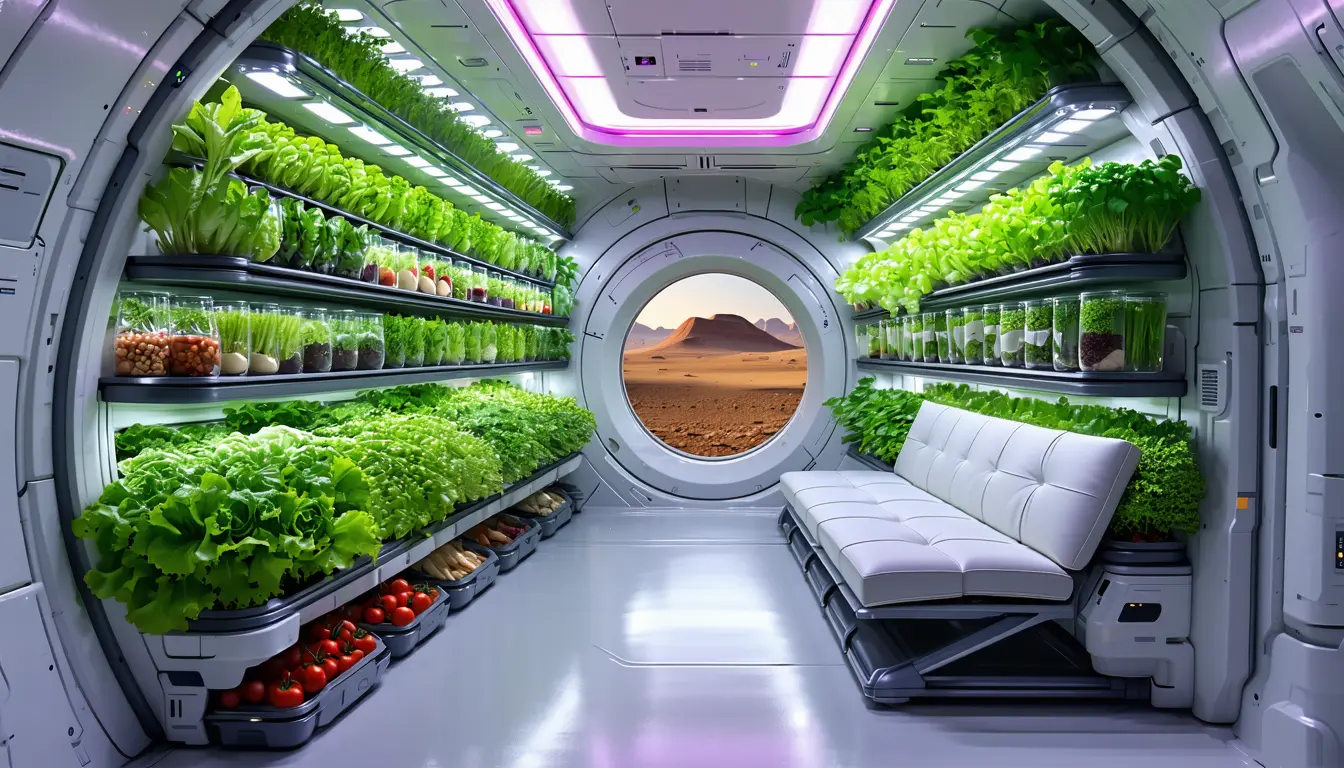
- Chinyere Ukeje of Philadelphia won the $300,000 top prize for ANI, which mixes controlled-environment crops, fermentation, fungi and bioreactor nutrient recycling.
Compiled by The ScientistSomething wrong?How this is made
Why it matters
- decision Mars food-system designers now have to weigh crop output against the hours a crew spends tending it, since NASA's brief counts both food variety and upkeep.
- precedent Both top-placed designs mix locally produced food with Earth stock and plan for breakdowns, so NASA's follow-on food work is likely to start from hybrids of grown food and stockpile.
- constraint Because entries were layouts, meal plans and videos, their self-supply and crew-time figures cannot go into a mission mass budget until test data exists.
Fifteen people on the surface for 513 days is 7,695 crew-days of eating [1]. ANI is designed to produce 50% of its food away from Earth, alongside a limited stock of food provisioned from Earth [7]. That leaves roughly 3,850 crew-days' worth still launched from Earth, assuming each day's ration is the same size [2]. Today's arrangement ships nearly everything: station meals are almost entirely cooked, packaged and sent up from the Space Food Systems Laboratory at Johnson Space Center [12]. NASA's case against doing the same for Mars rests on a one-way trip of at least nine months, on shelf stability, and on mass limits [13].
In my view the most informative part of the results is how the two top designs handle failure. ANI plans to keep cooking fresh meals daily through shortages of power, water, equipment or crew time [8]. Crew time sits on that list as a supply that can run short. The brief treated it the same way [4].
Cislune's second-place design, Fresh, Ferment, Reserve, grows model-selected crops and turns part of the harvest into familiar foods in instrumented culture cassettes [9]. A protected reserve loaded on Earth covers biological variability, utility curtailment and rejected batches [9]. Both designs keep a share of Earth food in the plan [7][9].
The thing this doesn't tell you is whether any of it works at the stated rates. Teams delivered a design layout, a meal plan, a concept of operations and a walkthrough video [6]. The earlier Deep Space Food Challenge, which NASA began with the Canadian Space Agency in 2021, focused on prototyped production methods [3][4]. Widening the scope to whole systems also moved the judging from prototypes to documents [4][6]. ANI's 50% is a design target, and the release does not say how judges scored crew time or how many hours counted as limited.
"The criteria we laid out for this competition were challenging, but intentionally so," said Alexander Meyers, the challenge's head judge [14]. He described the entries this way: "Every new idea presented in this challenge represents a possible new tool in NASA's plans for the future of space exploration" [15].
The first and second prizes plus three $50,000 category awards add up to $650,000, the full amount NASA gave out [3]. The category awards went to Ohā Kanu of Hilo, Hawaii, for Applied Frameworks; Orbital Health Systems of Evansville, Ind., for Mission Simulation; and Autonomic Resilience Collective of Bentonville, Ark., for Human-Centered Design [10]. NASA also recognized one international team, Astrofood of Ellezelles [11].
What to watch
- Whether NASA funds prototypes or ground tests of ANI or Fresh, Ferment, Reserve that report measured yields and crew-hours per week.
- Publication of the Mars to Table judging rubric, especially how crew time and food variety were weighted against each other.
- Whether later NASA Mars surface-habitat studies size their food mass around a partly grown diet, as the top two designs assume.