Science1 distinct publisher3 min readPublished
The Wide-Field Instrument was justified by dark energy, but the General Investigator programs NASA has now selected point it at newborn black holes and nearby galaxies too, all drawing on the same 1.4 terabytes a day.
The Scientist · Science desk

Compiled by The ScientistSomething wrong?How this is made
The mirror is 2.4 metres, the same class as Hubble's, and that number does more work than it looks like it does [4][3]. Seeing about a hundred times more sky in a single exposure is not seeing a hundred times deeper [6]. Roman buys area, not sensitivity per pixel, so its natural currency is population statistics: how many of a rare thing exist, and at which cosmic epochs.
The data figures at least hang together. 1.4 terabytes a day across 365 days is 511 terabytes, which sits comfortably against the roughly 500 terabytes a year NASA officials quote [7][8][1]. Dividing that annual figure by the 35-plus years of Hubble output it is said to match puts Hubble's long-run average near 14 terabytes a year, making Roman's rate about 35 times that [2][3]. Hubble's output was never constant, so read that as an average over a career, not an instrument-to-instrument comparison.
What the volume does not tell you is whether anyone can use it. For a General Investigator team, the scarce resource is unlikely to be photons; it is cross-matching, calibration and source detection at the depth their proposal assumed. NASA's own framing calls the wide field both a unique capability and a data management problem [6][16]. Telescope time was the thing you competed for with Hubble. With Roman, the competition looks more like software staffing inside each of the 118 groups.
The little red dot program is the sort of design I like, because it can lose. Vasily Kokorev's team at UT Austin starts its search two billion years after a big bang dated to 13.8 billion years ago, asking whether these objects genuinely fade with cosmic time or were simply missed [11]. The two hypotheses make different predictions: if the dots harbour the huge stars or black holes thought to seed globular clusters, their numbers should hold steady across cosmic history; if they are black hole stars feeding inside dense gas, the counts should fall as the fuel disperses [12]. JWST cannot settle a counting question over large volumes, which is what Kokorev means when he likens the attempt to using enormous binoculars to read a book held in front of your face [13].
Steven Finkelstein's program takes the complementary route, hunting very bright distant galaxies that other observatories can then dissect [14]. GN-z11, found by Hubble in 2016 at 400 million years after the big bang, is the reference case: JWST has since seen further, but GN-z11's luminosity is what makes chemical follow-up practical [15].
One ambiguity sits in the source itself. The 118 are described as observer programs, while Kokorev's is described as working from Roman's data, and many of the selected programs are expected to capitalise on the survey stream rather than command their own pointings [1][2]. Until that split is published, I would call this agenda queued rather than locked.
Ranked by verification strength, evidence, and original report placement.
If little red dots contain the humongous stars or black holes thought to be the beginnings of globular clusters, they should appear in similar numbers throughout the age of the universe; if they are black hole stars growing inside dense gas cocoons, their numbers should drop off as matter spreads out and their fuel runs dry.
NASA recently selected 118 programs to use the Nancy Grace Roman Space Telescope, which is set to launch on August 30.
The 118 selected projects are 'General Investigator' observer programs, and many of them will seek to capitalise on Roman's data volume.
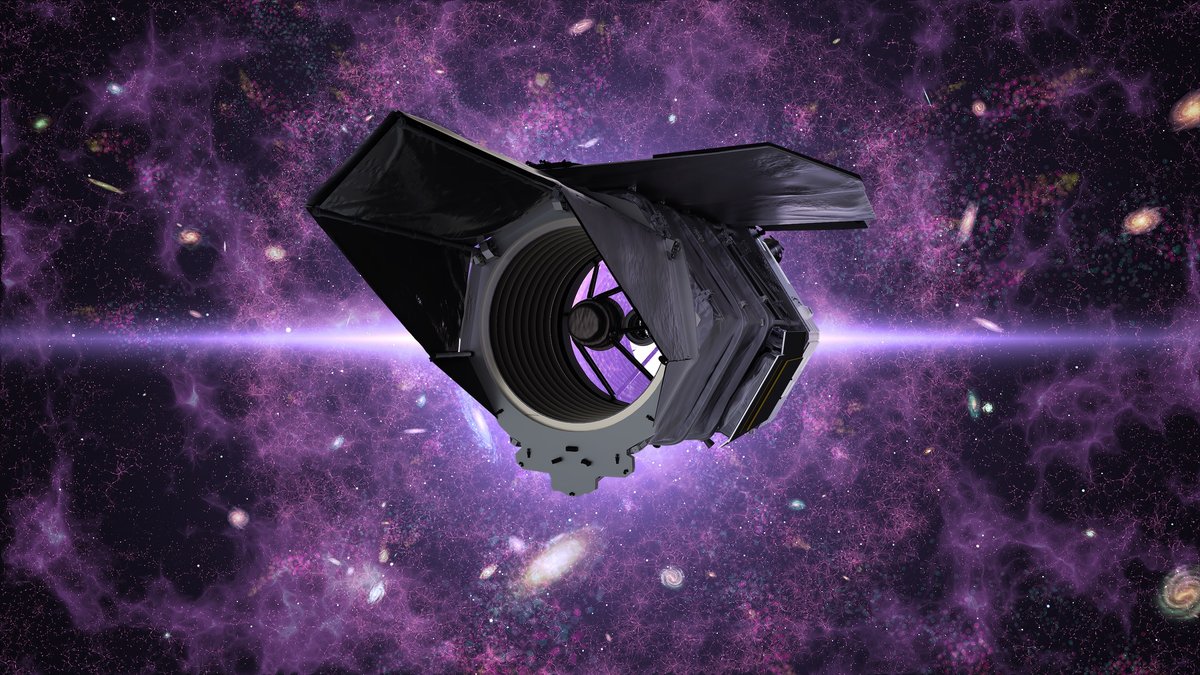
Roman has been more than a decade in the making at a cost of $4.3 billion, including a Hubble-sized panoramic mirror sourced from U.S. spy satellite programmes.
Roman pairs its mirror with a 300-megapixel infrared Wide-Field Instrument and a Coronagraph Instrument for high-contrast imaging, and will operate 1.5 million kilometres (one million miles) from Earth, where the James Webb Space Telescope also sits.
Distinct publishers with included, body-backed reporting in this cluster.
1 article · August 27, 2026
Follow any of these and your For You feed starts watching them — no settings page required.
product
Roman's 100x field is a pipeline bill, and August 30 is when it comes due1 distinct publisher
science
A spiral galaxy at redshift 2 suggests Webb's little red dots are partly a resolution problem1 distinct publisher
science
Roman's coronagraph is a bet on hardware, and the payoff is a factor of 1,0001 distinct publisher
science
Katalyst's servicer spent its fuel on its own tumble instead of raising NASA's Swift telescope1 distinct publisher
Evidence-backed comparisons of source perspectives and observed adoption signals. Read the methodology
Which Builder, Operator, and Investor concerns the observed source mix emphasized—not a truth score.
Evidence, demonstrated adoption, hype gap, incentives, and confidence are assessed independently, each on its own current evidence. How these are measured.
Specific and internally consistent, but single-source and pre-launch
All factual weight rests on one established science publication. In its favor: named, affiliated researchers with direct quotes; specific hardware figures (2.4 m mirror, 300-megapixel Wide-Field Instrument, 1.5 million km observing post); a program count of 118; and throughput numbers explicitly attributed to NASA officials that survive an arithmetic cross-check (1.4 TB/day implies ~511 TB/year against the ~500 TB/year quoted). Against it: no primary NASA document, solicitation, or archive plan is cited; no second publisher corroborates; and every capability claim describes a telescope that has not yet flown, so nothing here is measured on-orbit performance.
Strong pre-launch commitment, zero operational use
There is a real, countable adoption signal: 118 General Investigator programs have been selected, spanning multiple institutions (UT Austin, University of Missouri, Space Telescope Science Institute), with some taking bespoke observations rather than only reusing survey data. That is committed scientific demand for the platform. But the telescope has not launched, no data has been produced, and no user has actually operated against the stream, so adoption is entirely intent-stage. The score reflects broad institutional commitment discounted heavily for the absence of any realized usage.
Headline framing outruns a modest, well-attributed body
The overstatement is concentrated in framing rather than in facts. 'Will rewrite how we study the universe' and 'super-Hubble' are asserted about an unlaunched instrument, and the Hubble comparison is presented in its most dramatic form (a year of Roman equals 35 years of Hubble) without noting that detector generations differ by decades. Offsetting that, the substantive numbers are attributed, mutually consistent, and the article itself flags the data-management challenge and the fact that LRD origins are unresolved. Positive but small.
Promotional alignment on both sides of the sourcing
Two incentive structures are visible in the supplied material itself. First, every substantive voice is invested in Roman's success: NASA officials supplying the throughput figures are promoting a $4.3 billion program weeks before launch, and the quoted scientists (Kokorev, Finkelstein, Yan) lead selected programs whose value depends on the telescope performing as advertised. No skeptical or independent voice appears. Second, the article carries an inline subscription solicitation, indicating a reader-revenue model that rewards engaging mission narrative. None of this implies inaccuracy, but it means no participant had a reason to stress-test the claims.
Moderate: coherent and specific, but one publisher and nothing verified on-orbit
Confidence is capped by structure rather than by any detected error. One publisher, one article, no primary documents, and no independent corroboration mean the cluster cannot distinguish accurate reporting from accurately reported optimism. What raises it above low: the figures are attributed, they reconcile arithmetically, sources are named with institutions, and the article discloses its own key uncertainty (data management, unresolved LRD physics). What holds it down: hardware performance, launch date, and all 118 programs' outputs remain unrealized, and every quoted party is aligned with the mission.