Science1 distinct publisher3 min readPublished
The nine-month rescue vehicle failed upstream of the grapple, so the flight tested attitude control rather than capture, and mission planners still have no servicing result they can bank on.
The Scientist · Science desk

Compiled by The ScientistSomething wrong?How this is made
The mission ended upstream of the maneuver it existed to prove. Nothing about closing on a client that was never designed to be caught, and nothing about holding onto one, got flight-tested [21]. That makes this a result about one first-flight vehicle's attitude control rather than evidence against robotic capture, and the useful reading of it is narrow.
Schedule belongs next to that. NASA gave Katalyst nine months to develop the refrigerator-size spacecraft, and engineers rushed testing because the clock was running [5]. Nine months is 0.75 years; Swift launched in 2004 and has been observing for more than twenty [2]. The vehicle sent to save it was therefore designed and built in under 4 percent of the time its target has spent on orbit: 0.75 / 20 = 3.75 percent, and that figure is an upper bound, since Swift's run exceeds twenty years [19]. Science News reports no causal link between the compressed schedule and the malfunction, and I will not supply one. What a nine-month build does set is the prior you attach to a first flight. David Barnhart, an astronautical engineer at the University of Southern California, puts it without decoration: "there's full expectations that the first missions may not succeed" [13]. He also holds that the enabling pieces, rendezvous sensors, propulsion systems and robotic arms, are on a very good path [12]. Both statements can be true. A risk register cannot carry both, because it wants a probability a program can act on.
Swift's paused observing is the part that does not come back. The observatory's distinguishing trick is agility: it swivels toward a gamma-ray burst afterglow within minutes and pinpoints the source [10]. Huei Sears, an astrophysicist at Rutgers University, says the longer bursts trace the deaths of very massive stars, and that our own galaxy is too metal-rich to host them [11], so every burst Swift localizes is a brief look into another galaxy's stellar environment, and every quiet week is a look not taken. Reentry was always in Swift's schedule [3]; the suspended science was supposed to buy years against it.
Katalyst did not answer a question from Science News about what becomes of LINK [18]. The queue behind it is real: Jared Isaacman offered to mount a SpaceX mission to raise Hubble's orbit before he was appointed NASA administrator [15], and in July the U.S. government dispatched a years-in-the-making spacecraft meant to inspect, relocate and eventually attach life-extending jetpacks to satellites already flying [16].
Servicing earns its line in a mission's risk register the day a vehicle grapples a client it did not launch with and raises that client's orbit. Until such a flight exists, it belongs in the technology development budget, and the observing time it interrupts should be booked as part of the experiment's cost.
Ranked by verification strength, evidence, and original report placement.
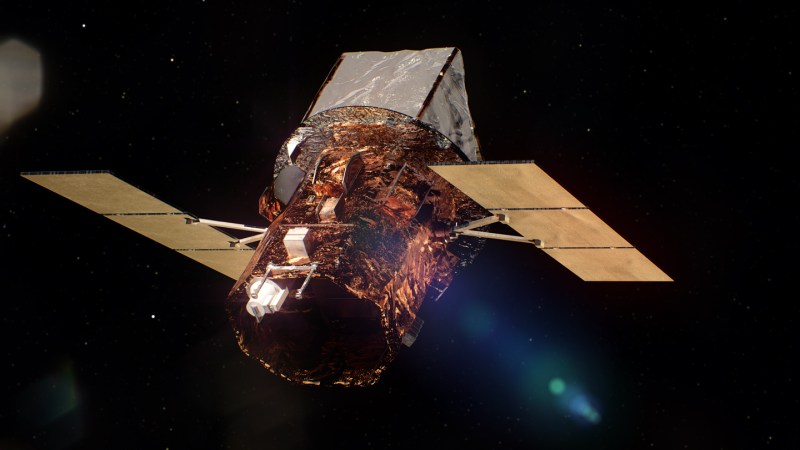
NASA's Neil Gehrels Swift Observatory is losing altitude at roughly 340 kilometers above Earth because of atmospheric drag and a recent bout of unusually strong solar activity.
Swift launched in 2004, observes gamma-ray bursts, and has studied some of the brightest phenomena in the universe for more than 20 years.
Swift was always going to end by incinerating in Earth's atmosphere.
Last year NASA decided it was not ready to say goodbye to Swift and hired the private company Katalyst Space to build a spacecraft to grab hold of the observatory and push it higher into space.
NASA gave Katalyst nine months to develop its refrigerator-size spacecraft, named LINK, and engineers rushed testing because the clock was ticking.
LINK set off the month before the abort and tumbled out of control as it approached Swift, despite efforts to get the mission back on track.
Follow any of these and your For You feed starts watching them — no settings page required.
Evidence-backed comparisons of source perspectives and observed adoption signals. Read the methodology
Which Builder, Operator, and Investor concerns the observed source mix emphasized—not a truth score.
Evidence, demonstrated adoption, hype gap, incentives, and confidence are assessed independently, each on its own current evidence. How these are measured.
Specific, on-record failure account from one outlet
The failure sequence, abort date, and the drag-reduction science pause are attributed on the record to Swift principal investigator Brad Cenko, with named outside experts for context. Weakening it: a single publisher carries the whole cluster, the propellant and malfunction details come from the operator and vendor rather than independent verification, and Katalyst declined to answer about LINK's fate.
Demonstration stage with no successful capture
On-orbit servicing is being funded and flown — a NASA-contracted commercial servicer launched, and a U.S. government servicing spacecraft was dispatched in July — but the flight in this story produced no grapple or reboost, there is no backup mission, and the target continues to decay. Real-world uptake is procurement and demonstration activity, not operational service.
Servicing promise still ahead of flight results
The surrounding narrative — servicing as a long-held industry dream, technology 'on a very good path', Hubble as the next prize, billionaire reboost offers — runs ahead of what has been demonstrated: a nine-month vehicle that lost attitude control and spent its fuel before reaching the client. The gap is moderate rather than severe because this reporting is itself deflationary and quotes an expert saying early missions are expected to fail.
Vendor, agency and schedule incentives all visible
Katalyst had commercial reasons to present the Swift mission as a preview of a Hubble servicing contract, and its post-abort messaging came from a marketing director while the question of LINK's fate went unanswered. NASA faced a hard decay deadline that compressed development to nine months, and the NASA administrator had previously offered a competing SpaceX reboost of Hubble — an interest worth naming even though the article does not tie it to this contract.
Solid on facts, thin on independent corroboration
Dates, altitudes, and the failure mechanism are concrete and attributed, and the derived conclusions follow directly from the reported sequence. Confidence is held below high because one publisher supplies everything, the vendor's account is partly unrebutted and partly withheld, and forward statements about proximity operations and Swift's reentry window are projections rather than observed outcomes.
product
NASA stops trying to save Swift, and gamma-ray burst alerts get a hard deadline1 distinct publisher
science
Two robots in orbit will decide whether satellites stop being disposable1 distinct publisher
product
Roman's 100x field is a pipeline bill, and August 30 is when it comes due1 distinct publisher
invest
Trump's 1,000-launch target is a permitting subsidy, and SpaceX owns the queue1 distinct publisher
Distinct publishers with included, body-backed reporting in this cluster.
1 article · August 27, 2026