Science1 publisher2 min readPublished
A Greenland comparison puts liquid nitrogen under Pluto's dark glacier streaks
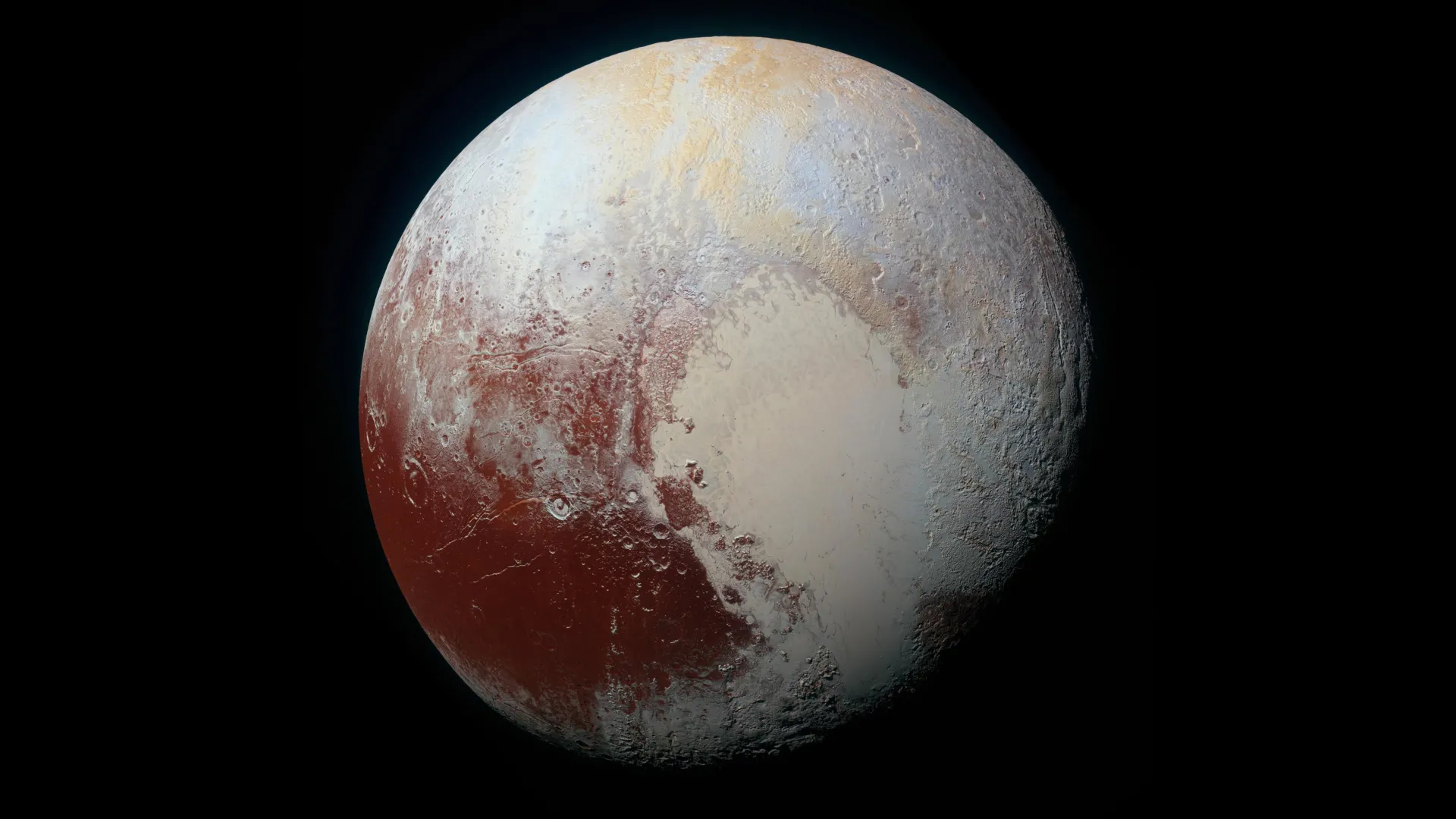
The evidence for seeping nitrogen on Sputnik Planitia is a resemblance to wet ice in Landsat 9 images of Greenland, backed by simulations in which nitrogen ice several kilometers down melts and rises.
The Scientist · Science desk
What happened
- A Southwest Research Institute analysis suggests liquid nitrogen is moving up through cracks and reaching Pluto's surface near the northern edge of Sputnik Planitia.
- The features at issue are thin dark lines and broader, more diffuse dark patches lying between city-sized convection cells, seen in New Horizons images collected in 2015 and 2016.
- Simulations led by Orkan Umurhan of the SETI Institute find that nitrogen ice at the glacier's base, several kilometers down, can melt into liquid nitrogen.
- The paper is in the peer-reviewed Planetary Science Journal, with Alan Stern, principal investigator of the New Horizons mission, as lead author.
Compiled by The ScientistSomething wrong?How this is made
Why it matters
- constraint A feature that wets and dries can only be confirmed by looking at the same ground twice, so the claim stays an interpretation of archived frames until another spacecraft observes Sputnik Planitia.
- capability Basal melting plus narrow channels gives modellers a specific plumbing scheme for a nitrogen glacier, testable against the widths and spacings of the markings already imaged.
- precedent If morphological resemblance plus modelling counts as evidence of present-day liquid here, the same standard will be pressed on dark terrain elsewhere in the outer solar system.
All the New Horizons frames record is darkening. The identification comes from Earth. On Greenland's ice sheet, Landsat 9 sees narrow dark markings where liquid water sits on top of ice and snow, and the team led by Southwest Research Institute reports the same look on the frozen nitrogen of Sputnik Planitia, a glacier larger than Texas and Oklahoma combined [6][8]. Liquid nitrogen cannot fall as rain on Pluto, because the dwarf planet's temperature and atmospheric conditions do not allow it [7], so the authors' wetting agent has to arrive from underneath [5].
The simulations supply the route up. Liquid nitrogen can move through narrow channels toward the surface, which the modelling likens to material moving through lava or geyser tubes, pushed by buoyancy or by pressure from below [10].
The recency of all this rests on a second model. "The surface of Sputnik Planitia is quite young, probably less than one million years based on modeling of the surface overturn, and thus these features that we are looking at must have formed since then," said SwRI Principal Scientist Kelsi Singer, a co-author [11]. That bound comes from modelling how quickly the glacier turns itself over, so the age of the dark markings inherits the assumptions of the overturn model.
Stern also flagged a second implication. "In addition to suggesting that liquids have recently expressed themselves on Pluto's surface, it also suggests a new kind of time-variable feature on Pluto," he said [12]. The images in hand were collected in 2015 and 2016 [4], and the paper appeared in September 2026 [14]. The pixels are ten years old [15].
The analysis does not settle when. Its authors allow both that liquid nitrogen sits beneath Sputnik Planitia today and that it was there very recently, where earlier work, including Stern's own, had put liquid flow on Pluto in the distant past [13]. The institute's release says the finding reveals that Pluto "may be much more geologically active than its frozen appearance suggests" [17].
What to watch
- Whether anyone finds a dark patch that changes between separate New Horizons frames. Such a find would move time variability from prediction to observation.
- Whether Umurhan's group publishes melting rates or channel widths that can be checked against the sizes of the observed dark lines and patches.
- Whether an independent group reproduces the Landsat 9 comparison with a quantitative match.