Product1 publisher3 min readPublished
IBM cut the Moon into orange wedges to keep its lunar training and test data apart
The NASA-IBM Lunar Foundation Model is a free download on Hugging Face, but the reusable part for other teams is the pixel-aligned dataset underneath it and the geographic split that stopped training leaking into the test set.
The Product Desk · Product desk
What happened
- NASA and IBM released the NASA-IBM Lunar Foundation Model on Thursday as an open-source system anyone can download from Hugging Face.
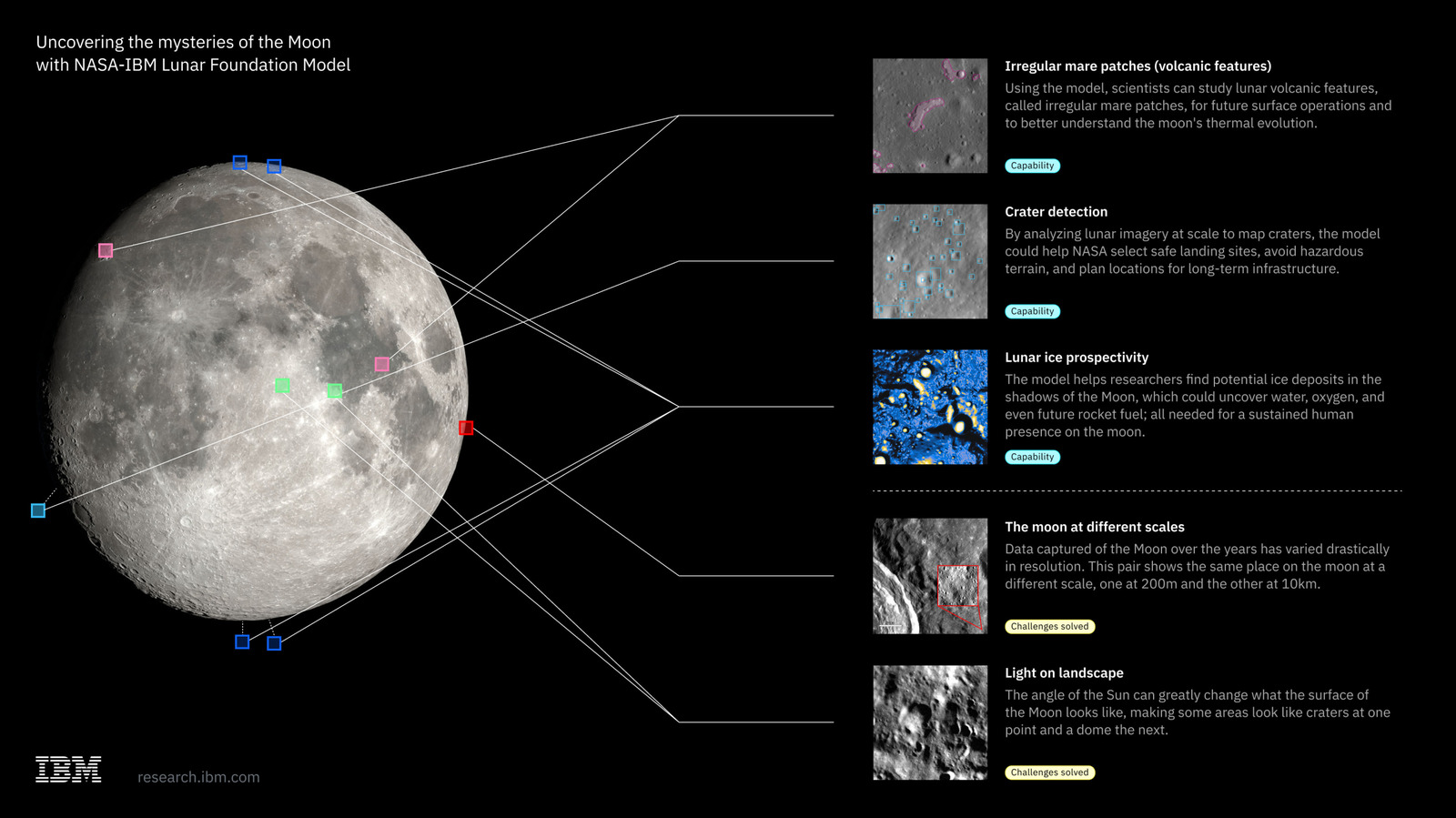
- It ships with an open-source dataset the two call a first of its kind, built from tens of thousands of images and instrument readings from the Lunar Reconnaissance Orbiter, GRAIL and Japan's SELENE.
- On finding candidate surface ice, the model cut errors by 23 percent against SwinV2-B, the Microsoft-trained vision system NASA and IBM used as their comparison point.
- On identifying and classifying craters it outperformed SwinV2-B by 19 percent while using half the training data.
- After a SpaceX Falcon 9 hit the Moon on August 5, IBM fed the impact image to the model and it flagged a new crater that closely overlapped an existing one.
Compiled by The Product DeskSomething wrong?How this is made
Why it matters
- capability The blocker Bernabe-Moreno names is data that was never organized for training, and that is the part now solved in public, so the next group attempting a lunar model does not start by reconciling three missions' archives itself.
- constraint Because both gains are quoted only against SwinV2-B, an outside team cannot size the model's absolute accuracy, which is the figure needed to weigh it against a workflow already in use.
- decision Any team pretraining on an archive of near-identical instances now has a published alternative to random masking sitting next to a downloadable dataset, which makes sticking with random masking a choice to defend rather than a default.
Someone will download this on Monday and spend the first hour on the dataset card rather than the weights, which is the correct instinct. The weights are tuned to a question NASA has. The dataset answers the question a research group has, which is whether the archive is in a shape anything can be trained on. Juan Bernabe-Moreno, who directs IBM Research Europe, UK and Ireland, says no comprehensive lunar model existed before because the data was not organized in the right way, and organizing it meant building a grid in which every pixel of imaging data corresponds to the other modalities available at that spot [13][12]. Three missions run by two agencies feed that grid [14].
The transferable craft is in the split. Standard vision pretraining hides part of an image and asks the model to reconstruct it, sometimes leaving a tenth of a crater and demanding the rest back [9]. That collapses on the Moon, partly because a lot of craters look much alike from orbit [11], and partly because the light does not hold still: the sun cuts hard shadows at different times of the lunar day, shadowed pixels carry no information at all, and the same feature can photograph as two different features on two passes [8]. Bernabe-Moreno calls the conventional attempts a complete disaster, and says the fix was cutting the Moon into wedges like an orange and keeping the training wedges entirely separate from the test wedges [10]. That is a geographic holdout, and it is the defence a team needs whenever neighbouring examples in an archive are near-duplicates of each other.
The scoreboard needs reading slowly. The ice figure is agreement with a reference map NASA and IBM built themselves from a published workflow over terrain, thermal and other environmental data, so it measures closeness to a model of where ice should be rather than to ice anyone has touched [3]. The crater comparison changed the training data volume at the same time as it changed the model [5], so nobody outside can tell from the published numbers how much of the gain belongs to the architecture and how much to the curation. Both results are quoted as relative improvements over a single baseline [15], and SwinV2-B holds that spot because it is the common baseline for image analysis tasks, not because anyone built it for airless bodies [4]. The Falcon 9 check is the most vivid item in the release and the thinnest, resting on one image and one correct call [6][7].
Two questions decide whether a release like this is useful in a different domain. The first is whether the bottleneck is assembling a labelled, aligned multimodal archive or capacity in the model sitting on top of it. The second is whether instances in that archive resemble each other closely enough that random masking quietly hands the model the answer. Groups blocked on assembly with look-alike instances get the most here, because both the dataset and the wedge discipline carry over [2][10]. Where the block is capacity, the checkpoint is the whole of the benefit. Where instances are genuinely distinguishable, the split argument matters less and the reported numbers can be read at face value. For anyone building an open scientific model in an unrelated domain, the shape of the release is the part worth copying, because shipping the training data next to the weights is what makes an outside check possible at all [1][2]. Whoever ships the next domain model with the weights alone will be asked why.
What to watch
- The licence attached to the dataset and weights on Hugging Face, which the release coverage does not specify, and whether it permits commercial reuse.
- An independent group reproducing the ice result against a different reference map, or against in-situ measurement rather than a workflow-derived map.
- Whether other planetary or Earth-observation groups adopt the wedge-style geographic holdout, or publish competing results on the same released dataset.