Science1 publisher3 min readPublished
Change.org's AI writing assistant lengthened petitions without winning them more early support
Cornell researchers analysing 1.5 million Change.org petitions found its AI writing tool made them longer and more alike but did not improve early support. Change.org's staggered launch made it a natural experiment, and the result cuts against lab work finding AI-written text persuasive.
The Scientist · Science desk
What happened
- The tool reached the US, Britain and Canada first and Australia 11 weeks later, leaving one English-speaking market without it during the rollout.
- Petition titles began calling on people to "implement," "mandate" or "urge," words that had rarely appeared on the site before the tool arrived.
- The paper, led by Cornell doctoral student Isabel Corpus with Mor Naaman on the team, appeared Sept. 30 in Nature Human Behaviour.
Compiled by The ScientistSomething wrong?How this is made
Why it matters
- contradiction Lab studies finding AI text persuasive did not predict what happened on a live platform, so they are a weak basis for forecasting what a shipped writing feature will do to engagement.
- decision A platform that tunes an assistant toward the markers of past winners has to test outcomes directly, since matching those markers here brought no extra comments or signatures.
- constraint Because success meant one comment or 10 signatures, the study cannot say whether AI-assisted petitions won or lost more campaigns, only that early traction did not rise.
- precedent A country-by-country launch let outside researchers run a causal comparison without a randomized trial, and other platforms' phased AI launches could be audited the same way.
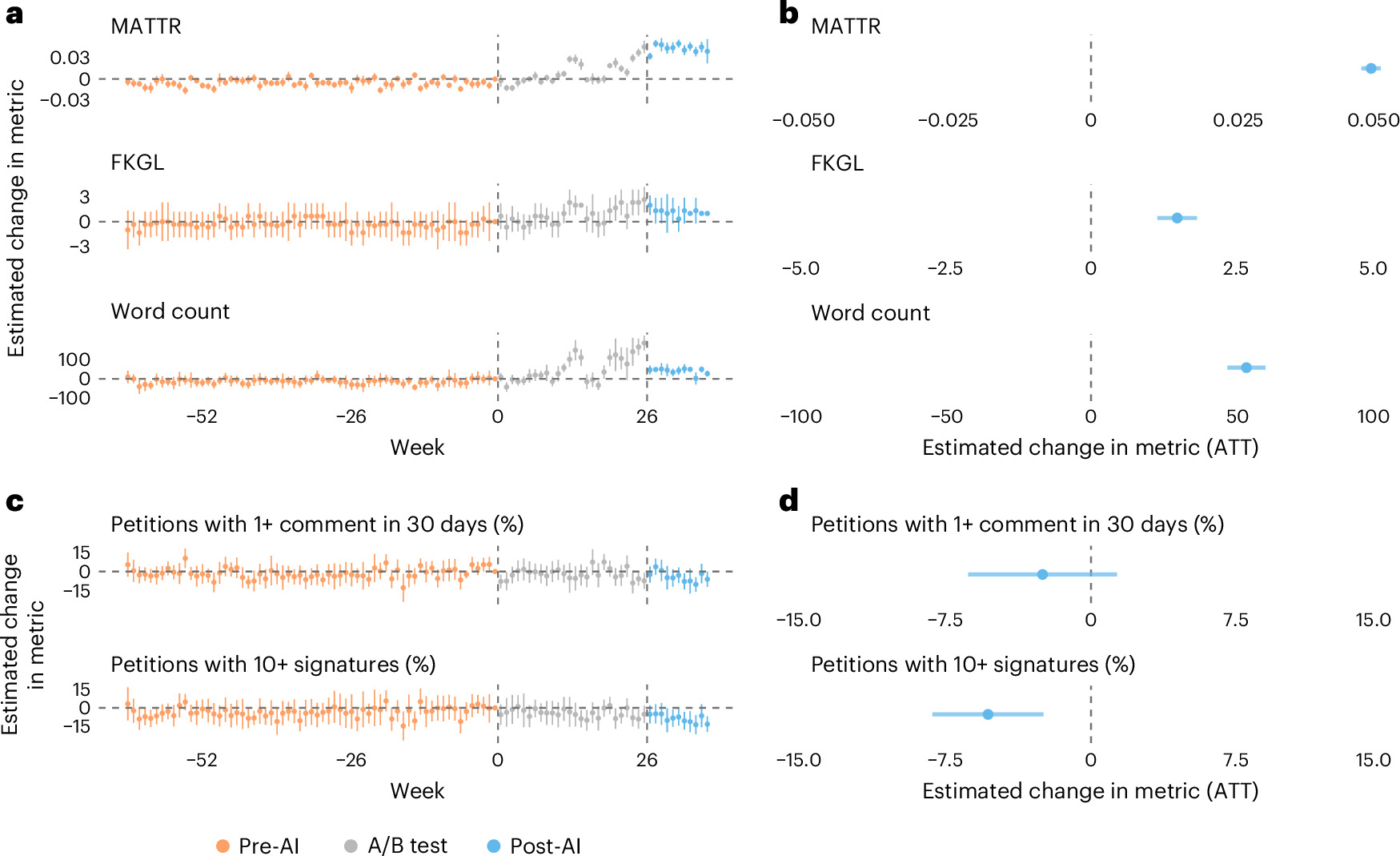
The researchers' premise was that the four countries had tracked one another on petition style and outcomes before the tool arrived [5]. If that held, any divergence between Oct. 2 and Dec. 15, 2023, could be put down to the assistant [5]. A simple before-and-after comparison on one site would mix the tool's effect with whatever else changed that autumn. Comparing trends across countries strips out anything that moved all four together. It still depends on nothing else having hit only one side of the split during those weeks.
Style came from three measures: lexical diversity, the ratio of unique words to total words; readability, from words per sentence and syllables per word; and length, counting text and title [6]. Across the 1.5 million petitions analysed [1], the effect on those features was consistent. Petitions written with the assistant's help were longer and used more complicated and varied words [7].
Success was set at two low bars: the share of petitions reaching one comment within 30 days, and the share reaching 10 signatures by the time the data were collected [9]. Neither improved on pre-AI levels, and in some cases they got worse [9]. The drop in comments is measured relative to the pre-AI rate [10].
The result sits badly with laboratory work. "There is this existing research that shows AI-generated text is persuasive, it's believable and it can be creative, sometimes more so than people writing alone," Corpus said [12]. Of the field result, she said: "That was a surprise for us." [11]
Mor Naaman, the Cornell Tech information scientist on the team [2], suspects that the assistant was trained in part on petitions that had succeeded on the site before, though he said he could not be sure [13]. He said the data showed the AI-enhanced petitions carried the markers of what had been successful in the past [14]. If he is right, the tool reproduced the surface features of past winners and the support did not follow. He offered two explanations. One is that readers distrust text that feels machine-written, though he noted how early the study period was. "People didn't have their AI radars as high in 2023," he said [16]. The explanation he considered more likely is that AI-assisted petitions tended to be less specific and detailed [17].
The thing this doesn't tell you is whether any petition won what it asked for. One comment and 10 signatures measure early traction [9]. The comparison is also between countries and periods, so it estimates what offering the tool did to the platform's output as a whole. The report does not say how many petitioners actually used it. I think the result is solid for what it covers, and narrow: one platform, one window in late 2023, a tool built in when Change.org was among the first platforms to offer one [15], and outcomes counted as early engagement [9].
What to watch
- Per-petition data on who actually used Change.org's assistant, which would separate the effect of using the tool from the effect of offering it.
- Whether the same pattern shows up in longer-horizon outcomes, such as petitions that achieve their demands.
- A replication with post-2023 models or on another platform, given Naaman's point that readers' AI radars were lower in 2023.