Product1 publisher3 min readPublished
Meta moves the VR processor and battery into a pocket puck for spring 2027
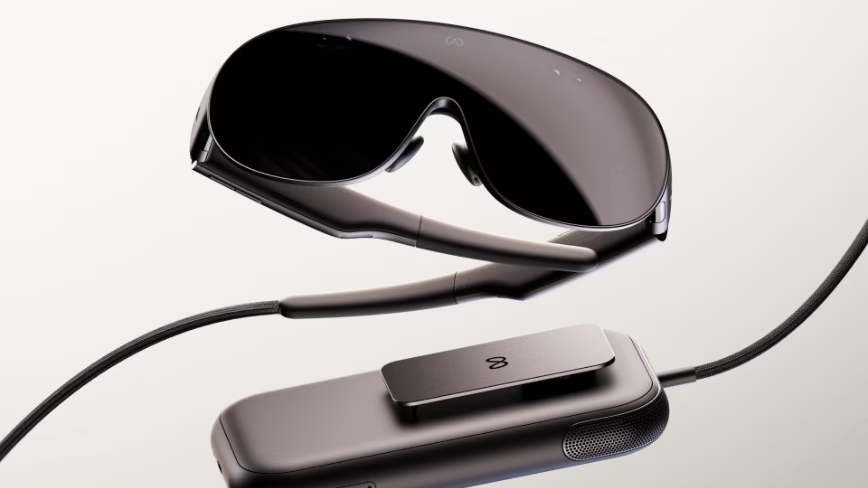
Meta's new VR glasses weigh about 100 grams, cost $1,299.99 and depend on a pocket puck rated for up to three hours of video playback. Zuckerberg said Meta will build fewer VR devices and ship them only on a breakthrough.
The Product Desk · Product desk
What happened
- Meta will sell VR glasses weighing about 100 grams for $1,299.99 from spring 2027, with the processor, storage and battery moved into a puck that clips to a pocket on an optical tether.
- The glasses use micro-OLED displays and Qualcomm's new Snapdragon Reality Elite chip, and Meta says the puck battery lasts up to three hours of video playback.
- Zuckerberg said Meta has decided to focus a little less on the metaverse and build fewer VR devices, releasing them only on a real breakthrough, and he called these glasses one.
- Meta calls the device the first VR product certified as IMAX Enhanced, with Marvel films in 3D on Disney+ from November and first-time 3D catalogues on HBO Max, Peacock and Paramount+.
- A new Hearing Enhancement feature turns Meta Glasses into an FDA-cleared over-the-counter hearing aid for perceived mild to moderate loss, tuned by a guided test in the phone app.
Compiled by The Product DeskSomething wrong?How this is made
Why it matters
- constraint Three hours of video playback is the outer edge of the media use case Meta is selling, so the person wearing the glasses has to plan long sittings around a charger.
- decision Studios with Quest builds now pick between maintaining for hardware its maker has said it will replace less often and retargeting to a tethered micro-OLED device roughly two quarters out.
- capability Someone with perceived mild hearing loss can get an FDA-cleared amplifier by buying frames and taking a test in an app, with no clinic appointment in the path.
- precedent A stated policy of shipping VR only on a breakthrough sets developers up for longer waits between devices, so this spec has to carry more than one content cycle.
Put the glasses on for one of the 100-plus immersive live events Meta promises a year, with ESPN and UFC among the partners, and the thing on the clock is the puck in your pocket, rated at up to three hours of video playback [11][4]. That budget covers a feature film and a little more.
Meta says the glasses weigh less than a fifth of a Meta Quest 3 [5]. By that comparison the Quest 3 sits above 500 grams [3]. The 100 grams counts the glasses only [1]. Meta also pitches them as a computer with several virtual screens and any flat surface acting as a keyboard, with Muse built into the operating system so users talk to it instead of opening menus [12].
The product with a firm date on it costs far less. Ray-Ban Meta Audio has no camera, weighs 43 grams, starts at $349 and ships on 13 October, with up to 12 hours of battery and 48 more from the case [20][21]. The VR glasses cost about 3.7 times that entry price [1]. Taking the October ship date as the year before spring 2027, the two products land roughly five to seven months apart [2].
Zuckerberg framed the whole line-up around Muse, Meta's personal AI agent, at Connect on Wednesday [8]. "It's now clear that personal superintelligence will not only come first, it will be much bigger and more important," Zuckerberg said [7].
The buyer who gets something new soonest is the one with mild hearing loss. Zuckerberg said one in six American adults has some form of hearing loss [18]. Meta did not give a price for Hearing Enhancement, saying only that it costs a fraction of a hearing aid [17]. Phonak already sells an AI hearing aid, the EON [19].
Calls will run as photorealistic holograms, including full-body holograms in VR for the first time, Meta's Andrew Bosworth said [14]. "Yes. We've finally solved the genuinely hard problem of giving you legs in VR," Bosworth said [15].
For a team with a Quest build to maintain, two tests settle the retarget question, and both can be answered before spring. The first is whether the session your product depends on fits inside three hours away from a charger [4]. The second is whether the value survives the compute and the cell being clipped to a pocket or a bag on an optical tether [2]. Two yes answers make the 100-gram device the target, and micro-OLED plus Snapdragon Reality Elite is the spec sheet to build against [3]. One no leaves you supporting hardware that Meta has said it will replace less often [6]. Input is the other variable to plan around: more than 75 games will work with hand gestures alone at launch [13].
What to watch
- A published puck weight, and whether it charges while tethered, would settle what a session longer than three hours looks like.
- A price for Hearing Enhancement would let buyers compare it with products already on sale, such as Phonak's EON.
- Whether the 13 October audio glasses and the 23 October Adventurer ship on their announced dates.