Build2 publishers3 min readPublished
128GB of DDR5 is $3,399: your 2026 memory budget is void
Tom's Hardware tracks DDR5 up near 500% in twelve months, and hyperscale buyers have reportedly pre-bought almost all of 2027's global DRAM output. Deferring the purchase is not a plan.
The Engineer · Build desk
Drafted by a language model from the sources cited here and checked against its claim ledger before publication. How we use AISend a correction
What happened
- Memory prices have climbed 500% in 12 months, with year-over-year increases nearing 500% for high-capacity DDR5 kits.
- 128GB of DDR5 now costs $3,399.
- 128GB DDR5 kits are fully ten times more expensive than the lowest price Tom's Hardware has ever tracked.
- Hyperscale buyers have reportedly already locked in almost all of the global DRAM production capacity for 2027, handing over advance deposits to guarantee supply.
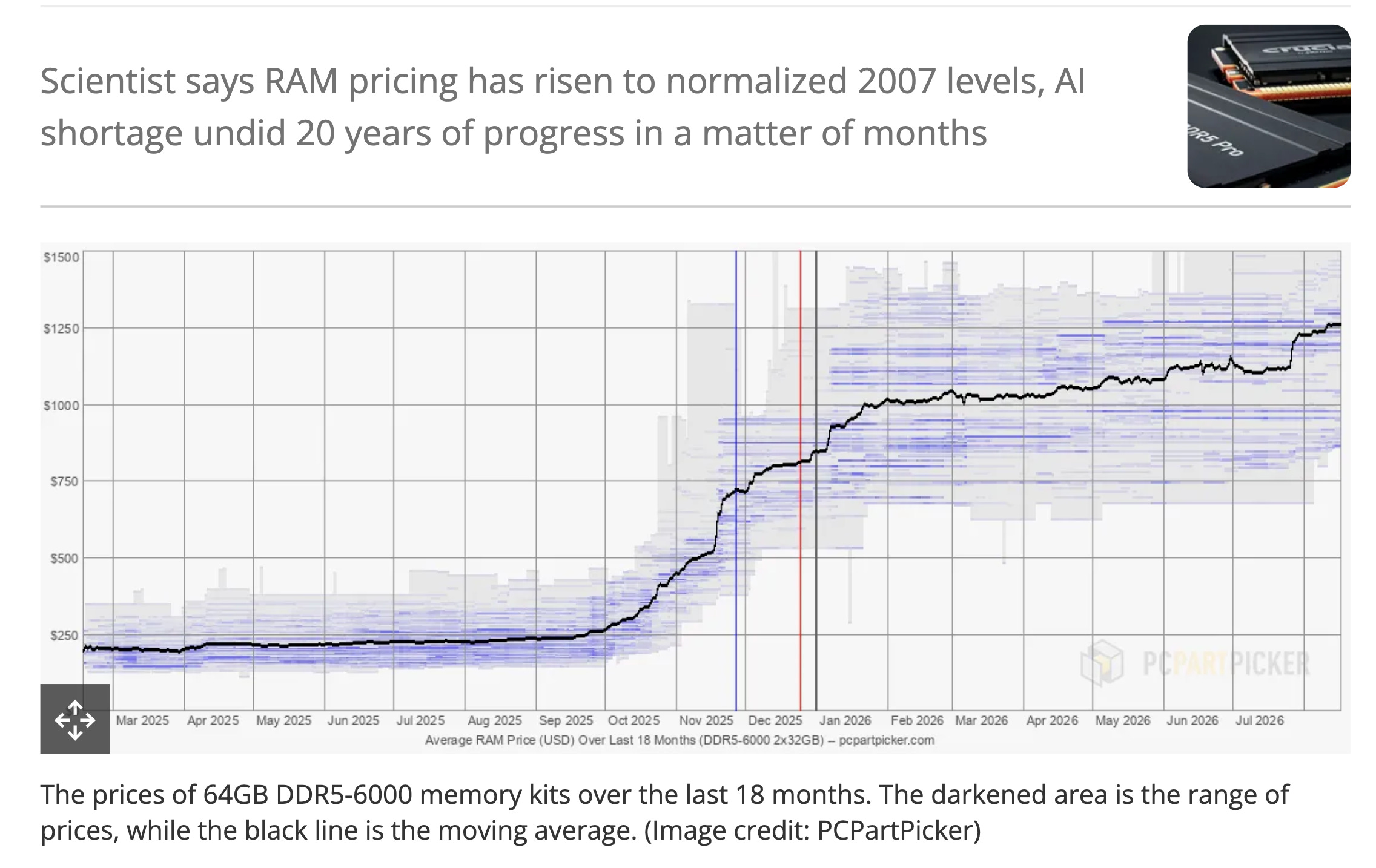
- A standard 64GB (2x32GB) DDR5-5600 kit that would have cost under $200 last summer is now demanding over $1,100.
Compiled by The EngineerSomething wrong?How this is made
Why it matters
Tom's Hardware reported in August 2026 that 128GB DDR5 kits are selling for $3,399, ten times the lowest price the site has ever tracked, with year-over-year increases nearing 500% on high-capacity kits [1][2][3]. If your 2026 capacity plan carries memory as a boring, predictable line item, that plan is void, and the usual response of pushing the buy a few quarters right does not work here: hyperscale buyers have reportedly already locked in almost all global DRAM production capacity for 2027, with advance deposits [4].
The mid-range is where fleet refresh actually lives, and the mid-range moved too. A 64GB (2x32GB) DDR5-5600 kit that was under $200 last summer is now over $1,100 [5], more than a 5x move [2]. A kit that cost $72 a year ago is $392 [6], roughly 5.4x [1]. The comparison is PCPartPicker average retail prices for August 2026 against a year earlier, and the author calls the data somewhat approximate [7], so treat it as a directional index for consumer kits rather than as your quote.
Downgrading platforms is not an exit either. With DDR5 out of reach for most builders, the scramble for older DDR4 boards pushed DDR4 kits up 120% to nearly 180%, including one kit that went from $105 to $281 [8][9], about 2.7x [5]. In Europe, ComputerBase reports average RAM prices up 345% against September 2025, with hard drive and SSD prices both up over 125% in the same window [10][11]. That last figure matters if you were planning to buy your way out of a memory constraint with storage tiering.
Run the arithmetic on your own sizing sheet before the next planning meeting. At $3,399 for 128GB, retail DDR5 is about $26.55 per gigabyte [3]. A single 512GB CPU-memory host is therefore around $13,600 in DRAM alone at that rate [4], against roughly $2,700 for the same arithmetic a year ago on the same tracker [6]. That is the actual cost of the self-hosted-inference thesis right now, and it lands in the same week that Latent Space's AINews recap described Moore's Law as reversed for memory while celebrating a 27B open model with 262K context as locally runnable frontier-ish [16][17].
The supply side has no reason to accommodate you. PC and smartphone makers are described as fighting over scraps, ranked as low-priority buyers next to AI datacenter buildouts [13], and all four memory vendors, SK hynix, Samsung, Micron and CXMT, have doubled, tripled or better their revenues inside a year [14]. Mainstream DRAM chips are now worth over half as much per kilogram as gold [15].
Watch the vendor guidance, because it is unusually explicit. SK hynix CEO Kwak Noh-jung has warned that 2027 will be the worst year for memory supply in the industry's history, with demand outstripping production well into 2030 [18]. ADATA chairman Simon Chen put the crisis at possibly another ten years [19]. Tom's Hardware' own read is that consumer relief requires a major contraction in the AI market [20], which is to say the two things a buyer might hope for are mutually exclusive. Re-price memory and storage in every 2027 model you own, and get the quantity commitments signed rather than optioned.