Science1 publisher2 min readPublished
Mount Sinai's at-home magnetic headset lifts long COVID cognition scores in a 30-person pilot
Mount Sinai's 30-person pilot found an at-home magnetic headset beat a sham on long COVID cognition, with gains holding a month after treatment ended. Only 10 people were in the sham arm, so the result argues for a larger trial before anyone calls the headset a treatment.
The Scientist · Science desk
What happened
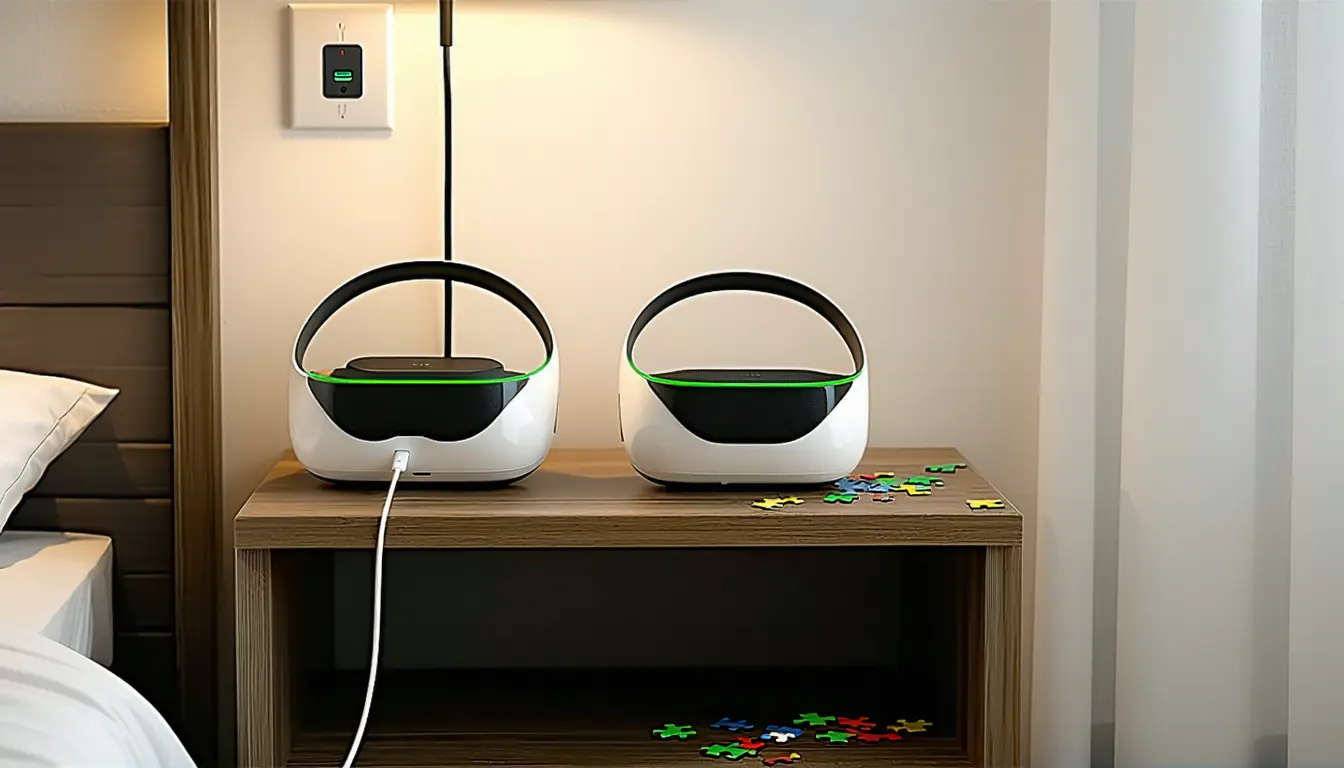
- Participants, all with objectively documented post-COVID cognitive impairment, were randomized two to one between the active headset and a sham that looked, sounded and operated identically.
- Each person wore the headset at home for 15 minutes twice a week for four weeks, with Mount Sinai trial coordinators monitoring remotely.
- The active group gained on working memory, processing speed and verbal learning, and reported better emotional well-being, relative to the sham group.
- Completion exceeded the trial's 80 percent threshold, and the release reports no significant device-related adverse events.
- The technology, Microtesla Magnetic Therapy, is proprietary to Fareon, a clinical-stage biophysics company.
Compiled by The ScientistSomething wrong?How this is made
Why it matters
- constraint A 10-person control arm cannot establish how big or how reliable the cognitive benefit is, so the pilot supports funding a larger trial and does not support prescribing the headset.
- capability Home self-administration under remote monitoring cleared the completion bar, so a larger trial could enroll patients who cannot travel to a clinic twice a week.
- decision The persistence claim rests on a single follow-up at week eight, so designers of the next trial have to choose a longer follow-up to tell a lasting effect from a slow fade.
The denominator is small. A two-to-one split of 30 participants puts 20 on the active headset and 10 on the sham [3][1]. Every active-versus-sham comparison in the Brain Communications paper runs through those 10 people [2]. Each participant took the same cognitive, mood and quality-of-life assessments three times: at baseline, at week four and at week eight [7]. The sham looked, sounded and operated like the real device [3]. Its job is to absorb two rival explanations for improvement: getting better at a familiar test, and the expectation that comes from wearing a medical headset twice a week.
The dose was modest. Twice a week for four weeks is eight sessions, and at 15 minutes each that comes to 120 minutes of stimulation per person [4][2][3]. The headset delivers low-amplitude, nonthermal radio-frequency magnetic fields to the whole brain [5].
The team leads with what happened after the headset came off. According to the Mount Sinai release, cognitive scores in the active group kept improving between week four and week eight [9][14]. The release attributes this to "lasting neuroplastic or anti-inflammatory changes" [9]. The outcomes it lists are cognitive, mood and quality-of-life measures [7], so that explanation is an inference from test scores.
"Cognitive symptoms are among the most persistent and disabling manifestations of long COVID, yet evidence-based treatment options have been sparse," said Jacqueline Becker, a clinical neuropsychologist at Icahn Mount Sinai and co-senior author [11]. "What is particularly encouraging about these findings is that we observed improvements across several cognitive domains, as well as in daily functioning and well-being, and that these improvements persisted even after treatment ended," she said [12].
The thing this doesn't tell you is how large the benefit is. The release calls the gains significant and marked [8] but does not report effect sizes or confidence intervals. With 10 people in the control arm [1], one or two unusual responders could move a group mean.
The practical findings are firmer. Participants ran the protocol at home under remote monitoring and cleared the 80% completion threshold, with no significant device-related adverse events reported [4][10].
I think that justifies a larger, longer sham-controlled trial. It does not yet make the headset a treatment for long COVID brain fog, a condition for which clinically validated interventions remain "exceedingly rare," according to the release [13].
What to watch
- Registration of a larger sham-controlled trial of Microtesla Magnetic Therapy, and how many people it puts in the control arm.
- Effect sizes and blinding checks in the full Brain Communications paper, including whether participants could guess which device they had.
- Follow-up beyond eight weeks showing whether the cognitive gains hold, grow or fade.