Science1 publisher2 min readPublished
Two lutetium ion clocks agree at 5.7 parts in 10^19 after 200 hours of averaging
Each 176Lu+ reference has an evaluated systematic uncertainty near 1 x 10^-19, and the direct comparison between them resolves any difference only to 5.7 x 10^-19, six times coarser than the budget under test.
The Scientist · Science desk
What happened
- Two independent 176Lu+ single-ion optical references were compared directly by correlation spectroscopy, giving a relative frequency difference of -0.1 x 10^-19, with a statistical uncertainty of 5.7 and a systematic uncertainty of 1.0 in the same units.
- Each reference carries an evaluated systematic uncertainty near 1 x 10^-19, which the authors describe as a fourfold improvement on the lowest previously reported for an optical standard.
- The verified agreement level of 5.7 x 10^-19 was set by the precision of the comparison after 200 hours of averaging, not by the uncertainty budgets of the two references.
- Both references operate as practical room-temperature systems, and the paper reports comprehensively evaluated uncertainties below 10^-18 for each of them.
Compiled by The ScientistSomething wrong?How this is made
Why it matters
- constraint The 1 x 10^-19 figure for lutetium still rests on the evaluated budget alone, because the experimental test stops six times short of resolving a difference that small. A longer or quieter comparison is what would confirm it.
- decision The community seeking consensus on a redefined SI second now has same-species evidence for lutetium, in a field where the highest-precision comparisons between different species have disagreed with their own reported budgets.
- precedent The three-criterion protocol, which requires deliberately shifting a large systematic to see whether the clock frequency moves as predicted, gives reviewers a standard to hold other sub-10^-18 budget claims to.
- capability If this accuracy transfers outside the lab, clock comparison can resolve height differences at the millimetre scale; the authors also list Lorentz invariance tests and dark matter searches among the uses.
Add the comparison's two uncertainties in quadrature and the combined figure is about 5.8 x 10^-19 [1]. The measured offset, 0.1 x 10^-19, is under a fiftieth of that [2]. So the difference is consistent with zero, and any disagreement between the two systems that their budgets do not already account for is bounded at roughly six parts in 10^19.
That bound is about six times coarser than the budget it tests [3]. The limit is the comparison's statistics. If the statistical term keeps averaging down as the square root of time, resolving 1 x 10^-19 would take about 32 times longer than the 200 hours already spent, near 6,500 hours, or 271 days of continuous comparison [4]. The systematic uncertainty on the comparison itself is 1.0 x 10^-19 [1], the same size as the budgets in question.
An uncertainty budget is a prediction, and the authors say so directly. "An evaluated uncertainty budget is a quantitatively testable prediction that two frequency standards of the same species, corrected for their evaluated systematic shifts, should agree to within their combined uncertainties," they wrote [5]. Tests of that kind are relatively few [6]. Across different species, at the highest precision, comparisons have shown significant inconsistencies relative to reported uncertainty budgets [7].
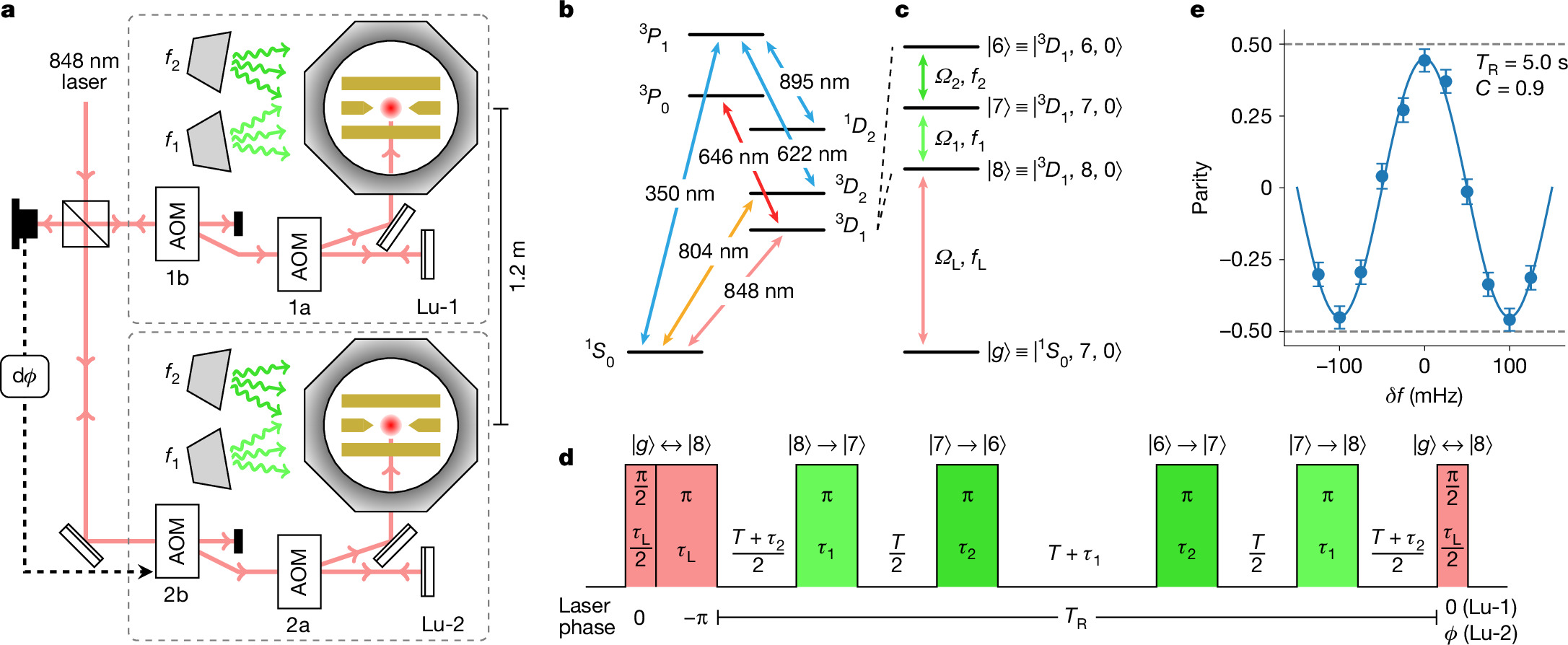
Reaching this precision on a practical timescale is a stability problem, and single trapped ions have historically lagged neutral-atom optical lattice clocks on that figure of merit [8]. Correlation spectroscopy is how the group got around it. The technique rejects common-mode phase noise from the clock laser the two ions share [9].
A relative measurement between two systems of the same species cannot see a shift they both carry in equal measure, because identical errors cancel in the difference [5]. The paper's third criterion is aimed at that gap: for any systematic substantially larger than the comparison precision, deliberately shift it and check that the clock frequency moves by the predicted amount [10].
The low budget starts with the ion. The 176Lu+ transition used here, 1S0 to 3D1, has the lowest sensitivity to blackbody radiation and magnetic fields of any established clock system, and the ion's large mass makes it less susceptible to motional shifts than lighter species [11]. The assessment, summarized in the paper's Table 1, builds on an improved micromotion compensation method, a quadrupole shift evaluated by microwave spectroscopy of 176Lu+, and an evaluation of background gas collision effects [15]. The lowest evaluated systematic uncertainty previously reported was about 4 x 10^-19 [6].
What to watch
- Whether a longer or quieter comparison pushes the measurement precision below 1 x 10^-19, where the two evaluated budgets actually sit.
- Whether 176Lu+ measured against a different species reproduces this agreement, given the inconsistencies reported in the highest-precision inter-species comparisons.
- Whether other groups publish the deliberate stress tests the authors' third criterion demands for systematics larger than their comparison precision.