Science1 distinct publisher3 min readPublished
A husband-and-wife team at Purdue calculates that almost nothing escaped upward through the impact dust, which would cook unsheltered animals within two hours and set lichen alight. It is one model, and its headline number is a calculation rather than a measurement.
The Scientist · Science desk

Compiled by The ScientistSomething wrong?How this is made
Falling rock is the part worth slowing down for. More than 1000 km3 of vaporized material went up, and what goes up condenses into droplets of rock and comes back down through the air, depositing the energy of that fall in the atmosphere instead of losing it to space [4][5]. That is how one population of particles ends up carrying two opposite signs. A previous study had those same condensed spherules blocking sunlight on the way in, a cooling term [10]. The Johnsons' calculation has the resulting layer blocking radiation on the way out, which is a heating term where the animals live [6].
The exponent is what makes people look twice. An upward transmittance of 10^-286 is a model output, not a reading off an instrument, and Alexandria Johnson says she asked her co-author to rerun it because the answer amounted to nothing at all [6][7]. Read physically, the exact size of that exponent is doing less work than it appears to. Once transmittance sits far below one, the surface energy budget is set by what comes down; a number many orders of magnitude larger would leave the same conclusion standing. What matters is not the 286 itself but that the layer is optically thick enough to close the top of the atmosphere for a while.
What follows are two kill mechanisms on wildly different clocks. Heat fluxes in this model give unsheltered, non-burrowing animals an hour or two, and enough radiation to ignite lichens, grasses and pine needles [8][9]. Then the same dust, in particles about as fine as wildfire smoke, blocks the Sun for as long as decades, which is where Brandon Johnson puts the collapse of ocean food chains [11][12]. Take a single decade of darkness against a two-hour pulse and the second phase runs roughly 40,000 times longer than the first [19]. The two phases are not competing explanations; they select different victims.
Whether anyone outside Purdue gets the same opacity is still an open question. The Physics World account carries no independent assessment, only the two authors [18]. The real pressure point is upstream of the radiative transfer: earlier work argued the impact could not have ejected enough material for effects on this scale, and Brandon Johnson's answer is an analysis of rock vaporization thresholds that makes the plume massive enough to spread material worldwide, without which the damage stays near the Yucatan crater [16][17]. The rocks preserve part of the story and leave the rest to calculation. The K-Pg boundary, a few millimetres of iridium-rich sediment, records that the dust arrived and where it came from [13]. How opaque it was while suspended is a calculation, and that is the calculation the next group has to reproduce.
Ranked by verification strength, evidence, and original report placement.
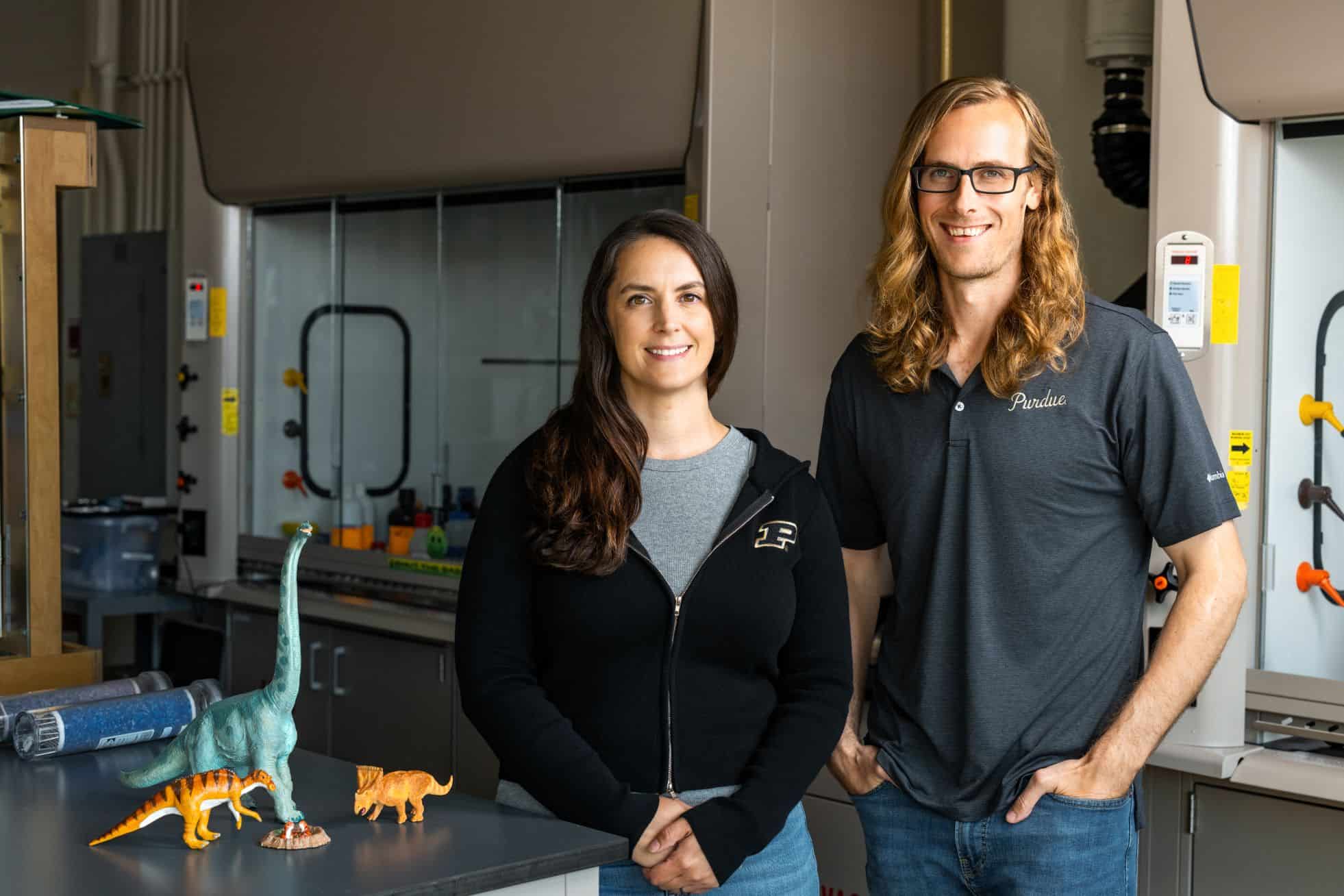
New research by Brandon and Alexandria Johnson at Purdue University, published in Journal of Geophysical Research: Biogeosciences, concludes the Chicxulub asteroid impact sent up a near-impermeable layer of dust that smothered the entire planet.
The study combines Brandon Johnson's research on impact cratering with Alexandria Johnson's expertise on the behaviour of atmospheric particulates.
The work revives a theory that had fallen out of favour: that extreme heat and wildfires were the main killers on the day the asteroid hit.
The impact sent a massive plume containing over 1000 km3 of vaporized material high into the atmosphere.
Alexandria Johnson says the spherules added energy back to the atmosphere by travelling through it to the surface, reversing the dust cloud's potential cooling effect.
By the Johnsons' reckoning the dust layer trapped almost all radiation within the atmosphere, allowing an upward transmittance of just 10^-286.
Distinct publishers with included, body-backed reporting in this cluster.
1 article · September 4, 2026
Follow any of these and your For You feed starts watching them — no settings page required.
science
The magnitude 9 nobody recorded: why simulated ground motions stay out of the codes1 distinct publisher
science
Graz group measures the geometry a single-molecule collision has to hit1 distinct publisher
science
Silicon's ceiling comes with numbers; its successors so far come with names1 distinct publisher
science
The oldest grains we have were magnetised before the sun finished forming2 distinct publishers
Evidence-backed comparisons of source perspectives and observed adoption signals. Read the methodology
Which Builder, Operator, and Investor concerns the observed source mix emphasized—not a truth score.
Evidence, demonstrated adoption, hype gap, incentives, and confidence are assessed independently, each on its own current evidence. How these are measured.
One paper, two voices, zero outside checks
Every load-carrying number here — the plume volume, the transmittance, the one-to-two-hour lethal window — comes from a single Journal of Geophysical Research: Biogeosciences paper as retold by Physics World, and the only people quoted are the two authors. The journal is named and the quotes are direct, which is worth something; what is missing is anyone who could say whether 10^-286 survives a different radiative treatment. The report even names prior work that concluded the impact could not eject enough material, then leaves that objection sitting there unanswered.
Nothing to count yet
A paper appearing in a journal is not uptake, and our coverage offers no citations, replications, or competing groups picking up the dust-lid calculation. The follow-on work described — geological record studies, combustion experiments, 3D impact simulations — is explicitly still hoped for rather than under way, so there is nothing here to measure.
Headline certainty outruns one model
The framing is that scientists have settled how the dinosaurs died, and a number carrying 286 orders of magnitude reads like a measurement. It is a model output, unexamined by anyone outside the household that produced it. The internal arithmetic also strains: a lethal heat pulse lasting two hours and darkness lasting decades are four orders of magnitude apart, and the story asks readers to hold both as the main killer without saying how the two accounts of the extinction fit together.
The authors are also the referees here
The two people whose paper this is supply every quotation, including their own astonishment at the answer, which functions as a selling point. Their result revives a theory that had lost favour, so its vindication is theirs, and the piece closes on the research programme Brandon Johnson wants to pursue next. Physics World presents this warmly and links to its own earlier Alvarez feature; nobody in the chain has an interest in the calculation being ordinary.
Sure what was claimed, unsure what is true
We can be confident about the record: a named journal, named authors, quotes in their own words, and a clean description of the mechanism they propose. What we cannot do from this reporting is judge whether the opacity calculation is robust, and no second account exists to test it against. High confidence in the reporting, deliberately moderate confidence in the physics.