Leadership2 publishers3 min readPublished
AfD's Saxony-Anhalt plurality shakes Germany's CDU as immigration drives far-right gains
The party's plurality came in a state of barely two million people, too small for any firm to plan against on its own. The federal coalition's response is what firms can actually plan against, and two more state votes are days away.
The Board Room · Leadership desk
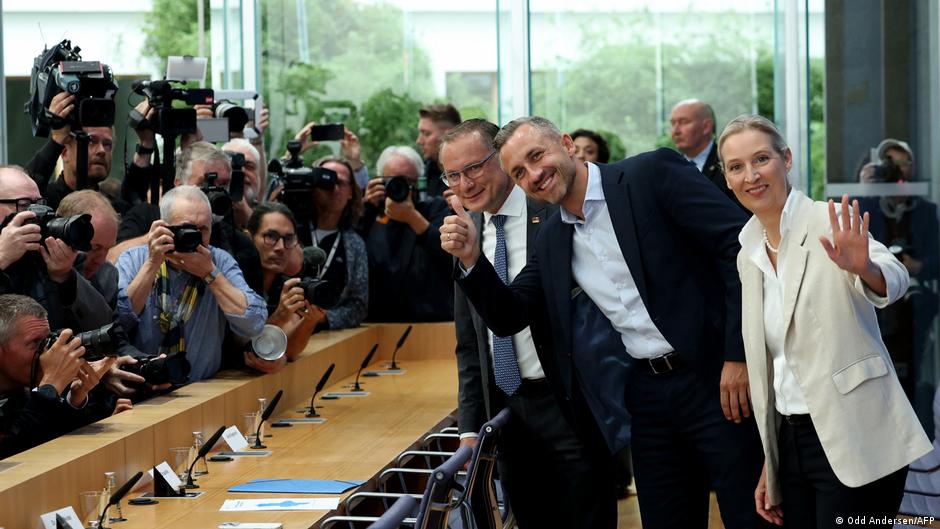
What happened
- The AfD took 43.8 percent of the vote in Saxony-Anhalt, a plurality that leaves it just short of a majority of seats in the state parliament.
- Since the vote its leadership has been negotiating with other factions to form a government, with no clear read yet on whether it can succeed.
- Voters in Berlin and Mecklenburg-Vorpommern go to the polls later this month.
- Nationally the party holds 151 of the Bundestag's 630 seats, second only to the CDU.
- Vox reports that the White House has lent the AfD support in public and in private, and that Elon Musk spoke at an AfD rally while serving in the administration last year.
Compiled by The Board RoomSomething wrong?How this is made
Why it matters
- decision The near-term policy that touches hiring and staffing is more likely to come from the AfD's opponents trying to blunt it than from the AfD itself, so the thing to model is the grand coalition's migration package, not the party's programme.
- constraint Because rivals refuse to govern alongside it, a plurality buys the AfD blocking weight rather than a mandate, which limits what any Saxony-Anhalt government can agree instead of handing it one to run.
- exposure German domestic intelligence has the party under surveillance while Washington backs it, which puts any plan assuming a predictable Berlin-Washington channel on an unpriced variable.
- contradiction Vox treats the result as a possible route to a national wave; Noahpinion treats it as a warning shot bounded by the east-west divide and by every other party's refusal to deal. Which reading you take decides whether this is a this-quarter item or a this-decade one.
The variable a firm can act on is not the AfD's vote share but the behaviour of the government currently in office. Robin Brooks, quoted by Noahpinion, argues the surge has one main driver: the CDU-SPD grand coalition is proving incapable of confronting immigration with the urgency many voters want [17]. Read that way, the coalition has two moves and both carry a cost. It can tighten migration policy fast enough to take the issue back, and own consequences it has not yet had to price, or it can hold and let the AfD campaign on the country's most salient issue through the next two state votes. The second option is cheaper this month and dearer later.
Noahpinion supplies the obvious objection itself: the result does not mean the AfD is taking over Germany, because the far right is much more popular in the post-communist east than in the more populated western regions, Germany is a parliamentary democracy, and almost everyone else in it hates and fears the party [15]. All of that is true, and the point stands anyway, because the transmission runs through the incumbents. Chancellor Friedrich Merz said the result shook the CDU to its very foundations [4], and Cas Mudde of the University of Georgia describes a national debate that is now one of crisis, centred on the AfD's success and the alleged reasons for it [14]. Parties that describe themselves as shaken tend to legislate.
A board deck would put it this way: the AfD polls ahead of the CDU nationally [8] and sits 57 seats above the 94 it won in 2017, a gain of about 61 percent [7][2]. The deck is incomplete on timing, because the driver underneath it moves slowly. Konstantinou and Roumanias, cited by Noahpinion, estimate from more than 4,500 regional electoral outcomes between 2000 and 2017 that a 1 percent rise in immigration stocks raises far-right voting by between 1.78 and 2.97 percent [18]. The top of that range is about 1.67 times the bottom [3], which fixes a direction of travel without sizing a forecast. Adam Tooze's reading of AfD voters points the same way: cost of living is among their worries, but asked why they voted AfD they lead with security, foreigners, woke politics and remoteness, and economic issues barely come up [16]. Noahpinion also notes that the explanation resting on pandemic-era anger at incumbents now looks dead [19]. This is a decade-scale driver, and it will not resolve inside one planning cycle.
The record gives a direction of travel, not the number an employer would want. The AfD's 2025 platform calls for remigration, a mass deportation programme aimed primarily at recent Syrian and Afghan arrivals, alongside an explicitly blood-based definition of German citizenship [10], and nothing in this evidence counts how many workers such a programme would reach, in which sectors, or on what schedule. The same gap applies to whatever the coalition does pre-emptively to hold the issue. For this quarter, German migration policy is a dated calendar item with an unmeasured staffing effect, and only the first half of that belongs in a forecast.
What to watch
- Whether the Saxony-Anhalt coalition talks produce an AfD-led government or break down, and which faction moves first.
- The Berlin and Mecklenburg-Vorpommern results, read against the east-west divide rather than as a national total.
- Any federal migration measure the CDU-SPD coalition dates before those two votes.