Loading today’s stories
Science1 distinct publisher2 min readUpdated
Laser plasma stalls a stellar eruption, and the missing-CME problem gets a mechanism
A Physical Review Letters study reports that strong magnetic fields can trap coronal mass ejections before they escape. The scarcity of stellar CMEs may be confinement rather than blindness.
The Scientist · Science desk
What happened
- An international team of astrophysicists and plasma physicists has provided the first experimental evidence that strong magnetic fields surrounding active stars can completely suppress coronal mass ejections.
- The study, published in Physical Review Letters, combines astrophysical simulations, high-energy laser-plasma experiments and advanced three-dimensional numerical plasma modelling.
- CMEs are routinely observed on the sun, but convincing detections around other stars have remained surprisingly scarce.
- CMEs play a major role in shaping stellar evolution, driving mass and angular momentum loss, and influencing the space weather environments of orbiting planets.
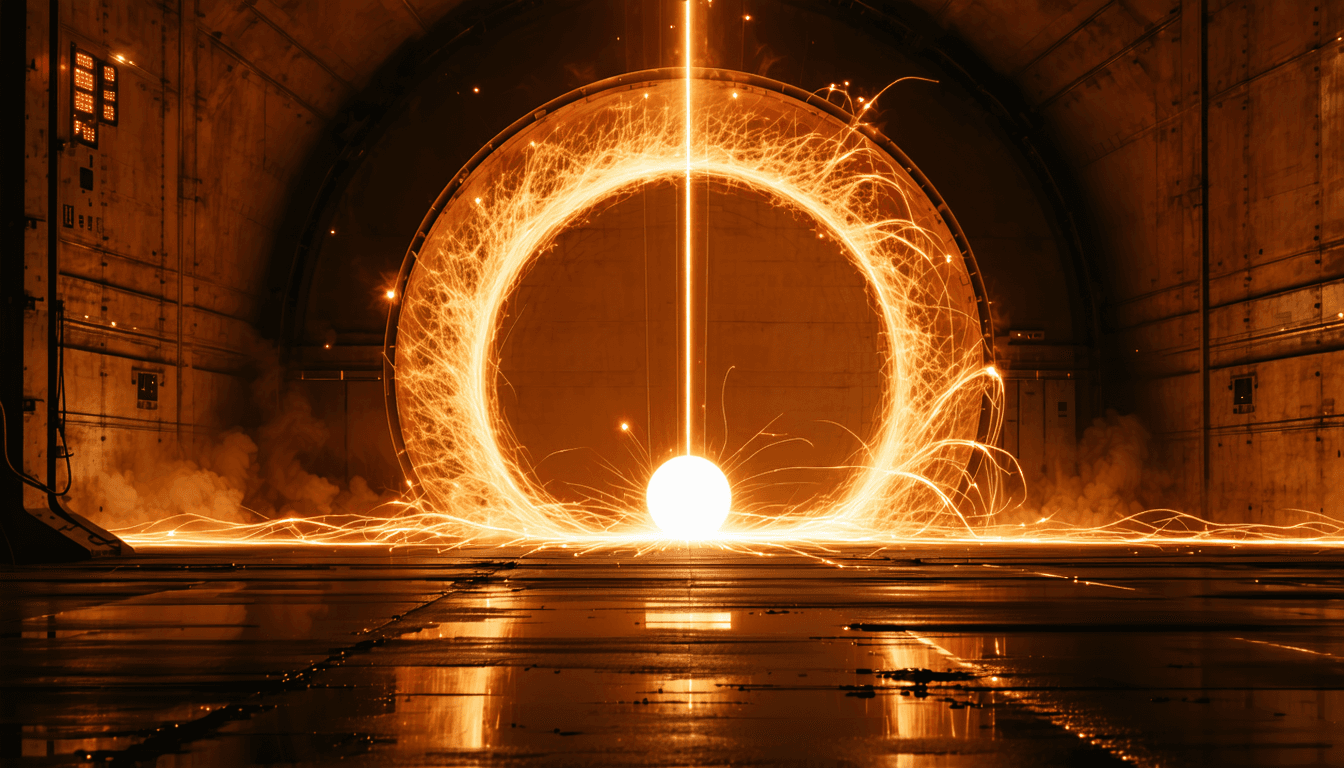
- Using scaling laws said to faithfully reproduce astrophysical conditions, the team generated laser-driven plasma flows in the laboratory to mimic the core of stellar CMEs.
Compiled by The ScientistSomething wrong?How this is made
Why it matters
The trigger in the laboratory was crude and deliberate: a laser struck a target, the target's thermal pressure rose, and the plasmoid expanded and moved [10]. What stopped it under a strong ambient field was not a simple ceiling. Three-dimensional plasma modelling identified a kink instability as the disruptive mechanism [9], and the flow bent and in places travelled backward [11]. The eruption was not pressed down so much as turned against its own path, which is a different failure mode from a lid, and a testable one.
Everything rides on a single joint. The team used scaling laws meant to reproduce astrophysical conditions in laser-driven flows standing in for the core of a stellar CME [5], and Julian D. Alvarado-Gomez of the Leibniz Institute for Astrophysics Potsdam supplied the astrophysical modelling that ties the laboratory shots to real stellar environments [7]. The published account carries no ambient field value and no threshold at which the behaviour flipped, nor any stated conversion from laboratory field to stellar field [1]. Until that number is public, the result establishes that confinement happens, not where on the main sequence it starts.
The habitability sentence deserves the hedging its authors gave it: if many CMEs are suppressed, some exoplanets may sit in a less hostile environment and hold atmospheres for longer [14]. Two conditions are load bearing. Suppression appeared only once the field was strong enough [6], so planets orbiting active stars with weaker large-scale fields inherit the old picture unchanged [2]. And the flares do not go away; the claim is that the eruption they should launch never leaves the star [12]. The atmospheric stripping and chemical rewriting attributed to CMEs [13] would be spared. Nothing here subtracts the flare.
For observers, the useful part is that a long-standing absence now has a physical candidate instead of only an instrumental one [3]. Convincing detections around other stars have stayed scarce while solar CMEs are routine [3], and the default reading was sensitivity. Julien Fuchs, then a senior scientist at LULI/CNRS and now a professor at Technion, said the change in the plasma's behaviour as the field was raised came as a surprise [8]. What follows is a prediction that existing surveys can attack without new hardware: eruption signatures should thin out preferentially on the most strongly magnetised stars. Models of stellar mass and angular momentum loss that assume every large flare exports plasma [4] need a confinement term, and the size of that term depends on a threshold nobody has yet quoted in stellar units [1].
Loading topic controls
Loading related stories