Invest1 publisher3 min readPublished
Spinach doubled in a month: Korea's heat shock is a price mechanism, not a weather story
Retail spinach rose 100.8% in a month to 2,108 won per 100 grams, and four other vegetables rose more than 40%. The agriculture ministry's answer is that levels are still below a normal year.
The Investor · Invest desk
Drafted by a language model from the sources cited here and checked against its claim ledger before publication. How we use AISend a correction
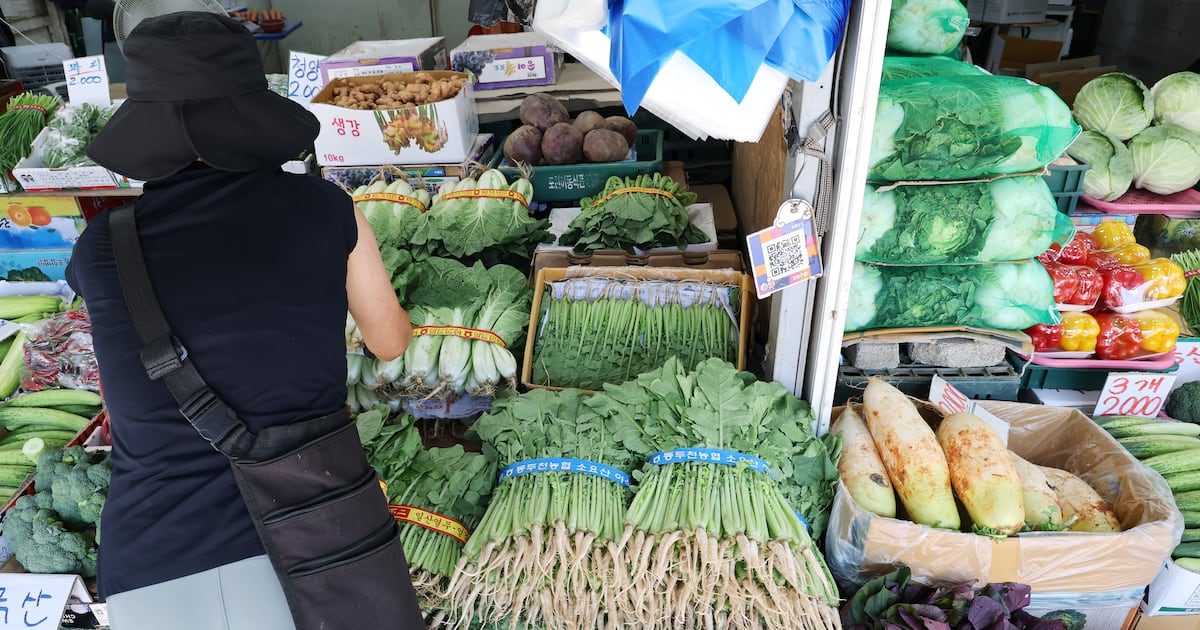
What happened
- A supermarket purchase of a bag of spinach, 10 cucumbers and one zucchini costs anywhere from 4,000 won to more than 10,000 won more than the same purchase a month earlier.
- Retail spinach averaged 2,108 won per 100 grams as of the 14th, up 100.8% from 1,050 won a month earlier; the price took one month to double.
- The spinach price data comes from the Korea Agricultural Marketing Information Service (KAMIS), run by the Korea Agro-Fisheries & Food Trade Corporation (aT).
- Cucumbers rose 62.2%, to 11,987 won for 10 from 7,387 won.
- Perilla leaves climbed 61.6%, to 1,537 won per 50 grams from 951 won.
Compiled by The InvestorSomething wrong?How this is made
Why it matters
Retail spinach in Korea averaged 2,108 won per 100 grams on the 14th, up 100.8% from 1,050 won a month earlier, according to the Korea Agricultural Marketing Information Service, which is run by the Korea Agro-Fisheries and Food Trade Corporation [2][3]. A basket of spinach, ten cucumbers and one zucchini now rings up 4,000 won to more than 10,000 won higher than the same purchase a month ago [1], which is the sort of move households register without reading a statistical release.
The doubling is the headline, but the breadth is the substance. Cucumbers rose 62.2% to 11,987 won for ten, or about 1,199 won each [4][25]. Perilla leaves rose 61.6% to 1,537 won per 50 grams, zucchini 47.1% to 1,502 won each, and a head of napa cabbage 41.1% to 4,937 won [5][6][7]. Every one of the five items moved at least 41.1% in a single month [24]. Spinach at 2,108 won per 100 grams works out to 21,080 won a kilogram [22].
The transmission channel is physical, not speculative. Thin-leaved crops such as spinach and lettuce lose moisture quickly in high temperatures; leaf tips burn, produce loses marketability, and shippable volume falls [8]. In cucumbers and zucchini, poor growth, flower drop and deformed fruit cut normal shipments [9]. This is what the source material calls heatflation, and it is not confined to Korea: the FAO's global food price index stood at 131.1 points in July, up 0.6% on the month, its largest monthly rise since January 2023, with international wheat prices up 5.8% on heat damage to harvests in major producing countries, per the FAO [10][11].
The government's rebuttal is a level argument, and it is a reasonable one as far as it goes. The Ministry of Agriculture, Food and Rural Affairs says early-August retail spinach was 14% below a normal year, with lettuce down 25%, napa cabbage down 26% and radish down 32%, because output of major vegetables generally rose this year and kept prices below normal through the first half [18][19]. Note the mismatch in measurement: the ministry is comparing early-August levels with a normal year, while the doubling is a month-on-month change measured through the 14th [2][18]. A good harvest can absorb a shock in the year-on-year comparison while the monthly change is the number that resets purchasing contracts and restaurant menus. One food industry official quoted in the report said prolonged heat destabilises supply and raises raw-material sourcing costs, and that cost pressure across processed foods and restaurants would grow in the second half [12].
The response says something about expected duration. Since the 7th the government has run a special heat wave and drought management period and elevated its disaster response office to a vice-ministerial recovery headquarters [15], distributing shade nets, fine-water sprayers and blower fans while moving to secure purchased reserve stocks [16], and cutting the chicken supply price to large supermarkets by more than 1,000 won [17]. The weather backdrop: Yangsan hit 41.4C on the 31st of last month and 42.5C on the 2nd, and a newly created severe heat wave alert took effect across Seoul for the first time on the 4th [13][14].
What to watch is the conditionality. The Korea Rural Economic Institute forecasts zucchini shipments up 5.2% and napa cabbage up 5.6% year on year this month, holding August wholesale prices below year-earlier levels, but the forecast assumes the heat wave does not run longer than it already has; another week of spikes could change the figures at any time [20][21]. Watch second-half processed food and restaurant pricing rather than the vegetable aisle [12], and watch whether the next FAO index print extends the July move [10].