Invest1 publisher3 min readPublished
Korea targets commercial tandem solar cells by 2028 in the roadmap behind its R&D budget rules
Korea's climate ministry targets commercial tandem solar cells by 2028 in a roadmap that will shape the country's 2028 national R&D investment standards. Superconducting grids go to a new advisory committee that will study the state's role over 10 to 20 years.
The Investor · Invest desk
Drafted by a language model from the sources cited here and checked against its claim ledger before publication. How we use AISend a correction
What happened
- Vice Minister Lee Ho-hyun chaired the second 2026 meeting of the Climate and Energy Technology Strategic Investment Council, a public-private body launched in July.
- The roadmap, drawn up this year to support Korea's 2035 Nationally Determined Contribution, splits 10 fields across four sectors and uses 2030 and 2035 as reference years.
- Designs for wind turbines of 20 megawatts or more are due by 2030, and commercialization is to be finished by 2033.
- A sodium-battery storage commercialization project and a large vanadium battery demonstration are both due by 2031, followed by next-generation storage demonstrations.
Compiled by The InvestorSomething wrong?How this is made
Why it matters
- constraint Money set under the 2028 standards reaches tandem cells in the year they are due to go commercial, so it can back scale-up and the 2030 efficiency goal, while pre-launch work has to be paid for out of earlier budgets.
- capability The year-by-year schedule gives the council, whose remit includes evaluation and investment coordination, fixed dates for judging whether funded projects are on track.
- exposure Suppliers of superconducting and direct-current grid equipment have to plan around a review of the state's role that runs out to 2036 to 2046, while solar and storage suppliers have delivery years.
The ministry's roadmap sets a year for each target in each field. Seoul Economic Daily's report does not include a budget figure for any of them [5]. The money question runs through a different ministry. The Ministry of Science and ICT must set the 2028 National R&D Investment Direction and Standards by March next year [3]. The climate council reviewed only the climate and energy portion of that document [3]. A ministry official said the climate section "contains considerations drawn from the 5th Energy Technology Development Plan and the energy technology diffusion strategic roadmap, aimed at responding to the climate crisis and accelerating the energy transition" [4].
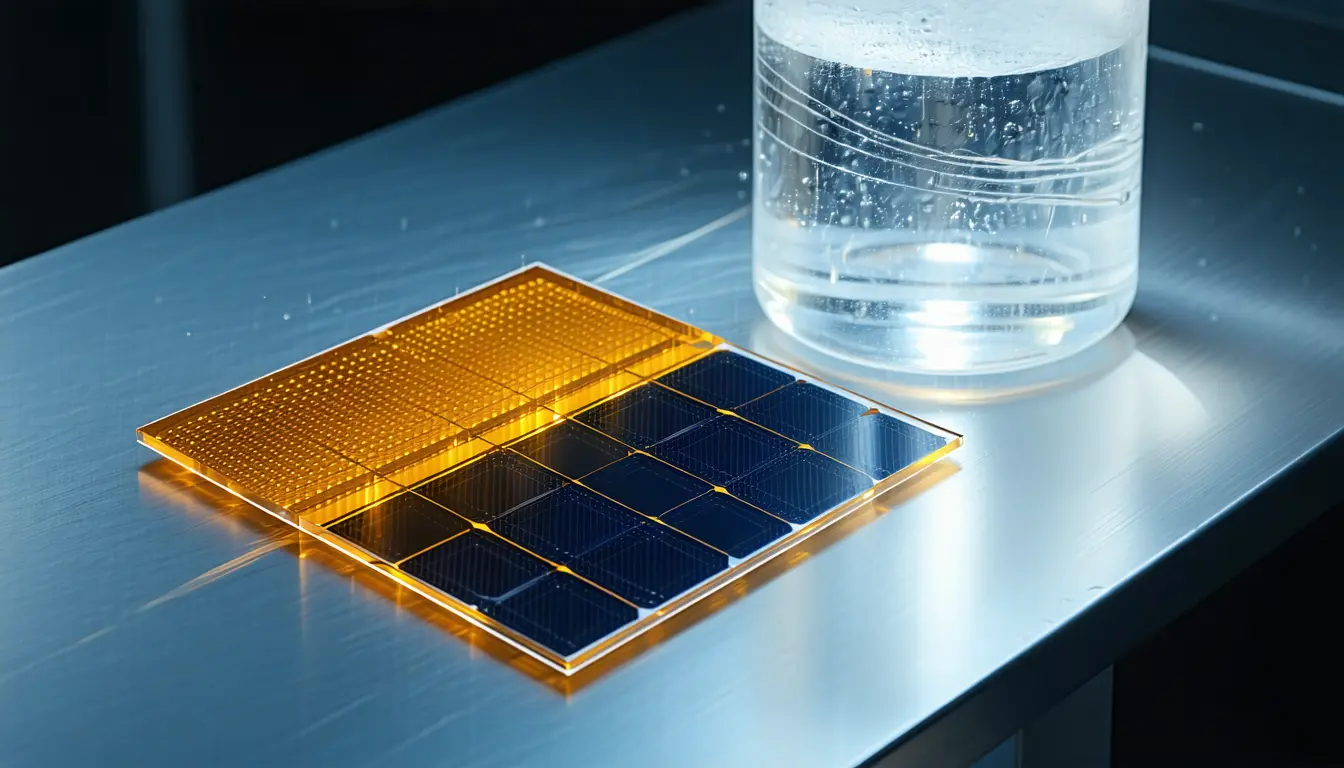
Tandem cells are at the front of the schedule. Commercialization is due in 2028 and 35% generation efficiency by 2030 [6], so the standards now under review cover the commercialization year itself and leave two years to reach the efficiency target [1]. Everything else with a reported date runs later. Flexible output control at large nuclear plants is to be demonstrated and piloted between 2029 and 2034 [8]. A 50-megawatt green hydrogen production plant is to be demonstrated from 2030 to 2034 [13]. Of the five areas the report dates, four finish after the 2030 reference year, and tandem cells are the exception [3].
Superconducting grids come in as a study item. The council decided to form an advisory committee to set technology direction for the next 10 to 20 years [10]. Its subcommittees cover future outlook, clean power, heat and fuel conversion, and future power grids [11]. They will examine future technologies in renewable energy, small modular reactors and storage, and the government's role in smart power grids, direct-current transmission and distribution, and superconducting transmission [12]. Counted from 2026, that horizon reaches 2036 at the near end and 2046 at the far end [2].
If the Science ministry carries the roadmap's years into the 2028 standards as priorities, tandem cells and the storage projects are where the money shows up first [3][9]. If it folds the climate section into broader lines, the dates stay the climate ministry's own targets. The committee could also decide the state should lead on superconducting or direct-current grids and pull them into a later planning round [12]. I think the first path is the likelier one for the items with near dates, because the official described the climate section as drawing on the roadmap [4]. The superconducting question belongs to the next decade [2]. "We will clarify investment priorities by examining both policy alignment and technology and market outlooks, and over the long term we will further strengthen strategic focus and innovation," Vice Minister Lee Ho-hyun said [15]. That view is wrong if the March standards name superconducting transmission as a funded priority for 2028 [3].
What to watch
- Who sits on the new advisory committee, and when its future power grids subcommittee reports on superconducting and direct-current transmission.
- Whether any Korean producer announces commercial tandem cell output in 2028, or efficiency results close to the 35% target.