Science1 publisher3 min readPublished
Researchers trace a ciliate's millisecond contraction to a calcium-loosened protein fishnet
North Carolina State University researchers say calcium makes the protein Sfi1 go slack, tightening a fishnet of myonemes around a single-celled ciliate. They are still working out what starts the calcium signal and how the cell resets to fire again.
The Scientist · Science desk
What happened
- North Carolina State University researchers reported on September 19, 2026 that the single-celled organism Spirostomum ambiguum compresses to one quarter of its original length in under five milliseconds.
- Calcium ions start the contraction, and the movement itself is carried out by a fishnet-like protein structure.
- The fibres doing the pulling are myonemes, built from two calcium-binding proteins, centrin and Sfi1, which single cells use in place of the muscle fibres they lack.
- Human muscle fibres can shorten by comparable proportions, but the process takes about ten times longer, and that gap is what drew researchers to the organism.
- How the cell resets itself so the contraction can happen again is one of the major questions the work leaves open.
Compiled by The ScientistSomething wrong?How this is made
Why it matters
- capability Two named proteins and a defined net topology give a soft-actuator lab something to fabricate and to falsify.
- constraint A device copied from the geometry alone would contract once. Repeatability depends on a reset step nobody has identified yet, so the biological design is only partly specifiable.
- decision Groups funding ATP-free actuation now have to pay for mechanical and electrophysiological measurement on the organism; structural imaging has taken the question about as far as it goes.
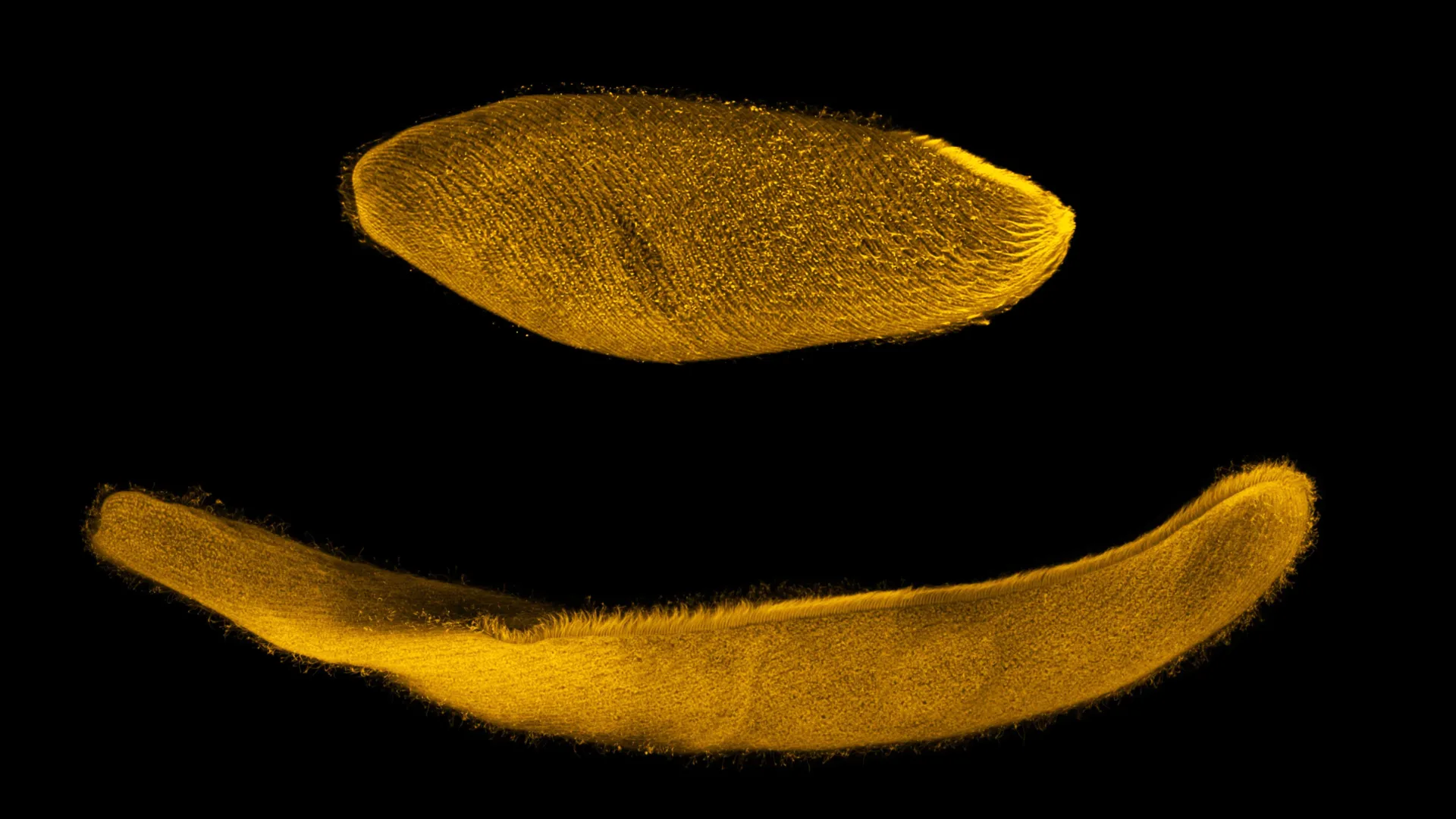
Electron microscopy and immunofluorescence answer two questions well: where the parts sit, and what they are made of. The North Carolina State group used both, and what came back was a geometry [5]. The myoneme fibres form a fishnet-shaped web around the outside of the cell, and once contraction begins that web tightens inward and then returns to its original configuration [8]. Mary Elting, an associate professor of biophysics at NC State and co-corresponding author of the work, said the fishnet arrangement lets the organism contract uniformly and protects its internal organelles while it moves that fast [15][10].
The switch sits in one protein. "In the presence of calcium ions Sfi1 loses its stiffness and clumps up like a ball of wet spaghetti, which causes the fishnet to pull tight, shrinking the organism," Elting said [9].
Two speed figures appear in the work, and they agree with each other. Shrinking to one quarter of its length means shedding three quarters of a body length, and at five milliseconds that works out to 150 body lengths per second [20]. The roughly 100 body lengths per second the team reports is the conservative of the two [3]. Ten times slower, in human muscle, puts the same proportional shortening near 50 milliseconds [21]. Scientists think the ciliate uses the move to escape predators or to communicate with other ciliates [17].
Human muscle stores and releases the energy for contraction with ATP, and the researchers report that Spirostomum appears to rely on a different process [11]. "Comparing the way our muscles contract to the way Spirostomum works is like comparing gas to electric power," Elting said. "ATP undergoes a chemical change and gets 'burned up,' like gasoline, whereas calcium ions act like an electrical current, although we still don't know what produces the voltage that starts the current, or how it gets 'reset' so contraction can happen again" [12].
A soft-actuator lab can take the parts list and the topology from this today, but not the supply. "We would expect calcium-triggered reactions to be 'one shot,' but Spirostomum can do it repeatedly," Elting said [13]. She puts the missing piece into the engineering specification herself: "Understanding those aspects of its motion are the keys to building a fast-moving, ATP-independent artificial muscle" [14].
The release reports geometry, composition and timing. It does not give force, work per cycle, or how many contractions the net survives [22]. Whether a copy of the design works as a device depends on those figures. The imaging was also done in a single cell, a giant ciliate that swims with a fringe of hairlike cilia [16], and scaling that net up to a centimetre of actuator is a separate problem. In my view the next useful experiment is a mechanical one: hold one organism, trigger it, and measure both the force it develops and the interval before it can fire again. The researchers say they now want to determine more precisely how calcium triggers the contraction and how the organism prepares itself to repeat the process [23].
What to watch
- A force measurement on a single contracting Spirostomum, since stress and work per cycle decide whether the fishnet is useful to actuator engineers.
- Identification of what generates the calcium signal and what resets it, the step Elting calls the key to an ATP-independent artificial muscle.
- Whether centrin and Sfi1 nets can be assembled outside a cell and still stiffen and go slack on calcium.