Invest1 distinct publisher3 min readPublished
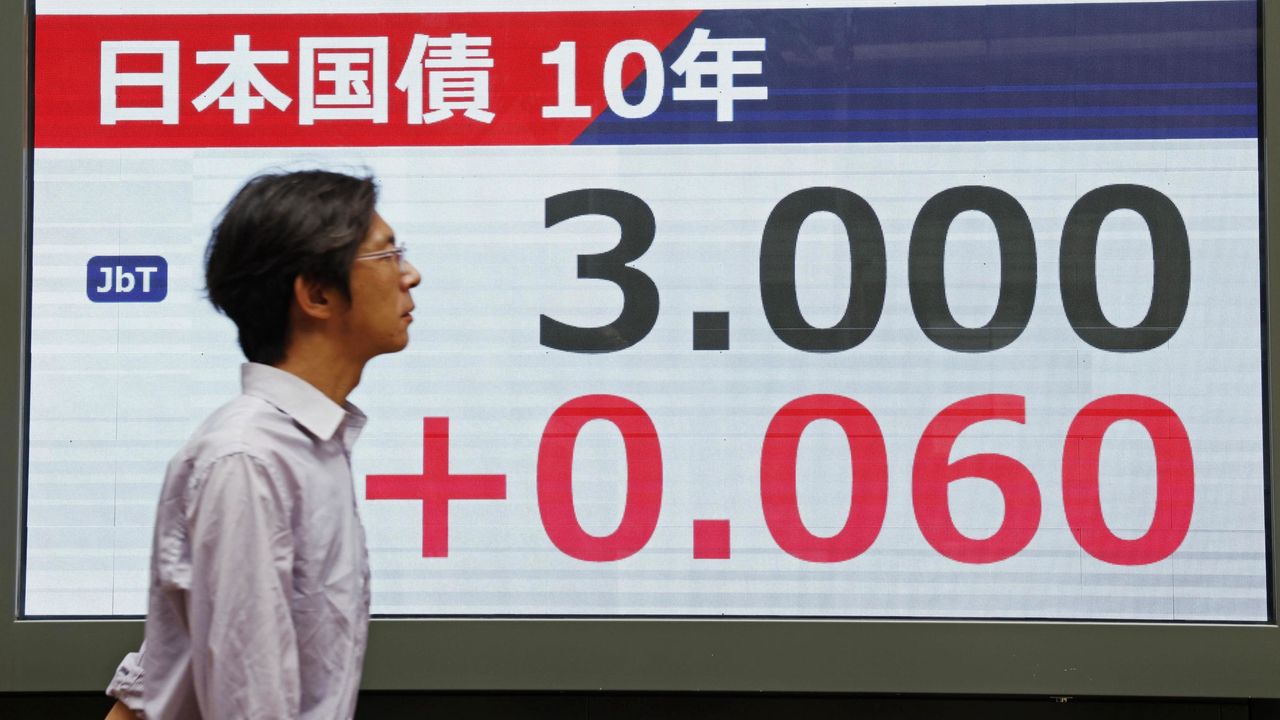
The 10-year JGB touched 3.027% before slipping back into the 2.9% range, while 40-year paper trades near 93 yen per 100 of face and insurers are asking their asset managers how to limit valuation losses.
The Investor · Invest desk

Compiled by The InvestorSomething wrong?How this is made
Follow any of these and your For You feed starts watching them — no settings page required.
invest
Bessent's blessing of a stronger yen reprices the funding leg of the carry trade1 distinct publisher
invest
Korean savers bought 51.9 billion yen at almost exactly the price it trades at now1 distinct publisher
invest
Japan's record $96.4bn yen defence has already given back 57% of its gains1 distinct publisher
invest
Yields rose, the dollar fell: Bessent's buybacks broke the offset allocators price1 distinct publisher
A falling price is supposed to recruit its own buyers, and the mechanism failed here for a simple reason: a yield rising on fiscal supply has no level at which it becomes automatically cheap; it only has a level at which the next holder insists on being paid more. That is why the Nihon Keizai Shimbun opened its account of the turmoil with the adage about not catching a falling knife rather than with the one about value [3], and why anxiety over deteriorating public finances, not a growth surprise, is what the paper put behind the move above 3% on the 1st [1].
The long end is where a rate story turns into an accounting one. Forty-year paper is trading about seven points under par [1], and 25-year bonds printed below 80 yen per 100 of face at one point [7], which is more than a fifth of face value gone [2]. Put a modified duration near 17 on that 25-year bond (my assumption, not the Nikkei's) and 20 points of price decline implies roughly 1.2 percentage points of yield rise since it was written [3]. That arithmetic is why Ryutaro Kimura at BNP Paribas Asset Management says the inquiries keep arriving from insurers and pension funds asking how to limit valuation losses [8]. The Bank of Japan, which used to make that arithmetic somebody else's problem, has slowed the pace of its purchases [9], and the executive at an eastern Japan regional bank who told the Nikkei the move was too abrupt, and that it was unfortunate to be running asset management just now [4], is describing a job whose risk profile changed without any change in his mandate.
The currency leg is the part that travels. Nomura's Yujiro Goto called the American comments a fairly direct intervention in the Bank of Japan's policy management and expects the pressure to continue while the yen sits near 160 to the dollar [13]; the yen reached the 156 range on the 3rd, its first visit in about a month [14], which is around 2.5% of appreciation from Goto's threshold [5]. For a Japanese institution, a domestic 10-year at 3% and a firming yen change the relative appeal of unhedged foreign paper without anyone announcing a decision, and that is the transmission line to watch rather than any single auction.
My view, and it may well be wrong, is that the buyer base repriced rather than the level, because when the domestic holder who used to sit to maturity starts asking how to limit valuation losses [8], 3% reads as a waypoint. The counter-case, or rather the more interesting version of it, is positioning: the 3.027% print gave back roughly a tenth of a percentage point within a day [4], which is what a squeeze around a budget headline looks like, and if the Bank of Japan tightens while the yen keeps firming, the same insurers become buyers at these prices and the 3% handle turns out to have been the top. The thesis should fail on evidence rather than argument, and the evidence would be long-dated auctions clearing with domestic institutions adding duration instead of writing memos about how to account for it.
Ranked by verification strength, evidence, and original report placement.
The yen strengthened to as much as the 156-per-dollar range on the 3rd, the first time it had reached that level in about a month, since the 7th of last month.
The Nihon Keizai Shimbun reported on the 3rd that anxiety over deteriorating public finances drove Japan's 10-year government bond yield, the benchmark for long-term rates, above 3% on the 1st.
The 10-year Japanese government bond yield climbed as high as 3.027% on the 2nd and eased back to the 2.9% range on the 3rd.
The Nikkei cited the market adage warning against catching a falling knife, that is against hasty buying when prices plunge, as it examined the turmoil in Japan's bond market.
An executive at a regional bank in eastern Japan told the Nikkei the move in yields was too abrupt, adding that it was unfortunate to be in charge of asset management at such a time.
A bond dealer at a foreign brokerage asked who would buy when yields are rising because of fiscal concerns, even after the 3% threshold was breached; falling prices normally create a value opportunity, but this time that appeal failed to attract buyers.
Distinct publishers with included, body-backed reporting in this cluster.
en.sedaily.com
1 article · September 3, 2026
Evidence-backed comparisons of source perspectives and observed adoption signals. Read the methodology
Which Builder, Operator, and Investor concerns the observed source mix emphasized—not a truth score.
Evidence, demonstrated adoption, hype gap, incentives, and confidence are assessed independently, each on its own current evidence. How these are measured.
Precise numbers, one pair of eyes
Every figure that matters — 3.027%, 93 yen, 143 trillion, the 156 handle — reaches us the same way: en.sedaily.com reading the Nihon Keizai Shimbun. The levels are specific, dated and mutually consistent, and the interpretive voices (BNP Paribas Asset Management, Nomura) are named and on the record. But the two people who testify that nobody will buy are anonymous, no auction result, central-bank operation or budget document is shown, and one strand of the arithmetic depends on a duration we supplied ourselves.
Marks are hard, the buyer's strike is anecdote
The repricing itself is not in dispute: 40-year paper near 93 and 25-year paper under 80 are marks, not opinions, and insurers and pension funds phoning their asset managers about capping valuation losses is behaviour rather than commentary. What stays anecdotal is the headline phenomenon — a regional banker's sigh and one foreign dealer's rhetorical question stand in for volumes, auction demand and flow data that never appear.
Half a step ahead of the tape
The refusal-to-buy frame outruns the prices it is built on. Inside the same three days the ten-year came back under 3%, the yen firmed to 156, and the story's own final lines report traders moving to expect BOJ hikes every three months instead of every six. Buyers stood aside at the peak; the telling implies they have gone for good. Our own 25-year duration estimate, which makes the drawdown sound sharper, is an assumption rather than reporting.
Every quoted voice has a position
Bessent's advice that Japan abandon reflation comes bundled with a stated wish for a stronger yen — a US Treasury-market interest as much as a Japanese one. Katayama's 'surprisingly none' has a bond market and an auction calendar to protect. The sell-side strategist and the asset-management analyst earn their standing by narrating a selloff their clients are sitting in. And the anonymous dealer complaining that nobody will buy is, presumably, someone holding inventory.
Solid on levels, blind on breadth
We would defend the numbers and the sequence; they are too specific and too internally coherent to be loose. What we cannot do is see around the single relay carrying them. One outlet, one originating paper, no Japanese or American account to cross-check, a flat contradiction between the US Treasury Secretary and Japan's finance minister left unresolved, and a market already turning by press time.