Product1 publisher3 min readPublished Updated
Argonne's nano-bio sheet makes hydrogen peroxide from sunlight, air and water
The Argonne-led hybrid pairs a cheap semiconductor with a light-absorbing membrane from salt-loving microbes, and out-produced the semiconductor alone by more than five times.
The Product Desk · Product desk
Drafted by a language model from the sources cited here and checked against its claim ledger before publication. How we use AISend a correction
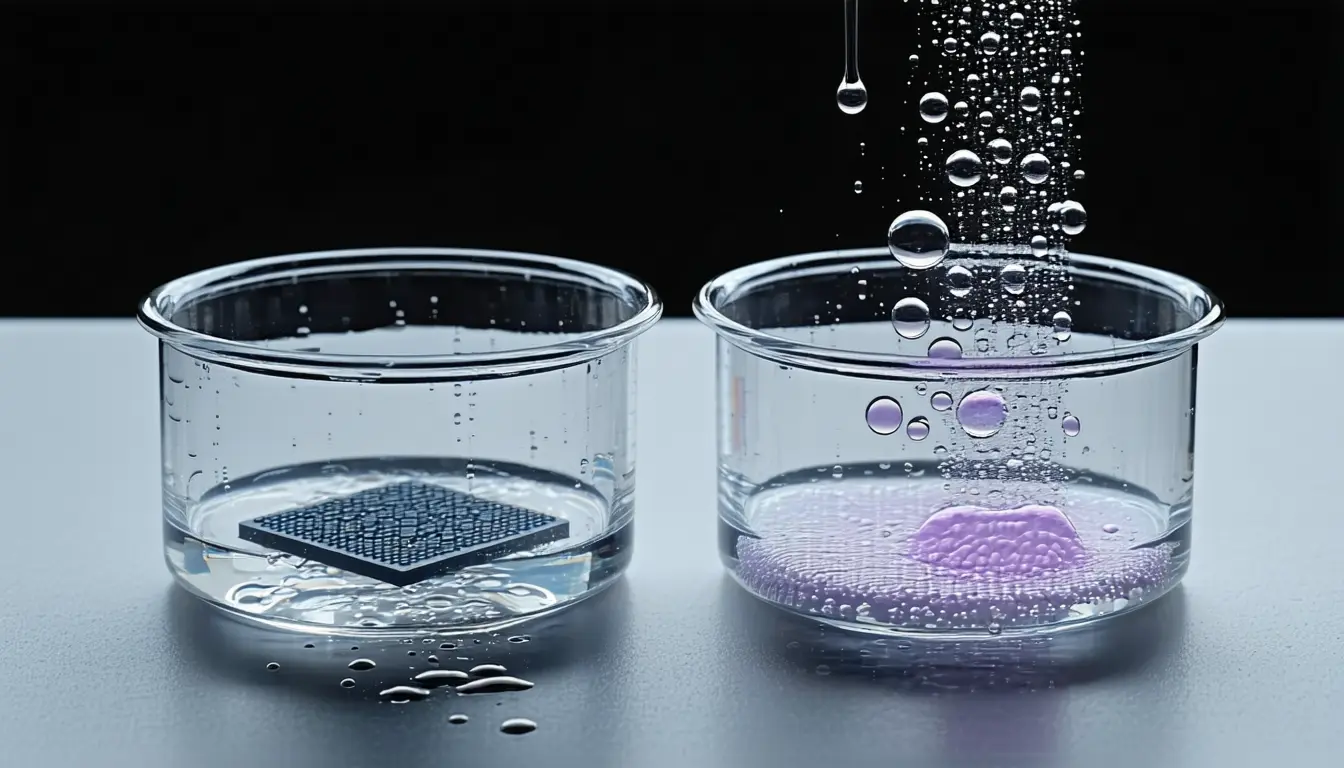
What happened
- A team led by the U.S. Department of Energy's Argonne National Laboratory developed a new material combining inorganic material with biological components to produce hydrogen peroxide more efficiently.
- The hybrid material was achieved using a technology called nanoarchitectonics to convert sunlight, air and water into hydrogen peroxide.
- Nanoarchitectonics uses nanoscale building blocks to assemble materials into functional architectures, often drawing inspiration from living systems.
- Jinhyeong Jang, an Argonne postdoctoral appointee, said: "Nanoarchitectonics is on par with artificial intelligence and quantum information science as one of the most important technologies of the 21st century."
- The material is based on layered nanosheets about 200 nanometers thick, approximately 500 times thinner than a human hair.
Compiled by The Product DeskSomething wrong?How this is made
Why it matters
A team led by the U.S. Department of Energy's Argonne National Laboratory has built a layered material that combines inorganic and biological components to produce hydrogen peroxide from sunlight, air and water [1][2]. The interesting part is not the chemistry but the location: hydrogen peroxide is used for disinfecting, bleaching and whitening in settings that run from manufacturing plants to the household medicine cabinet [11], and a light-driven route that works at ambient conditions is the kind of thing that changes where a chemical is made rather than what it is.
The material is a stack of nanosheets about 200 nanometers thick, which Argonne describes as roughly 500 times thinner than a human hair [5]. That comparison implies a hair diameter of about 100 micrometers [13]. Each sheet pairs bismuth oxychloride, a synthetic semiconductor, with patches of a purple membrane derived from archaea, salt-loving microorganisms whose light-absorbing protein does the harvesting [6]. According to the laboratory, the membrane acts as a biological solar panel: it captures light energy and drives protons and electrons across the interface with the bismuth oxychloride, which then converts oxygen from the air plus water into hydrogen peroxide [7].
The one performance number released is a ratio. The hybrid produced more than five times as much hydrogen peroxide as the semiconductor on its own, according to the Argonne press release as reported by Interesting Engineering [8]. Elena Rozhkova, a scientist at Argonne's Center for Nanoscale Materials, a DOE Office of Science user facility [12], said the system "operates at ambient conditions and uses only inexpensive, abundant materials" and that running the same reaction industrially "would require high energy input and more complex catalytic systems" [9][10].
What the material is not, yet, is a quantified process. The published account carries no absolute production rate, no output concentration, no operating lifetime for the archaeal membrane under illumination, and no cost per kilogram [14]. A five-fold improvement over a bare semiconductor is a comparison against a weak baseline, not against the merchant peroxide a plant currently buys. Biological components also raise the question every hybrid photocatalyst eventually has to answer: how many hours of sunlight the protein survives, and what it costs to replace the patches when it does not.
The framing around the work deserves a lighter touch than it got. Jinhyeong Jang, an Argonne postdoctoral appointee, said nanoarchitectonics is "on par with artificial intelligence and quantum information science as one of the most important technologies of the 21st century" [4]. Nanoarchitectonics, in the laboratory's own description, means assembling nanoscale building blocks into functional architectures, often taking cues from living systems [3]. That is a method, and this result is a bench demonstration of it, not a supply chain.
Watch for the peer-reviewed paper and the numbers it carries: peroxide concentration in solution, area-normalised rate under standardised illumination, and membrane stability over repeated cycles. Those three figures determine whether on-site generation is a procurement question for facilities that already handle dilute peroxide, or a materials-science result that stays in the lab. Also worth watching is whether Argonne's Center for Nanoscale Materials [12] takes external users into this system, which is usually the first sign that a hybrid material has left the single-group stage.