Product1 publisher3 min readPublished
Lockheed links two F-16 infrared pods to estimate range without switching on a radar
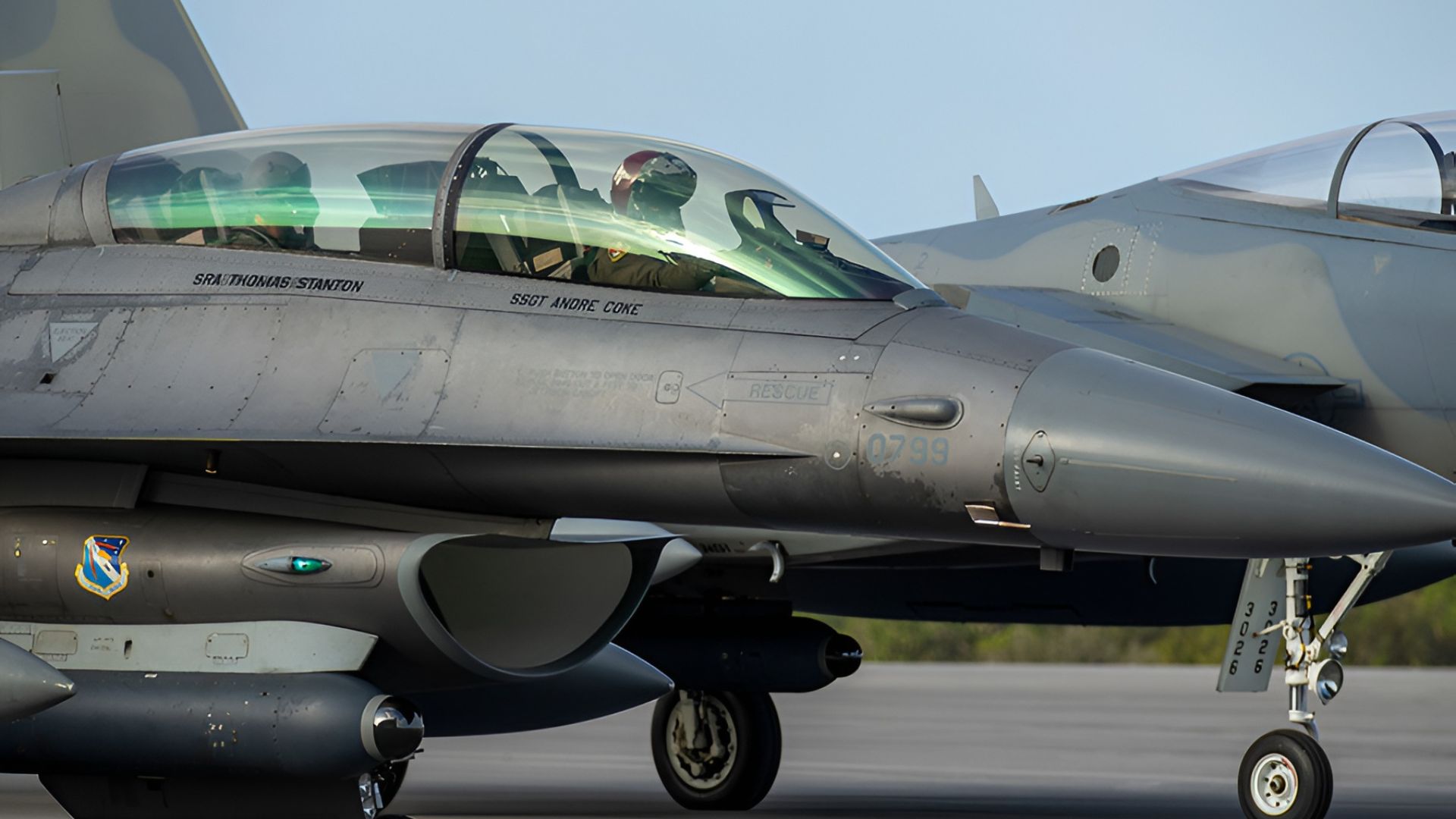
Two F-16s over Tucson flew Legion infrared pods wired together by a pre-production L3Harris link and combined their tracks to sharpen a range estimate. Lockheed Martin describes the effect as depth perception.
The Product Desk · Product desk
What happened
- Lockheed Martin flew two F-16s at Tucson, Arizona, with Air National Guard and AATC support, each carrying a Legion infrared pod fitted with a pre-production version of L3Harris' HiveLink.
- Legion is a passive infrared search-and-track system that finds and tracks airborne objects without the fighter's radar, and keeps collecting when an adversary disrupts or denies radar.
- Trading measurements in flight improved the accuracy of each aircraft's tracks and let the pods use one another's observations to sharpen a range estimate no active radar was needed for.
Compiled by The Product DeskSomething wrong?How this is made
Why it matters
- capability A pair of Legion jets can hand the aircrew a ranged track while neither aircraft transmits, so keeping quiet stops costing the flight its firing geometry.
- constraint The range estimate exists only while the pods stay connected, so HiveLink's behaviour under jamming sets the ceiling on what passive tracking is worth in the conditions that make it attractive.
- decision A wing cannot buy this one jet at a time, because the geometry needs two podded aircraft airborne together with a working link between them.
- precedent If fusion happens in the pod, the pod becomes where the next capability arrives, and Legion's development list already includes software-defined radios and gateways.
An infrared search-and-track pod gives the aircrew a bearing and an elevation to a contact. Range is the weak part: infrared systems detect targets well but may struggle to work out precise range, according to the account of the tests published by interestingengineering.com [7]. The other way to get a range is the radar. A conventional radar transmits [6].
Two aircraft looking at the same contact from two positions see it along two different lines. Cross the lines and you have a range. Over Tucson the two pods did that across the link, and the shared picture improved the accuracy of the tracks each aircraft held [8][4]. Lockheed Martin describes the effect as giving pilots rapid "depth perception" [9].
The two-ship geometry changes continuously. The publisher's headline puts the F-16 at 1,500 mph [18], or 2,200 feet per second [19], and both ends of the baseline move at something like that rate, so the crossing point is only as good as the time alignment between the two tracks. Lockheed did not publish a track accuracy figure, a sortie count or a fielding date [20].
Legion itself is already in service, podded, on Air Force F-15s and F-16s [14], on top of earlier Lockheed Martin IRST work with more than 300,000 flight hours on F-14 and F-15 aircraft [15]. The new piece is the pod-to-pod link, and the HiveLink flown at Tucson was a pre-production version [3]. L3Harris built it for contested environments, with line-of-sight and beyond-line-of-sight paths, mesh networking, CDL interoperability and flexible waveform support [11].
The development list around it is longer than the test. Software-defined radios and multi-waveform gateways are named as possible additions to the modular design, and manned-unmanned teaming sits further out [16][17]. What flew was two F-16s under an Air National Guard contract, with engineers still evaluating performance and interoperability in the air [12][13].
For a wing weighing what this buys, draw two axes: whether the radar is usable, and whether the link is holding. Where the radar is usable and the link is up, the radar already covers that corner. The corner the demonstration speaks to is radar denied with the link up, where passive detection plus a second aircraft's angle produces a range without either jet emitting [8]. With the radar available and the link degraded, crews use the radar. Lose both and each pod is back to angle-only tracking, the condition the fielded fleet already lives with [7][14].
So the question for the briefer is what the display shows when the wingman drops off the net, and how long the last shared solution stays usable. Lockheed Martin's stated aim for the current testing is to show that networked infrared sensing shortens engagement timelines [21].
What to watch
- Whether Lockheed Martin publishes a track accuracy or range error figure from the Tucson sorties. A wing would need one to judge the two-ship solution.
- Whether the Air National Guard contract moves from demonstration to a fielded pod-to-pod configuration, and whether F-15 pods are included.
- Whether the software-defined radio, gateway and unmanned-teaming items on the Legion development list ever appear in a flight test.