Science1 publisher3 min readPublished
Pairing drought forecasts with feed and finance outperformed forecasts alone in a seven-country model
Researchers led from Sydney and Imperial simulated pastoral households across seven southern African countries and report that better seasonal information helped the poorest herders only when something also paid for the response.
The Scientist · Science desk
What happened
- An international team led by the University of Sydney and Imperial College London reports in Nature Sustainability that improved forecast access alone will not protect many of southern Africa's poorest livestock farmers.
- The authors say forecasts have to arrive with risk-smoothing support such as supplementary livestock feed, drought insurance, targeted financial help or better market access, so households can act before drought hits.
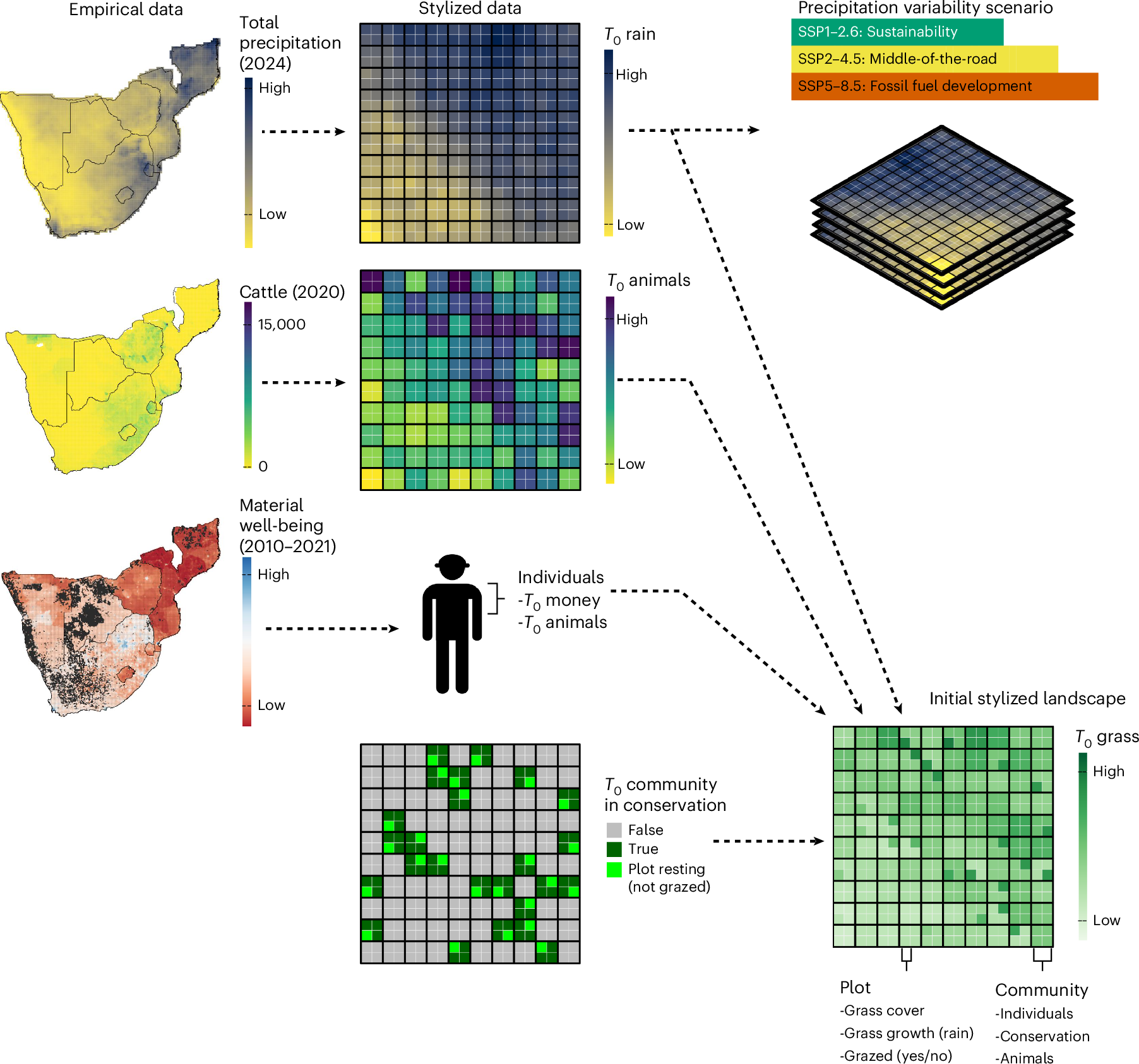
- The finding comes from a model of pastoral communities across seven southern African countries, driven by projected rainfall from European climate models and empirical data on livestock, vegetation and community wealth.
- Millions of pastoralists across Botswana, Eswatini, Lesotho, Mozambique, Namibia, South Africa and Zimbabwe depend on cattle, sheep and goats grazing the region's rangelands.
Compiled by The ScientistSomething wrong?How this is made
Why it matters
- decision A donor splitting an adaptation budget between wider forecast dissemination and a financing line now has a modelled reason to buy both, because funding the information channel alone leaves the targeted households without the means to respond.
- exposure Households whose herds are their savings, food supply and inheritance are the ones a forecast-only program reaches with information alone.
- constraint The result is simulated, which limits what it can settle: it can shape program design, but it cannot tell a ministry how many households would take up drought insurance or a feed subsidy at a given price.
The gap the study describes is a cash gap. A herder who can sell animals before a drought and restock afterwards keeps the value of the herd. A herder without that cash holds animals on drying rangeland and takes the loss. Lead author Matt Clark, a research associate in sustainability science at the University of Sydney's School of Geosciences, said: "The problem isn't that poor farmers don't have climate information. The problem is they often can't afford to act on it." [6] Wealthier producers, he said, can reduce herd sizes ahead of drought and rebuild when conditions improve, and many small-scale pastoralists do not have that buffer [6].
The evidence is simulated. The release describes the first model run as a business-as-usual future [11], and says the modelling was done alongside work with nongovernmental organizations in the field [17]. How big those differences between the scenarios were, it does not say [18].
In a model of household decisions, the result follows from the rules written into it: how much wealth a family holds, what it does when a forecast arrives, what grazing pressure does to vegetation [10]. A model of that kind is useful for finding costs the designer of an intervention did not intend, and the authors report one on each side. Climate information used alone and risk-smoothing support used alone each produced environmental trade-offs in the simulations; the two used together avoided them [3].
Gina Arena, science lead for Herding for Health at Conservation International, put the field version of the problem in terms of implementation risk. "It's that with greater uncertainty in climate comes greater risk. We need to help people identify the best decisions and reduce the risk of implementation," she said [9].
Clark's expectation for this season rests on a forecast of its own. He said that if the forecasts prove correct and a near-record El Nino develops, the team expects this will amplify inequalities across southern African rangelands [5], describing climate variability as an "inequity multiplier" [4]. The announcement says Africa is preparing for the arrival of a powerful El Nino event [15].
Both halves of the prescription already exist. "The encouraging finding is that this isn't about inventing new technology. It is about applying existing knowledge in new ways," Clark said [14]. He said forecasting is getting more accurate and the opportunity now is to pair those forecasts with practical support "so the people who need them most can actually benefit" [16], and that the method could be applied in Australia and other regions facing increasingly variable rainfall [13]. The paper's claim is that the pairing improves livelihoods, reduces inequality and protects rangelands at the same time [12].
What to watch
- Whether the full Nature Sustainability paper reports effect sizes and defines the environmental trade-offs the release leaves unquantified.
- Whether the near-record El Nino Clark conditions on actually develops, and whether observed livestock losses split by household wealth the way the model predicts.
- Whether any program pairs forecast dissemination with feed or insurance in a design that can be evaluated against a forecast-only comparison group.