Product1 publisher3 min readPublished
Google's satellite analysis puts the avoided warming at about 40%, with more than half of it coming from the Hong Kong to Singapore corridor, which is a better guide to where this pays than the trial's ultra-long-haul billing.
The Product Desk · Product desk

Compiled by The Product DeskSomething wrong?How this is made
Most flights never need this. Research collated by Resources for the Future finds that 2% to 3% of flights produce around 80% of contrail warming [6]. On North Atlantic routes, roughly 38% of flights made warming contrails and 14% made contrails that were cooling on balance, with the other 48% leaving nothing that persisted [7]. So 62% of that sample either did no harm or helped [8]. The 2% to 3% figure and the 38% figure answer different questions rather than fighting each other: a bit over a third of flights make a warming contrail at all, and a much thinner slice inside that group does nearly all of the damage.
That thinness is why the Cathay number should be read as a route result. One regional corridor carried most of the estimated benefit, while the trial was sold as the first test of the technique on services over 16 hours [3]. The account does not reconcile those two things, and until somebody does, the headline reduction describes a particular set of routes in a particular season rather than an efficacy rate an operations team can apply across a schedule.
The fuel objection has two answers on the record and they do not match. A 2023 study across 70 flights with American Airlines cut contrails by 54% at about 2% extra fuel on the rerouted flights, which the researchers argued would fall to as little as 0.3% spread across a whole airline schedule [9]. A larger transatlantic trial of 112 flights between January and May 2025 reported a 62% reduction against a control group and found no statistically significant difference in fuel burn [10]. Google's own calculation puts warming avoided at roughly 20 times the warming added by the extra fuel [11]. Note that its abatement range tops out at five times its floor [12], which is the honest measure of how precisely this can be priced. Add the three trials together and the entire operational record here comes to about 262 flights [13].
The European Commission puts non-CO2 effects at two thirds of aviation's climate impact and contrails alone at about a third [14], which makes contrails roughly half of the non-CO2 problem [15]. Of the £5m going into Operation Blue Skies, £2.65m comes from the Department for Transport through the Aerospace Technology Institute and £1.4m in kind from Google UK, with the Met Office, NATS, Imperial College London and the University of Cambridge in the consortium and 20 to 40 test days planned per winter season [16]. That leaves about £950,000 of the headline figure unattributed in the announcement [17].
Cathay's director of digital and IT, Lawrence Fong, said in a statement that aviation needs solutions to address climate change and that AI is accelerating that progress [18]. The forecasting is where the AI sits, and the deployment is a file-delivery problem the airline owns rather than the vendor. Two conditions sort operators here. The first is whether a document already reaches the flight deck in cruise. The second is whether the network crosses regions where persistent contrails form often. With both, this runs on existing plumbing at a fuel penalty inside normal variance. With the channel but not the corridors, crew attention goes to flights that were never going to matter. With the corridors but not the channel, connectivity is the project and the forecast is the easy part. On this evidence the corridor selects the airline rather than the reverse [6], and a carrier whose network misses the humid bands has nothing here to buy at any forecast quality.
Ranked by verification strength, evidence, and original report placement.
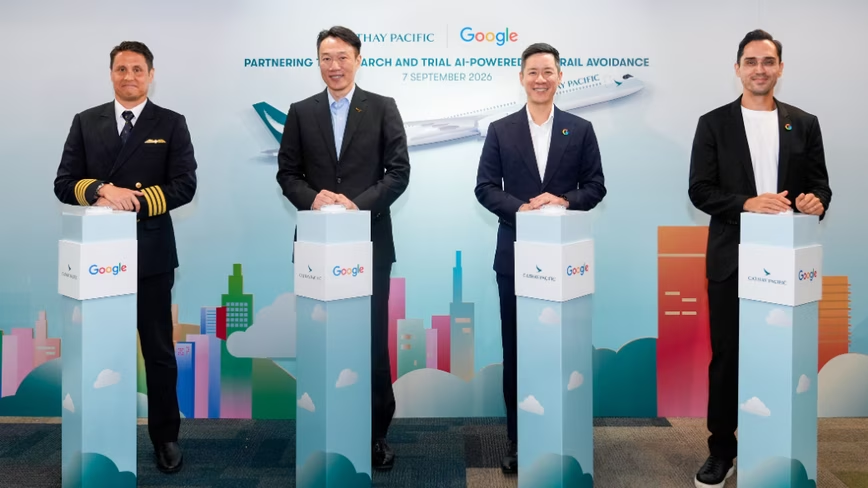
Cathay Pacific has flown more than 80 contrail-avoidance routes in a trial with Google that began in late 2025, adjusting cruise altitude to steer clear of thin bands of humid air where aircraft exhaust freezes into clouds that trap heat.
Google puts the result at roughly a 40% reduction in the warming impact of the contrails those flights would otherwise have made, based on its own satellite analysis.
The trial targeted ultra-long-haul services, meaning flights of more than 16 hours, and it is the first time the technique has been tested at that duration.
The Hong Kong to Singapore route, where persistent contrails form often, accounted for more than half the estimated reduction.
Predictions reached the flight deck through Cathay's electronic flight folder over in-flight Wi-Fi.
Research collated by Resources for the Future finds that 2% to 3% of flights produce around 80% of contrail warming.
Follow any of these and your For You feed starts watching them — no settings page required.
Evidence-backed comparisons of source perspectives and observed adoption signals. Read the methodology
Which Builder, Operator, and Investor concerns the observed source mix emphasized—not a truth score.
Evidence, demonstrated adoption, hype gap, incentives, and confidence are assessed independently, each on its own current evidence. How these are measured.
One company's measurement, third-party context
The 40% has a single author: Google forecast the humid layers, Google's satellite analysis scored the result, and no independent read appears. What holds the story up are the numbers that did not come from a trial participant, chiefly the European Commission's two thirds and one third split of aviation's climate impact and the Resources for the Future collation putting about 80% of contrail warming on 2% to 3% of flights. The 2023 American Airlines study helps because it published a fuel penalty rather than eliding one, and the reporting is honest that satellite precision has not been tested against a compliance standard.
262 flights and a live reporting rule
Roughly 262 flights across three trials is the entire operational record, and two of those trials are Google's own earlier work. Against that thinness, the guidance now travels on Cathay's existing flight folder rather than a side channel, and per-flight non-CO2 reporting has been mandatory in the EU since the start of 2025, which pulls contrail data into airline paperwork whether or not anyone reroutes. The UK has put £2.65m of public money behind further testing in Shanwick airspace. No carrier has yet shown a network-wide rollout, and Cathay's Asian and transpacific extension is stated as intent.
Billing outruns the corridor result
The trial is presented as an ultra-long-haul first, flights beyond 16 hours, yet more than half the avoided warming came from Hong Kong to Singapore, a short regional hop that happens to cross humid layers where contrails persist. The abatement figure is quoted as $5 to $25 per tonne, a spread of five to one that is doing the work of an error bar. Add a 40% scored by the party supplying the forecast and the framing sits ahead of the measurement, though not wildly: the earlier trials are specific, the physics is conceded even by the regulator, and the reporting names its own unresolved question.
The forecast vendor also keeps score
Google supplies the prediction, grades the outcome by satellite and has committed £1.4m in kind to the UK programme that will test the same technique over the North Atlantic. Cathay gets a climate result whose marginal cost is a few thousand feet of altitude, in the first years of an EU rule demanding per-flight non-CO2 numbers. The only quotation comes from Cathay's own digital and IT director, issued alongside Google Hong Kong. The physics behind the result stands on its own, but it's worth noting that no party in this story is placed to publish a disappointing number.
Single account, checkable edges
Everything here comes through one outlet and rests substantially on one company's analysis, which caps how far this can be trusted. The edges are verifiable, though: the EU reporting start date, the published fuel-penalty studies, the £5m programme's named contributors. The soft centre is the 40% and the abatement range, neither of which anyone outside the partnership has checked, and the two fuel results reported here, 2% extra on rerouted flights in 2023 and no significant difference in 2025, have not been reconciled.
product
Contrail avoidance gets a budget: a £5m trial to see if AI forecasts can move aircraft4 publishers
product
Poland asks Brussels for a €250M Meta fine it has no power to levy1 publisher
product
Brussels gathers information on Oracle's cloud licensing, echoing its pre-SAP approach1 publisher
leadership
Every notable AI release today arrived with a grade written by its own vendor1 publisher
Publishers with included, body-backed reporting in this cluster.
1 article · September 7, 2026