Science1 publisher3 min readPublished
IBM's bottleneck was cold volume, and its answer is an 8-foot box you can bolt to another one
IBM says infrastructure, not qubit counts, stood between error-prone chips and a fault-tolerant machine. Its modular cryostats and 1-metre superconducting cables are the commitment behind the 2029 date.
The Scientist · Science desk
Drafted by a language model from the sources cited here and checked against its claim ledger before publication. How we use AISend a correction
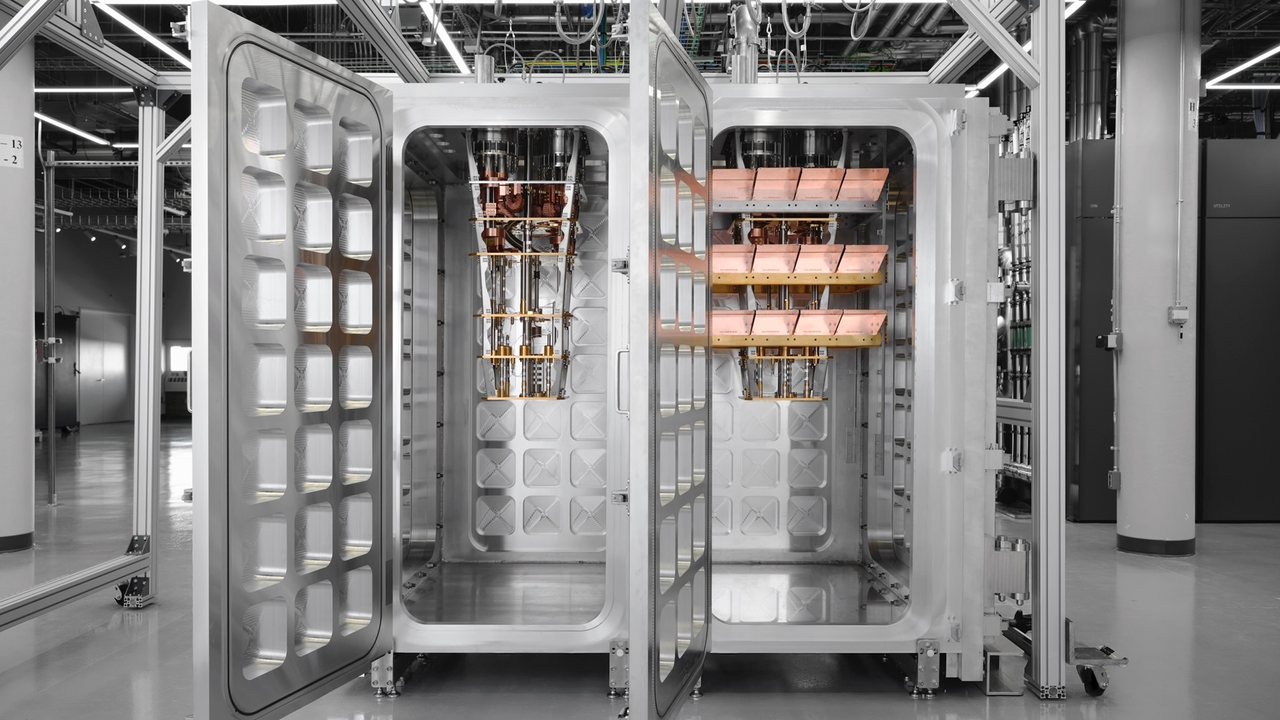
What happened
- IBM revealed a new modular, ultracold system designed to link hundreds of quantum computer chips together to address one of the field's biggest infrastructure bottlenecks.
- IBM says its new 'quantum fridges' will let it deliver the world's first fault-tolerant quantum computer in 2029.
- Fault-tolerant systems use quantum error correction techniques to fix noise in real time and run quantum operations without interruption.
- Until now one of the biggest hurdles between today's error-prone systems and fault-tolerant superconducting quantum computers capable of performing a hundred million operations flawlessly has been the infrastructure; IBM representatives say they have solved this with modular, interconnected quantum fridges.
- The new cryogenic system comprises individual units measuring 8 feet (2.4 m) tall by 8 feet wide, with an internal capacity of about 9 cubic feet (0.25 cubic m).
Compiled by The ScientistSomething wrong?How this is made
Why it matters
IBM has put hardware behind its 2029 promise: a modular ultracold system, built from units 8 feet tall and 8 feet wide, designed to link hundreds of quantum chips into one machine [1][5]. The company says these "quantum fridges" are what will let it deliver the world's first fault-tolerant quantum computer in 2029 [2].
The interesting claim is not the temperature. It is the diagnosis. IBM representatives say the main obstacle between today's noisy processors and a superconducting machine that can run a hundred million operations flawlessly has been infrastructure, and that the modular, interconnected fridges solve it [4].
The reason is a real estate problem. In IBM's architecture each chip has to be held below 15 millikelvin, because qubits are inherently error-prone and heat and electromagnetic interference have to be suppressed for the superconducting circuits to behave quantum mechanically [7]. Only a finite number of qubits fit on a chip [8]. Going past a few hundred or a few thousand gates therefore means more chips, and more chips means more cold volume [c14b].
The obvious answer, one enormous refrigerated hall packed with processors, is the wrong one. IBM's account is that such a system would demand enormous infrastructure and be brittle: every upgrade, fault trace or chip inspection would break the temperature seal and potentially interrupt operations [14]. The modules invert that. Each holds a limited number of chips inside about 9 cubic feet of usable internal volume [5], which is a small envelope for a cabinet whose front face alone is roughly 64 square feet [1]. Capability is added a stage at a time rather than in one build [15].
The cooling itself is bought in: third-party helium cryo compressors paired with commercial dilution refrigeration engines, with vacuum-sealed enclosures, electromagnetic interference gaskets and multilayer Mylar super-insulation shields for thermal protection [9]. IBM says it takes more than four days for a module to reach about 4 kelvin, with the final push below 15 millikelvin shortly after [10]. That number is the operational cost of modularity: any module opened for service is at least a four-day round trip back to running temperature, which is precisely why you want the rest of the fleet sealed and unaffected [2]. The fridges are specified down to 10 millikelvin, leaving roughly 5 millikelvin of headroom against the sub-15-millikelvin requirement [6][3]. The advertised comparison, more than 180 times colder than deep space, is the least useful figure in the announcement [6].
The part that has to work is the wiring between boxes. IBM connects modules with "L-couplers," superconducting cables about 3.3 feet long [11]. "Normally when we do quantum operations between qubits, we do them on chip," Oliver Dial, IBM's vice president of quantum operations, said at an Aug. 18 news conference, describing on-chip couplers that span very short distances to create entanglement [13]. According to IBM, this is the first demonstration of interconnectivity among quantum processing units housed in separate cryogenic modules [12].
What to watch: the announcement as reported quantifies geometry, temperature, cooldown time and cable length, but not the fidelity or error rate of module-to-module operations, which is the number that determines whether error correction survives the hop [4]. Also worth tracking is how many modules IBM actually networks, and at what cadence, on the way to the 2029 date [15][2].