Product1 publisher2 min readPublished
Microsoft's fanless Surface Pro stayed cool through a Blender render in one short hands-on
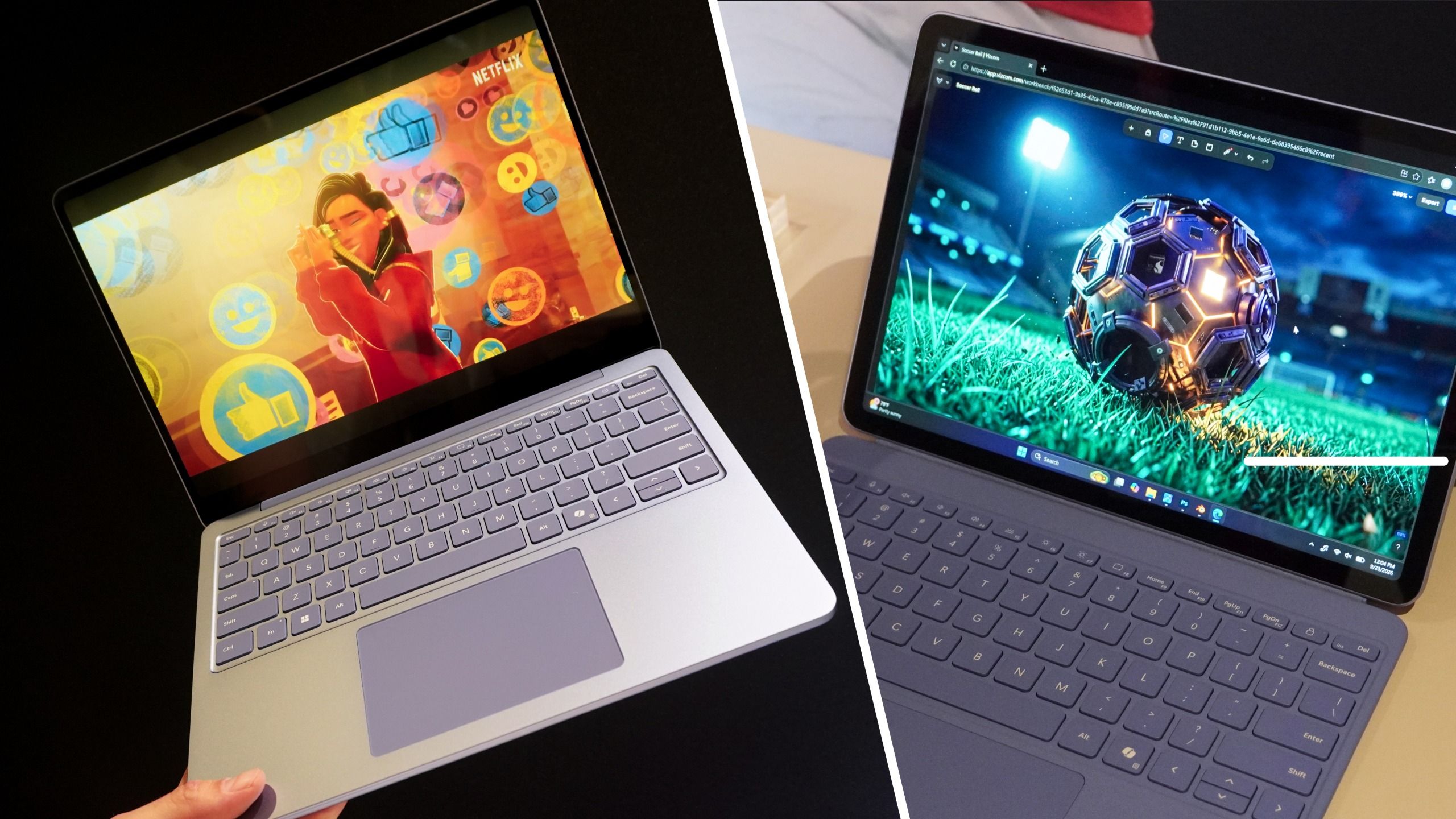
Tom's Guide found the fanless chassis cool with three creative apps running at once, and calls the new Surfaces the closest Microsoft has come to the MacBook Air. The session covered heat, not endurance.
The Product Desk · Product desk
What happened
- Microsoft is launching a 12-inch Surface Pro at $1,149 and a 13-inch Surface Laptop at $1,199 on October 13, both running the Snapdragon X2 Plus.
- Neither machine has an active cooling fan; Microsoft uses dense cooling pipes to move heat out of the aluminum shells instead.
- On the 12-inch Surface Pro the keyboard connects only at the bottom spine, dropping the magnetic attachment to the bottom bezel that braced the deck on earlier models.
Compiled by The Product DeskSomething wrong?How this is made
Why it matters
- constraint A three-app creative pipeline in a short session tells a buyer how the chassis behaves under three apps. The seats that decide a refresh run software the session never opened.
- decision With $50 between them, the first choice a fleet buyer makes is kickstand or clamshell, and that is settled before anyone argues Windows against macOS.
- exposure Specifying the 12-inch Pro for staff who work on trains and planes means accepting lap stability on the reviewer's guess. He said he could not test it.
- cost Memory pricing sits inside the sticker: Tom's Guide calls the entry points "quite a RAMageddon sting", and every seat in a refresh pays it.
Fanless Windows tablets used to fail in a predictable way: the chassis got hot and the clock came down. Tom's Guide puts it as past fanless designs "inevitably meant thermal throttling and scorched aluminum chassis" [12]. Microsoft's answer on these two machines is to drop the fan and run dense cooling pipes instead [2].
The cool-chassis result came out of a short hands-on session, and Tom's Guide did not report battery runtime or how long the load ran. The reviewer drafted a sketch, imported it into Blender to render 3D geometry, moved the render into Photoshop, and kept all three applications open and active while switching between them; he reported the switching as instantaneous with no perceptible stutter [3]. "I touched the back of the Surface Pro chassis and it remained cool to the touch," he wrote [4].
Tom's Guide's headline says "The MacBook Air should be terrified" [10]. Its verdict is more careful: the two Surfaces are "the closest Microsoft has come to matching the everyday magic of the MacBook Air" [9]. The 60 percent faster graphics rendering and 80 TOPS NPU cited in the piece are figures for the X2 Plus architecture, not measurements taken in the session [5].
The one caveat the reviewer flagged against the 12-inch Pro is the keyboard. Earlier Surface Pro keyboards snapped magnetically to the bottom bezel to brace the deck; this one connects strictly at the bottom spine [7]. "I wasn't able to test the lapability trade-off of this," he wrote, adding "I'd have to find out for myself to be sure" [8].
The same piece sorts the two machines by who they suit: the Surface Pro is "the creators choice" but "wrestles with its kickstand ergonomics", while the clamshell Surface Laptop "offers the best of both worlds" [15]. In a fleet that maps to a handful of seats that need the pen and a larger number that need a lid.
Prices start at $1,149 for the Surface Pro and $1,199 for the Surface Laptop, $50 apart [1][13]. Tom's Guide calls that "quite a RAMageddon sting" and says the machines are priced directly against Apple's core lineup [11].
For a buyer it comes down to two groups of software. A reviewer has now run Blender, Photoshop, a sketch tool and Windows 11 on this silicon in public [3]. The line-of-business applications your seats actually depend on were not part of this test. The thermal objection is answered for the software that ran. The number of applications in the second group decides whether $1,199 a seat buys a refresh or a pilot [1].
What to watch
- Full reviews of retail units after October 13 with measured battery runtime and a timed sustained-load test.
- Whether independent benchmarks reproduce the 60 percent graphics rendering gain and 80 TOPS NPU figures cited for the X2 Plus.
- Whether a reviewer who does test lap use finds the bottom-spine keyboard on the 12-inch Pro workable.