Loading today’s stories
Product1 distinct publisher3 min readUpdated
Rice's low-pressure diamond composite survives Mach 7 by turning itself into graphite
A sintering route that keeps diamond stable without extreme pressure produced a composite that converts to graphite in microseconds on impact. The absorbed energy matters more than the hardness.
The Product Desk · Product desk
What happened
- A new manufacturing technique developed at Rice University stabilizes diamond during thermal processing at low pressures, resulting in a dense, resilient composite material.
- The research was published in Materials Today.
- The study documents how hypersonic projectile strikes force diamond to turn into graphite in millionths of a second, a rapid phase change that absorbs kinetic energy.
- Small diamond particles are cheap and simple to fabricate, yet binding them into large solid shapes is difficult.
- Sintering uses heat and pressure to fuse loose grains into a solid mass.
Compiled by The Product DeskSomething wrong?How this is made
Why it matters
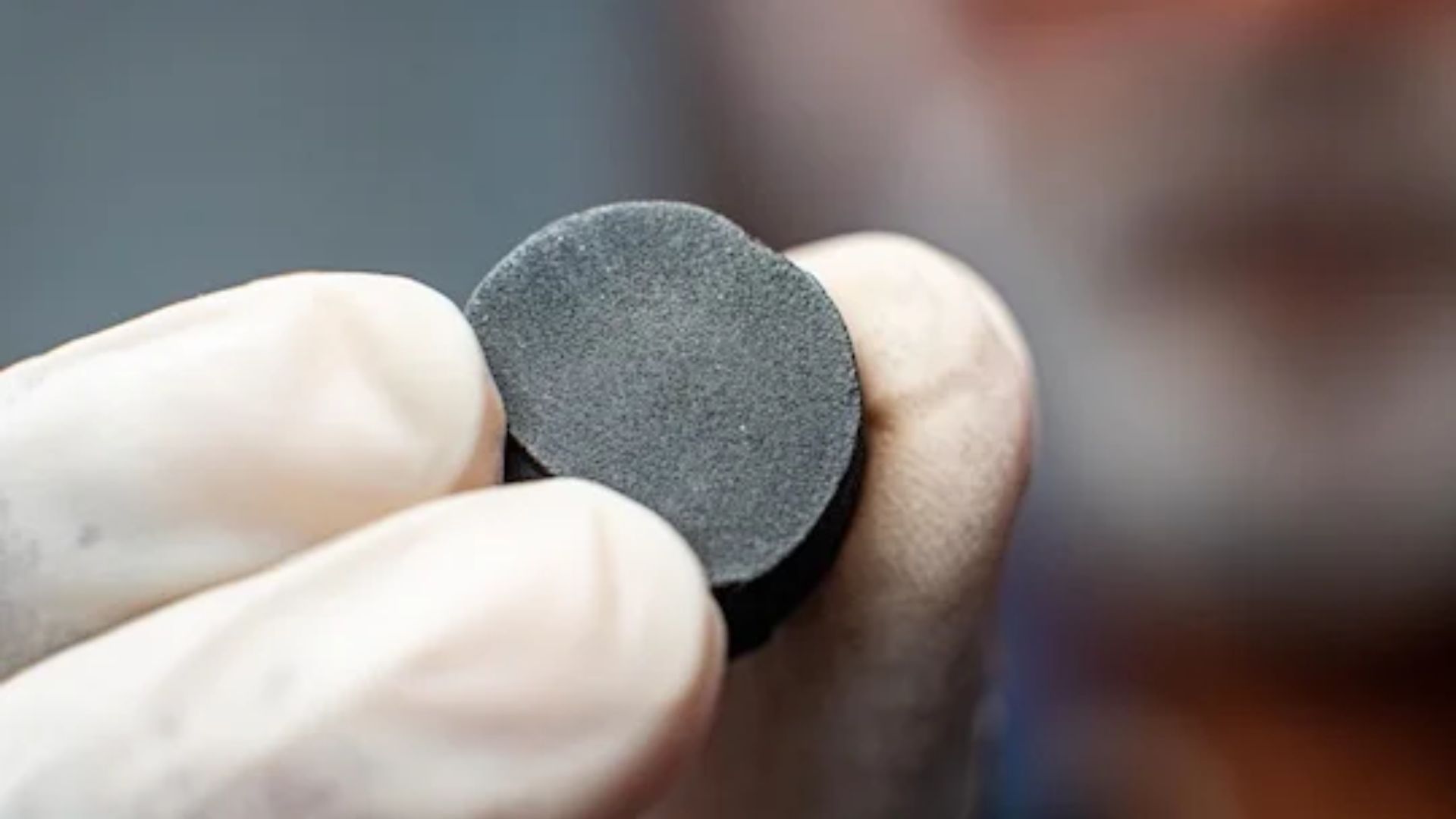
Rice University researchers have reported a manufacturing technique that stabilizes diamond during thermal processing at low pressures, producing a dense, resilient composite [1]. In the same study, published in Materials Today, they documented hypersonic projectile strikes forcing diamond to turn into graphite in millionths of a second, a phase change that absorbs kinetic energy [2] [3].
The manufacturing problem being solved is old and specific. Small diamond particles are cheap and simple to make, but binding them into large solid shapes is difficult [4]. Sintering fuses loose grains into a solid mass using heat and pressure [5], and at high temperatures diamond degrades into soft graphite unless it is held under extreme pressure [6]. Conventional high-pressure, high-temperature processing can produce polycrystalline diamond, but the pressure required caps the physical size of the resulting parts [7].
The team's workaround was compositional rather than mechanical. They mixed cubic boron nitride into fine diamond particles because the two substances share similar physical properties [8], added cobalt as a binder to stabilize the mixture during processing [9], and consolidated the blend with spark plasma sintering, which applies heat and pressure at once [10]. The result is diamond grains held inside a continuous cubic boron nitride structure with cobalt distributed throughout [11]. Because the route avoids extreme pressures, Rice presents it as a practical path to large-scale production of diamond-based parts [12].
That is the part with commercial consequence, and it comes with a catch the researchers state plainly. The embedded diamond makes the composite nearly impossible to machine [13]. First author Abhijit Biswas described it as "almost nonmachinable and tough due to the presence of dispersed diamond particles," and framed it as a guide for tougher materials in aerospace and defense [14]. Nonmachinable is a property for an armor tile and a problem for anyone who needs to finish a shape after sintering.
The ballistic testing sets the envelope loosely. According to Rice, the team fired metal projectiles measuring 1 to 4 millimeters across at the composite at hypersonic speeds [15]. Struck by a projectile moving faster than seven times the speed of sound, the composite held together and resisted destruction [16]. Struck by a larger projectile at a higher speed, it fractured [17]. The failure threshold therefore sits somewhere between those two conditions, which is as much precision as the reported results allow [18].
The more useful finding is in the failure mechanism. The team analyzed fracture surfaces and ran molecular dynamics simulations tracing atomic motion [19]. "We found that extreme impact can drive diamond to graphite within microseconds, rather than through the slower heat-driven process we normally associate with this transformation," Biswas said [20]. Diamond and graphite are both pure carbon; the difference in hardness comes from atomic arrangement [21]. Under hypersonic loading, the force and shock drive that rearrangement directly rather than through slow thermal degradation [22], and the structural shift absorbs collision energy, improving the material's capacity to withstand severe mechanical force [23].
That reframes what the composite is for. A hard material resists penetration; an energy-absorbing one converts the strike into something other than a crack, and here the conversion is the diamond consuming itself. Biswas argues that understanding phase change under force, alongside strength and hardness, should guide the design of future protective materials [24].
Worth tracking: what size of part this route actually yields, since removing the pressure ceiling was the point, and whether the graphitization absorbs enough energy per unit mass to compete with the ceramics already in armor stacks.
Loading topic controls
Loading related stories