Science1 distinct publisher2 min readPublished
Salk's mouse model left the Tbr1 protein abundant and put methyl tags on the DNA it has to land on. Deep-layer neurons developed poorly, and the electrophysiological consequences were still there in adulthood.
The Scientist · Science desk

Compiled by The ScientistSomething wrong?How this is made
The association has been on the books for decades: influenza in the second or third trimester tracked with a higher incidence of psychiatric disorders in children [9], and elevated maternal IL-6 became the leading candidate for the messenger [10]. Observational designs cannot assign the exposure, so the direction of that arrow stayed arguable. Here the immune challenge is administered by the experimenter [1], which settles direction inside the model: activation first, methylation after. It does not settle how much of a real infection a mimetic reproduces, and it does not move mouse frontal cortex any closer to human frontal cortex. The paper, in Molecular Psychiatry [4], reports thousands of epigenetic differences between exposed and unexposed offspring [3], and the useful part is that they are not scattered evenly. They pile up in the genomic regions that build deep-layer neurons [5].
The 25% overlap with SFARI [7] is the figure most likely to be quoted, and it is the one that needs the most care. It compares a curated human gene list against a mouse dataset in one cell class. The summary does not say how many high-confidence genes the database holds [15], so the percentage cannot be turned back into a count of genes, and no background rate is given for what a quarter would look like by chance. "Dysregulated" carries no direction or magnitude either. Read it as an alignment worth chasing rather than as an effect size.
What persisted into adulthood was electrophysiological [8]. The summary describes no behavioral testing of the offspring [16], and that gap matters, because "lasting changes in brain circuitry" is a physiological statement while the conditions this work is aimed at are diagnosed behaviorally. Closing that distance is most of the work still outstanding.
Neurodevelopmental conditions including autism and ADHD affect roughly ten percent of the US population [12]. This study does not estimate what share of that involves prenatal immune activation, and Ecker put the limit plainly: infection changes the odds, and not everyone who falls ill in pregnancy will have a child with a neurodevelopmental disorder [11].
Ranked by verification strength, evidence, and original report placement.
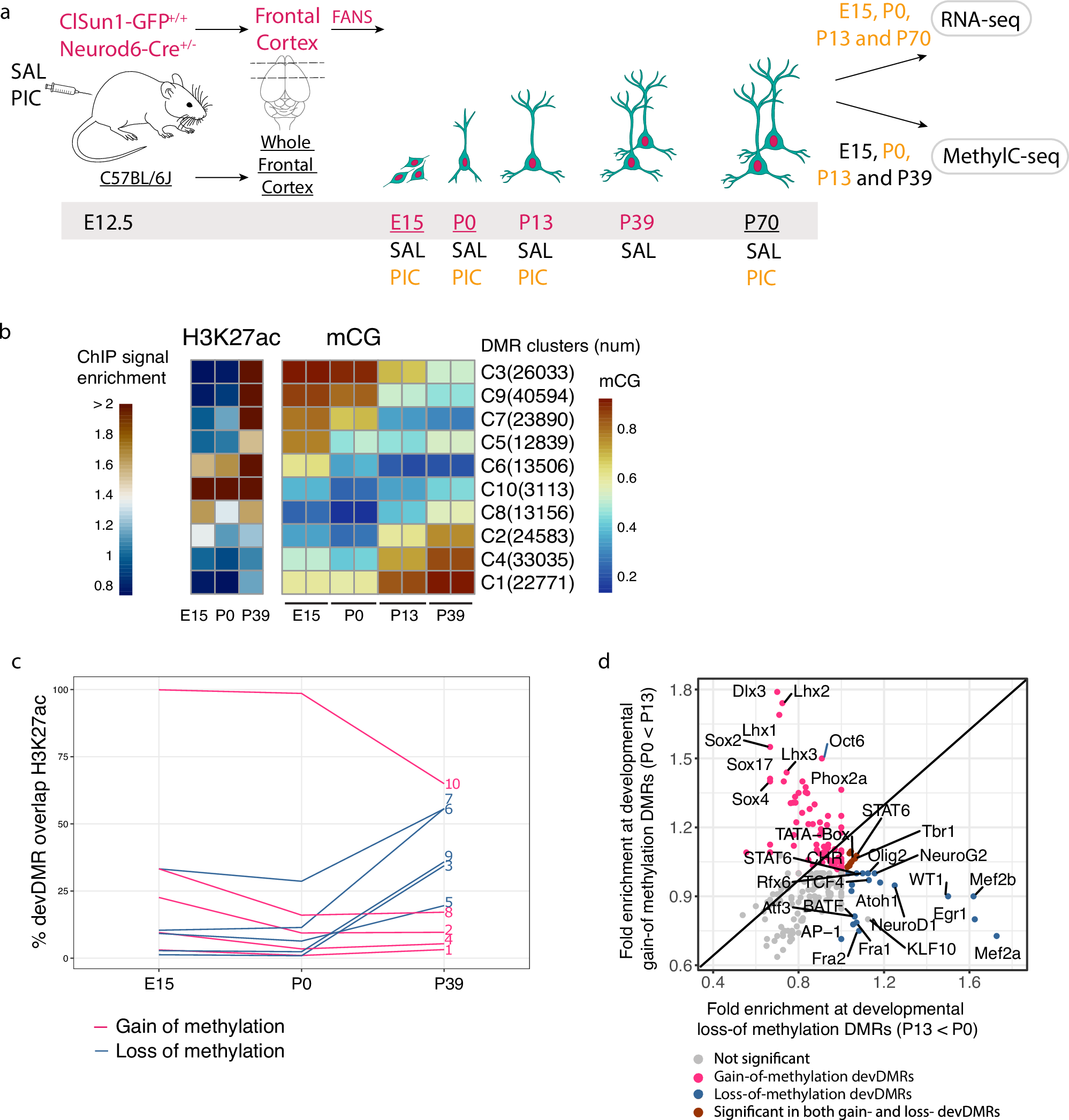
The Salk team used a well-characterized mouse model treated with the viral mimetic Poly(I:C), which mimics an influenza infection and triggers maternal immune activation (PIC-MIA).
The team analyzed mouse frontal cortex neurons from mid-gestation to two weeks post-birth, finding changes in both gene activity and DNA methylation in offspring of PIC-MIA pregnancies.
Analyzing epigenomes of mouse frontal cortex cells across fetal development, the team found thousands of epigenetic differences between offspring from healthy pregnancies and those from pregnancies affected by maternal immune activation.
The altered methylation patterns were heavily concentrated in genomic areas responsible for forming deep-layer neurons.
Genomic sites where the transcription factor Tbr1 typically binds were hypermethylated; although Tbr1 protein was plentiful, the excess methylation blocked correct binding, the regions Tbr1 interacts with were downregulated, and deep-layer neuron development was impaired.
Distinct publishers with included, body-backed reporting in this cluster.
1 article · September 2, 2026
Follow any of these and your For You feed starts watching them — no settings page required.
science
Mount Sinai puts a youth protein on aging microglia, and the mice answer1 distinct publisher
science
Salk's fly driver lines narrow octopamine access to single pairs of neurons1 distinct publisher
science
Synapse PET puts schizophrenia's connection loss on a map, with a left frontal anchor1 distinct publisher
Evidence-backed comparisons of source perspectives and observed adoption signals. Read the methodology
Which Builder, Operator, and Investor concerns the observed source mix emphasized—not a truth score.
Evidence, demonstrated adoption, hype gap, incentives, and confidence are assessed independently, each on its own current evidence. How these are measured.
Traceable to a real paper, unverifiable as reported
The good part: this points at a specific open-access paper with a DOI, a full author list, a named model, a stated developmental window and two independent readouts — methylome and electrophysiology. The limit is that everything a sceptic would ask for lives in the paper, not in the reporting. Not one animal count, effect size or significance threshold appears, 'thousands of epigenetic differences' is the only quantification of the primary result, and every word of it reaches us through the institute that produced it.
Publication is not uptake
Nobody has picked this up yet, and there is no honest way to score that as adoption. The single dated event in our coverage is the paper's own appearance on September 2, 2026. No second laboratory has repeated the methylome result, no human cohort has been tested against it, and no clinical or preclinical program is named — so we leave this blank rather than dress a publication up as traction.
Mouse mechanism, human headline
The title asks how severe illness in pregnancy alters fetal brain development; the experiment injects a synthetic viral mimic into mice. Between those two sits the 25% autism-gene overlap, the line most likely to be screenshotted and the one with neither a denominator nor a chance-level comparison. Ecker's caution that infection shifts odds rather than settling outcomes is the right correction, and it is real reporting to have included it — it just arrives well after the framing has landed.
Institute release, lightly re-voiced
Chain of custody: Salk's press office, its media contact by name, and Neuroscience News as the vehicle. The quotes selected are exactly the ones an institution circulates — a tip-of-the-iceberg promise and a future of maternal or fetal therapeutics — and the unsourced ten-percent prevalence figure at the top does the job of making a mouse study feel consequential. To its credit the outlet states that it read the paper in full, which is more than most syndication of this kind, but it also serves an audience whose attention reliably follows autism-mechanism headlines.
Internally consistent, externally untested
One publisher, one institution, one paper — and no contradiction anywhere in the record, which is less reassuring than it sounds, since there is nothing present that could have contradicted anything. The account holds together and can be traced to a verifiable citation, so we are reasonably confident about what was claimed; we have no basis at all for confidence about whether it replicates or transfers to humans.