Build1 publisher3 min readPublished
One developer, $80 a month, and 242 million Flock audit records
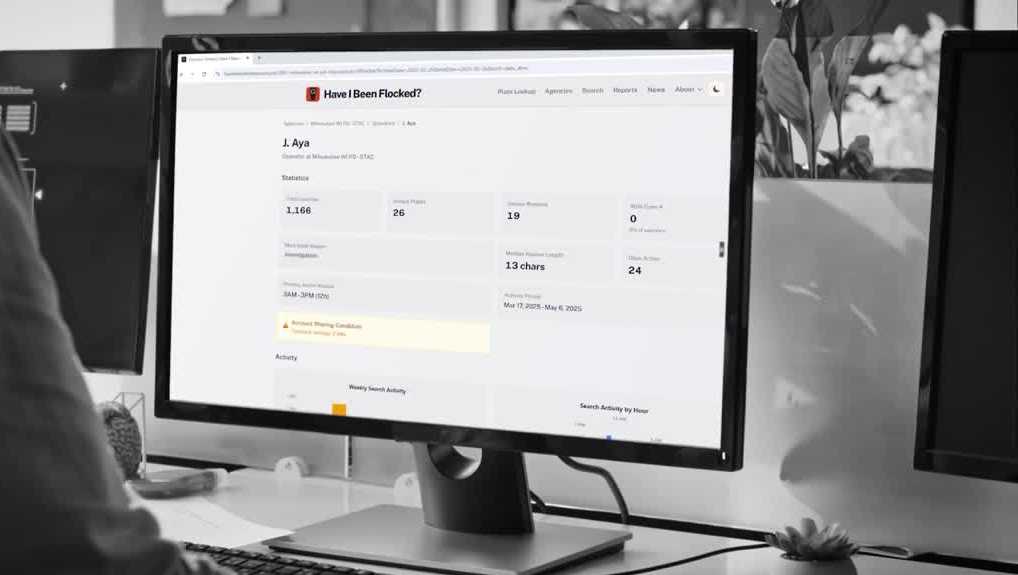
Have I Been Flocked has turned scattered public-records releases into a cross-agency search layer for a network its vendor says covers more than 5,000 law enforcement agencies.
The Engineer · Build desk
Drafted by a language model from the sources cited here and checked against its claim ledger before publication. How we use AISend a correction
What happened
- H.C. van Pelt's Have I Been Flocked? (@HIBFlocked) has assembled 241,961,192 audit records from Flock Safety systems into a searchable database, allowing drivers to check whether an operator queried their license plate.
- As of August 16th, the database contained searches involving 4,684,253 plates.
- Van Pelt says Have I Been Flocked's hosting and infrastructure cost about $80 a month.
- Flock says its network serves more than 5,000 law enforcement agencies, produces billions of monthly plate reads, and includes audit trails and transparency portals. Flock markets its license plate readers as cameras that use AI software to turn plate numbers, vehicle descriptions, locations and timestamps into searchable evidence.
- Those controls depend on agencies retaining, reviewing and releasing useful records.
Compiled by The EngineerSomething wrong?How this is made
Why it matters
H.C. van Pelt has assembled 241,961,192 audit records from Flock Safety systems into a database that lets a driver check whether an operator entered their license plate into the system [1], covering searches involving 4,684,253 plates as of August 16th [2]. The reason to care is not the plate lookup; it is that the cross-agency accountability tooling now exists outside the vendor and outside the agencies, running on about $80 a month of hosting and infrastructure [3].
Do the arithmetic on that budget and it comes to roughly $960 a year [1] for about 3.0 million audit records per dollar of monthly spend [2], averaging about 52 records per distinct plate [3]. Flock, for its part, says its network serves more than 5,000 law enforcement agencies, produces billions of monthly plate reads, and includes audit trails and transparency portals [4]. Those controls depend on agencies retaining, reviewing and releasing useful records [5], which is exactly where the project inserted itself.
The records came from local governments that released Flock audit logs through public-records requests or transparency portals [6]. Normally those files sit scattered across municipal records systems, arrive as spreadsheets or PDFs, and cover one jurisdiction [7]. Combining them is the whole product: a driver can search across agencies instead of first identifying every department that may have touched the network [8].
The engineering discipline here is in what the project refuses to claim. It is searching the audit layer, not reproducing Flock's underlying store of vehicle images and location data, so it does not tell a driver every time a camera photographed a vehicle [9]. Records may include the operator, agency, stated reason, case number, search time and search type [10], but a hit does not establish that the operator was a police officer, that the owner was suspected of a crime, or that the query returned useful footage [11]. Organization, network and public audit logs each expose different fields; network logs may redact both operator and plate, and public-portal releases can contain even less [12].
A clean result proves correspondingly little. The project says few governments provide easy access to their logs, records are frequently redacted, and newly obtained files may document searches conducted months or years earlier [13].
The free-text fields are the reason the site needs its own privacy plumbing. Operator-supplied reasons may describe investigations, personal details or the activity that prompted a search [14], so the pipeline strips Social Security numbers, birth dates, phone numbers, driver's license numbers and street addresses using pattern matching plus transformer-based named-entity recognition, with manual intervention when needed [15], and does not save plates or terms entered by visitors [16]. Those same fields feed reports on searches tied to protests, religious gatherings, journalists, political organizing, immigration enforcement, training exercises and low-level offenses [17].
This is a one-developer project on community donations, fiscally sponsored by the Alternative Newsweekly Foundation while remaining editorially independent [18], and van Pelt also publishes investigations into Flock contracts, security practices and government use of the system [19]. It predates the current campaign, having offered plate searches and long-term tracking analysis by November 2025 [20]; the lookup is being promoted during the August 16th-22nd National Week of Action Against ALPRs [21].
Watch the file formats and redaction practice on the supply side, because network-log redaction of operator and plate [12] is the cheapest way for agencies to keep complying while making aggregation useless. Watch the disclosure lag too: a database whose newest files describe queries from years ago [13] is a historical record, not a notification system. And note the concentration risk in one maintainer at $80 a month [3][18] carrying the audit function for a network of 5,000-plus agencies [4].