Science1 publisher3 min readPublished
A magnetar becomes a quantum lab, on evidence that is still contested
A US-led team reads up to 80% X-ray polarization from magnetar 1E 1547.0-5408 as QED vacuum birefringence. An Italian-led group says alternative explanations are not excluded.
The Scientist · Science desk
Drafted by a language model from the sources cited here and checked against its claim ledger before publication. How we use AISend a correction
What happened
- A US-led international team claims the first direct glimpse of vacuum birefringence, from study of X-ray and radio emissions of a neutron star that is both a magnetar and a pulsar; vacuum birefringence is a central but unconfirmed prediction of quantum electrodynamics involving polarization of the quantum vacuum by powerful magnetic fields.
- Another group headed by researchers in Italy remains unconvinced that the data constitute a smoking gun for vacuum birefringence, and believes alternative explanations remain viable.
- A key QED prediction, first made in 1935 by Werner Heisenberg and Hans Euler, is that sufficiently strong magnetic fields can make a vacuum birefringent by polarizing the virtual electron-positron pairs that fluctuate in and out of existence.
- Ninety years after the prediction, vacuum birefringence had not been observed because the huge fields required cannot be generated in the laboratory.
- Magnetars are a rare subtype of neutron star with extreme magnetic fields of up to 10^11 T, making them the most magnetic objects observed in the universe and bright sources of X-rays.
Compiled by The ScientistSomething wrong?How this is made
Why it matters
A US-led international team says that X-ray and radio measurements of a neutron star which is both a magnetar and a pulsar constitute the first direct glimpse of vacuum birefringence, a central but unconfirmed prediction of quantum electrodynamics [1]. Another group headed by researchers in Italy is not persuaded that the data are a smoking gun and holds that alternative explanations remain viable [2].
The prediction itself is old. Heisenberg and Euler proposed in 1935 that a sufficiently strong magnetic field polarizes the virtual electron-positron pairs fluctuating in and out of the vacuum, making empty space birefringent [3]. Ninety years later it has not been observed, because the required fields cannot be produced in a laboratory [4]. Magnetars, a rare neutron-star subtype with fields up to 10^11 T, are the most magnetic objects observed and bright X-ray sources [5], and NASA's IXPE telescope has shown that their X-rays are often polarized [6].
The difficulty is that polarization is not a clean signature. A magnetar's surface is likely surrounded by magnetized, birefringent plasma, whose field should be tangled and variable, so the net polarization imprinted on light escaping to the far field should be relatively small [7]. Vacuum birefringence, by contrast, should imprint a polarization that tracks the orientation of the magnetic poles into the far field as the star rotates [8]. Separating the two normally fails at the same point: the orientation of the magnetic poles relative to our line of sight is not generally knowable [9].
That is what the choice of target is meant to fix. A very few magnetars are also pulsars, emitting narrow radio beams from their magnetic poles, which sweep past Earth because the magnetic and rotational poles are misaligned [10]. Rachel Stewart of George Washington University and colleagues observed 1E 1547.0-5408, which is unique among observed objects in having persistent, bright radio emission alongside its X-rays [11], combining IXPE and NICER with radio data from Australia's Murriyang telescope [12]. The radio timing yielded the angle between the magnetic and rotational poles and the angle between the rotational pole and our viewing direction [13].
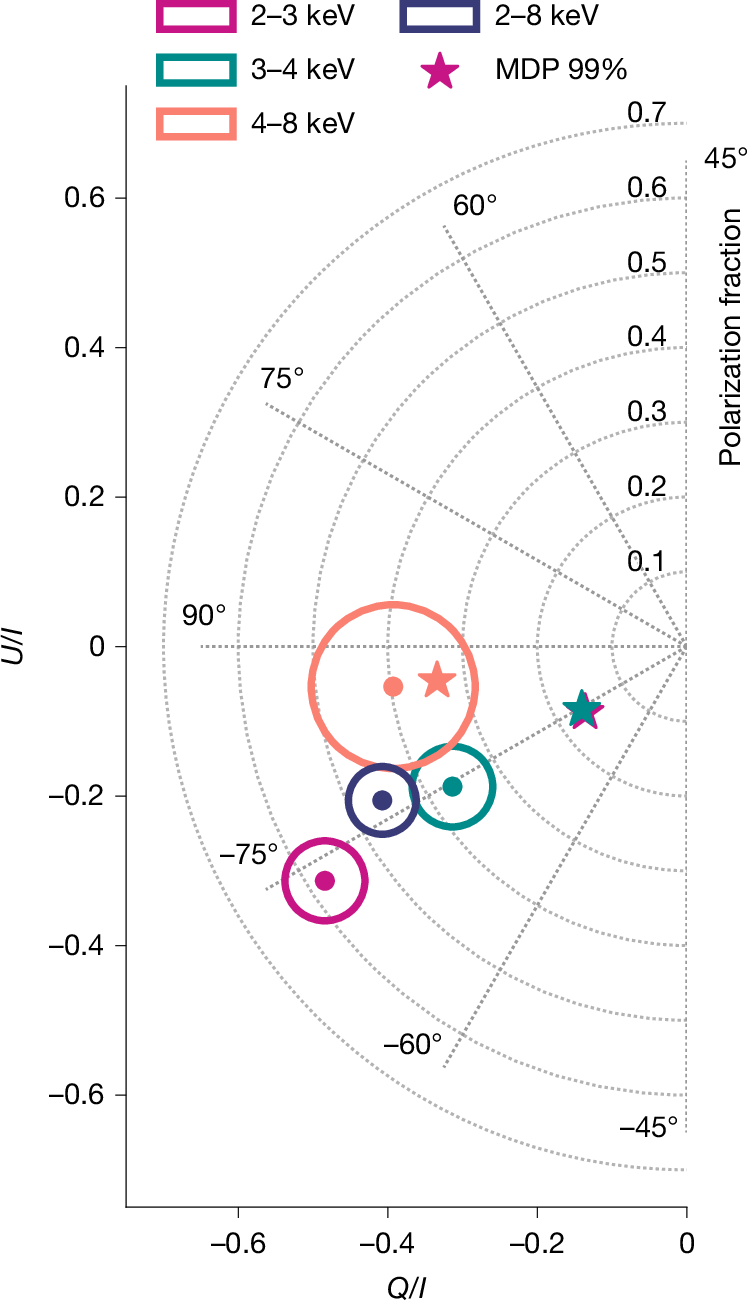
The measured X-rays are highly polarized, up to 80% at photon energies of 2-3 keV, which the team says is consistent with vacuum birefringence driven by the star's field [14]. They also report that the X-ray emission is closely aligned with the radio emission, which they attribute to near-alignment of the magnetic and rotational poles [15].
"Consistent with" is the operative phrase, and it is where the Italian-led group's objection lands [2] [14]. The material available here does not spell out which alternatives that group considers still open, so the specifics of the dispute are not yet assessable from it [2].
What to watch: whether the competing analysis is published with a quantified alternative, and whether the plasma contribution can be bounded rather than argued to be small [7]. Also watch the sample. Stewart notes the appeal of an existing natural laboratory for extreme-field effects [16], but the geometry trick that makes this measurement possible depends on radio-loud magnetars, of which very few are known [10] [11].