Science1 publisher3 min readPublished
Engineered E. coli stocks the mouse gut with phages before Salmonella arrives
Gut phage therapy usually fails because you cannot get enough phage to enough bacteria in time. A team writing in Nature Microbiology built a resident E. coli that makes the phage on site, and it protected mice against an oral Salmonella challenge.
The Scientist · Science desk
What happened
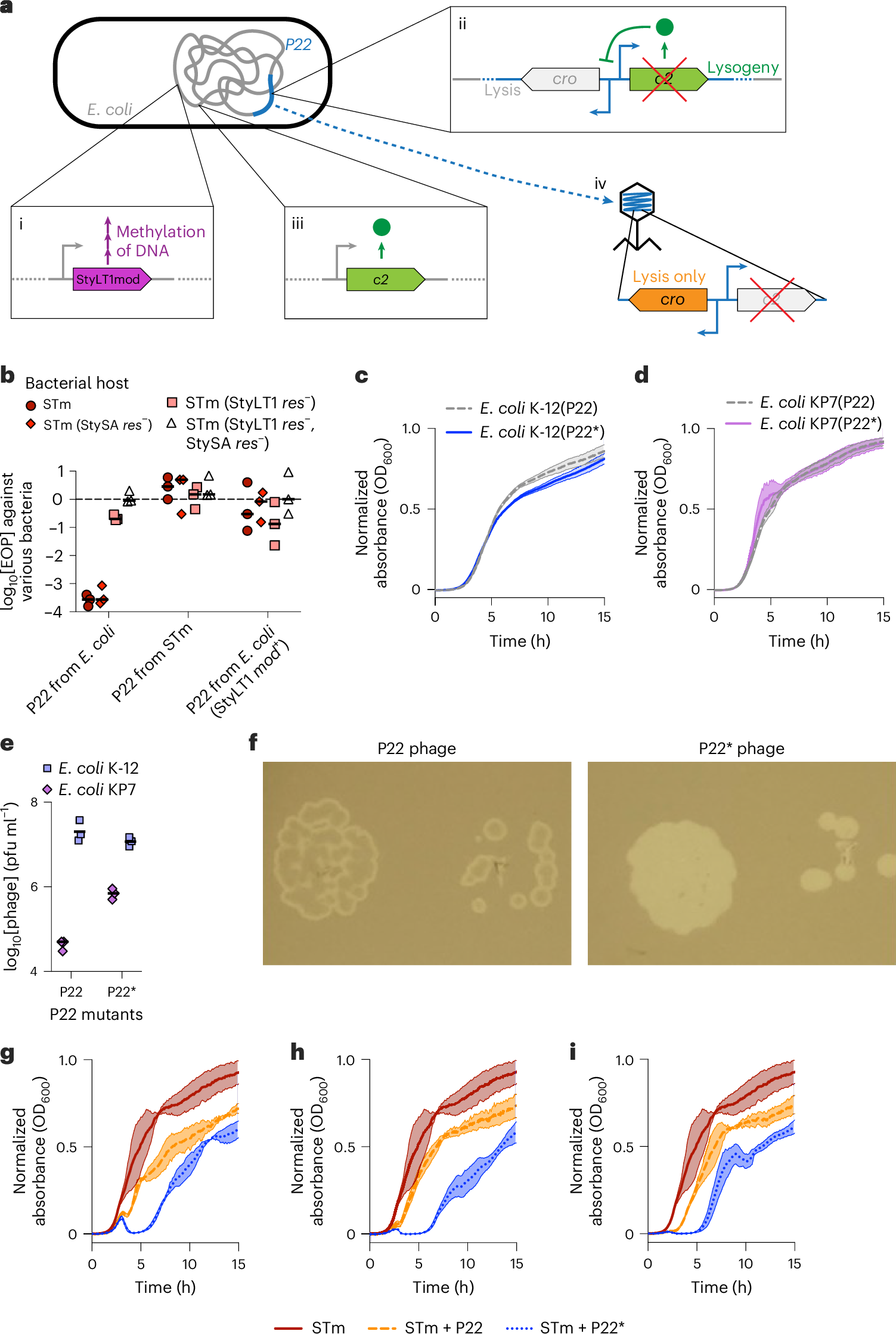
- Bryan Hsu's team engineered a nonpathogenic E. coli to carry and release a phage that infects only Salmonella, and reported that it protected mice against an oral Salmonella infection.
- The phage normally sits dormant inside the Salmonella genome, and several genetic changes moved it into E. coli and made it lyse Salmonella once released into the gut.
- Because Salmonella blocks phage DNA arriving from another species, the researchers inserted a Salmonella gene into the E. coli genome so the phage would not be recognised as foreign.
- The study was published in Nature Microbiology, with postdoctoral fellow Rogerio A. Bataglioli as lead author.
Compiled by The ScientistSomething wrong?How this is made
Why it matters
- constraint Protection here rides on a live engineered bacterium being resident and producing when the pathogen shows up, so the hard problem becomes stable colonisation of a healthy gut.
- capability Defeating a pathogen's self-versus-nonself recognition by putting one of its own genes into the delivery bacterium is a reusable piece of engineering, and it is the part other phage programmes would copy first.
- decision Anything built this way is offered to people who are not yet ill, which sets a different tolerance for a live engineered organism than a rescue therapy given to someone already in hospital.
Gut phage therapy fails for two reasons that have nothing to do with whether a phage can kill its host in a dish. One is a ratio problem. Phages and bacteria in the gut settle into long coexistence, and that coexistence makes the high phage-to-bacteria ratio a treatment needs hard to reach [10]. "It's challenging, especially in the gut, because phages and bacteria tend to coexist for long periods of time," Hsu said [7]. The other is access. "And then once you have a bacterial infection in your gut, a lot of times it's just not even accessible to phages," Hsu said. "It's already hidden away in the mucosa or cells of your body; it's not just free-flowing to where the phages would be able to access the bacteria" [9].
Both problems are problems of timing, and the design attacks timing. Put the phage factory in place first, and the pathogen meets a saturated environment on the way in. "What happens is that this good bacterium, the E. coli, produces all this antipathogen phage, and there is now a protective lining so that when Salmonella comes in, just after passing through the stomach and at its weakest point, it meets this high, killer density of phages," Hsu said [17]. The hard part, then, is colonising a healthy gut [22].
Moving the phage into E. coli needed one more trick. Salmonella can detect phage DNA produced by non-Salmonella bacteria and block it from replicating [14]. "We were able to trick the Salmonella bacteria into thinking the phage from E. coli was 'not foreign' by adding a Salmonella gene into the E. coli genome," Bataglioli said [15]. That matters because the kill is meant to compound: "A phage that comes from our E. coli can infect Salmonella, can propagate easily in Salmonella, lyse it, and then all the phages that are produced from Salmonella can just keep replicating," Bataglioli said [16]. The team calls the resulting construct a "lytic phage-producing lysogen," or lyto-lysogen [13].
The phys.org account does not give the number of mice, the challenge dose, or how protection was scored [21]. That leaves the size of the effect open, along with how long the engineered E. coli keeps producing once it is in place. Phages do not infect humans or animals [5], which removes one worry and leaves a different one: a preventive of this kind is a live engineered bacterium given to someone who is not yet ill.
Salmonella was chosen for how much disease it causes. The researchers cite its global disease burden, its ability to kill elderly people, children and people with HIV, its high prevalence of antibiotic resistance, and its upgrade to high-priority pathogen by the Centers for Disease Control and Prevention [18]. They think the approach generalises with adaptation [23]. They are clear about the ceiling: "It's not about replacing antibiotics but having one more option on the shelf to fight infections," Bataglioli said [19].
What to watch
- Whether the paper itself reports how long the engineered E. coli persists in the gut and keeps producing phage.
- Whether the same self-versus-nonself disguise works for a second pathogen-phage pair, which is what would make the approach a platform.
- Whether anyone tests the construct against a Salmonella infection that is already established.