Science1 publisher3 min readPublished
Stanford chemists synthesized the 20 polymers their models disagreed about most
A team trained on antimicrobial peptide data to rank a library of 1.7 million polymers, then sent to the bench the candidates its models split hardest over, on the theory that the models' disagreement marks the experiments most likely to be informative.
The Scientist · Science desk
What happened
- Stanford engineering researchers report in the journal Matter that they trained a model to find polymers that mimic the way antimicrobial peptides kill bacteria on contact.
- The screen ran across a computational library of 1.7 million candidate polymers, a number the team described as overwhelming to investigate manually.
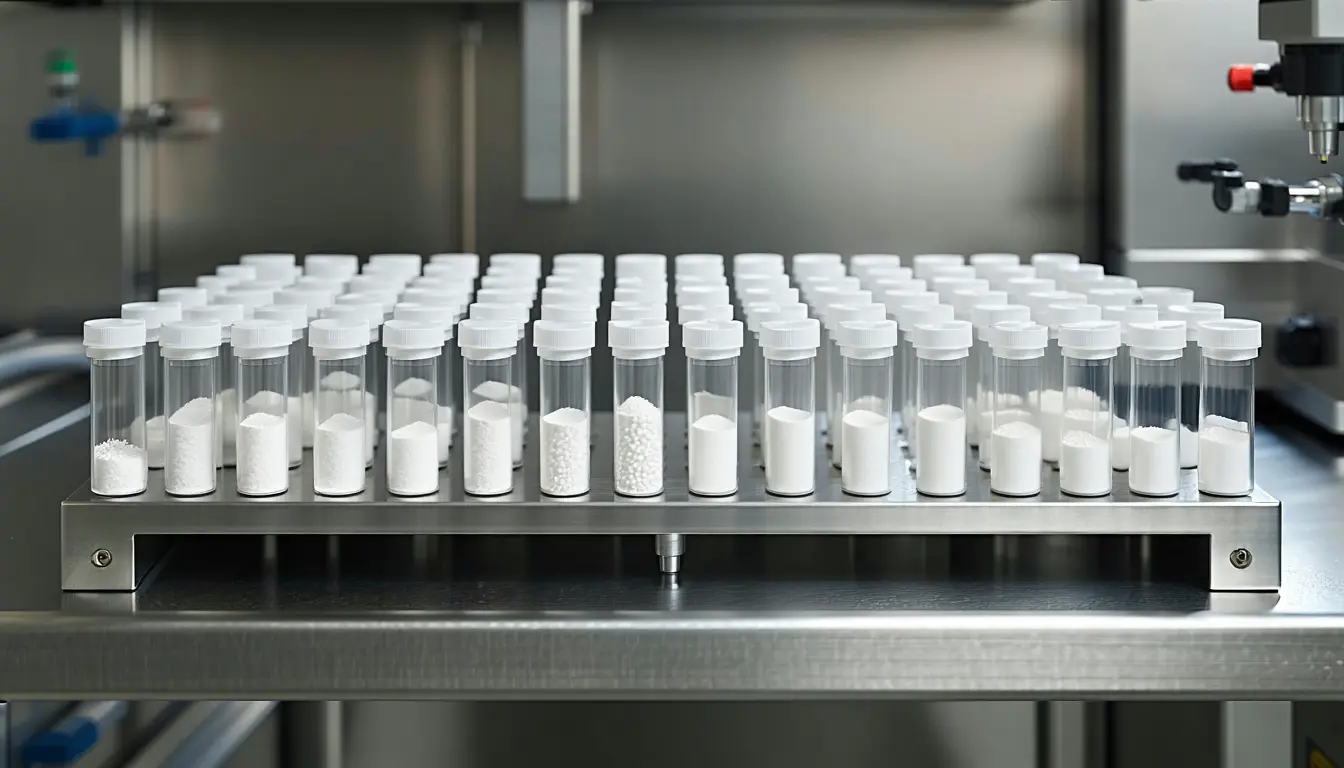
- They then synthesized and tested the 20 candidates their models disagreed about most, where some models predicted excellent antibiotics and others predicted failures, and retrained on the results.
Compiled by The ScientistSomething wrong?How this is made
Why it matters
- capability A group with no usable dataset for its own molecule class can bootstrap a working screen from 20 syntheses, provided a neighbouring class has already been characterised in bulk.
- constraint The transfer binds the polymer screen to the peptide literature, so the model's reach ends where characterised peptide chemistry ends.
- cost What gets manufactured changes the economics: a polymer that does not degrade easily can be shipped and stored in places a short-lived peptide cannot reach.
- decision Anyone funding the next stage has to price resistance evasion from the membrane mechanism alone, because the described work stops at antimicrobial testing of 20 compounds.
The resistance claim here is a physics claim. Eric Appel, a Stanford professor of materials science and the study's senior author, described the mechanism the polymers were chosen to copy: the peptides "literally rip holes in the cell membrane to kill them," he said [12][21]. His argument for why that should be hard to evade is about what a bacterium would have to rebuild. "It's much harder for a bacterium to change the entire lipid structure of its membrane or the electrical charge of its surface than to learn to reject a chemical drug or turn off its narrow pathway," Appel said [13]. Shoshana Williams, who did the work as a chemistry graduate student at Stanford and is now a postdoctoral scholar at the University of California, San Francisco School of Medicine, put the contrast with conventional drugs plainly: "Importantly, they don't need to get inside the cell to work, like a typical drug would. Nor do they work on one specific protein or pathway, like drugs do," she said [14][20].
That reasoning is the whole basis of the resistance argument as presented [15]. The experiments described cover property prediction, the synthesis of 20 polymers and antimicrobial testing, and do not include a resistance-evolution assay [23]. The phys.org account states that the new polymers share peptides' ability to overcome or escape microbial resistance [24]. The measurement that would support that directly is a passage experiment: repeated exposure over many generations, with the killing concentration tracked as it drifts.
Large datasets exist for antimicrobial peptides; the polymer equivalents are scarce [4]. That data problem, and the way the team got around it, is the part other labs will copy. "The dataset of antimicrobial polymers was simply nowhere near big enough," Williams said [6]. So the team trained on peptide chemistry and carried it across [5]. "With a chemist's intuition, however, we pivoted to training on the chemical properties of antimicrobial peptides first and applied that knowledge to the polymers. It worked!" Williams said [7]. Appel called that the primary intellectual leap of the paper, and gave the reason it was available: "There are thousands of peptides that have been evaluated where all of the chemical content is known," he said [25][26].
Instead of the polymers the models agreed on, the team took the ones they split over. It ranked candidates with several models and then looked for the widest disagreement, synthesizing the 20 where some models predicted excellent antibiotics and others predicted terrible ones [8][9]. "We figured that if you want to improve the models, it's really a good space to feed in more actual experimental data," Williams said [10]. Twenty measurements against a library of 1.7 million is one experimental data point per 85,000 catalogued polymers [22]. Williams said that after the results went back into training, "we had a much more robust system able to select the greatest hits from among the polymers in the library" [11].
Why want a polymer at all? Peptides are short-lived and expensive to synthesize [19]. Polymers are cheaper and easier to make and do not degrade easily, and the researchers say that allows global distribution and access in low-resource communities [16]. Appel also called polymers "super safe" [17]. The phys.org account puts annual deaths from drug-resistant microbial infections in the millions worldwide [18].
What to watch
- Serial-passage data: whether the selected polymers hold their killing concentration over repeated exposure, and against which species.
- Minimum inhibitory concentrations and mammalian cell toxicity for the hits. Those two numbers decide whether the membrane mechanism is selective enough to dose.
- Whether later rounds still need polymer-only training data, or whether the peptide-to-polymer transfer keeps working as the target properties change.