Build1 publisher2 min readPublished
Five undisclosed parameters sit behind Search Console's new AI Contribution earnings line
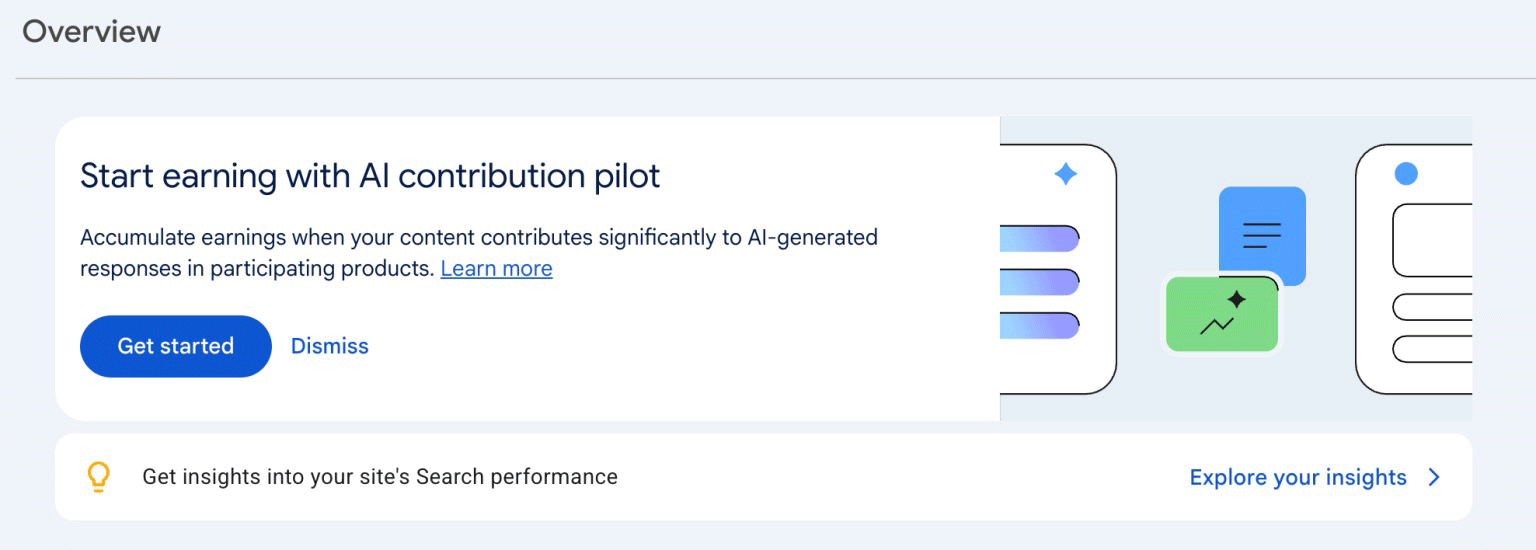
Google is testing monthly payments for content that grounds Gemini, AI Overviews and AI Mode, with the figure already visible to selected publishers in Search Console and the payment formula still undisclosed.
The Engineer · Build desk
What happened
- Google is testing a limited Search Console pilot called AI Contribution that tracks monthly earnings tied to content judged to contribute meaningfully to its AI-generated outputs.
- The experiment is reported to cover Gemini, AI Overviews and AI Mode.
- Reporting corroborated by Google indicates selected publishers can already see an AI Contribution earnings panel showing monthly earnings associated with their content's contributions to Google AI outputs.
Compiled by The EngineerSomething wrong?How this is made
Why it matters
- constraint With five parameters of the model undisclosed, the panel is an observation tool: a publisher cannot test whether any edit, template change or crawl permission moved the figure.
- decision Anyone weighing budget for documentation or specialist reporting on the strength of AI payments has no rate to model against, and dev.to's own advice is not to invest on assumed rates.
- capability Participating publishers get a Google-side figure for value delivered without a click. Clicks, impressions and referral visits could not express that.
- precedent If contribution payments arrive through negotiated partnerships, terms stay per-deal, and no public rate card will constrain what the next publisher is offered.
To instrument a number in a dashboard, you need to know what it counts and what rule assigns it to a page. According to dev.to, Google has published neither, and has not disclosed the payment formula, payout levels, eligibility rules, participant list or long-term scope [5]. The same report says it is unclear how Google decides that content made a sufficiently meaningful contribution to a particular AI output [6].
That leaves five unknown parameters behind one published figure [15]. The panel is intended to show monthly earnings associated with content contributions to Google AI outputs [3]. With the attribution rule undisclosed, a monthly total cannot be tied to a specific page or a specific edit.
The scope claims are narrower than the framing suggests. Google has called the work experimental and not a finalized commercial program [4]. The pilot does not give every page Google cites, crawls or surfaces a defined price [7]. Google has not presented it as a replacement for search visibility, audience development, advertising, subscriptions or existing publisher partnerships [11].
The policy context is dated. Google's public policy overview of support for the information ecosystem, published June 18, 2026, described broader partnership and monetization models for the AI era, including arrangements in which website content improves or grounds AI responses [8]. The same post describes a separate News AI pilot involving enhanced content rights and tailored delivery [9]. dev.to says Google's approach is focused on partnerships and contribution-based monetization [13].
The existing measurement still matters. Publisher economics have depended on referral traffic, advertising, subscriptions, licensing, or some combination [12]. dev.to's practical list is to watch Search Console for access if the pilot expands, keep pages where facts, expertise, authorship and updates are clear, and track how AI experiences affect referrals alongside conventional search performance [14]. It also warns publishers not to treat the pilot as a guaranteed revenue stream or to make editorial investments based on assumed rates [10].
What a publisher can act on today is thin. It comes down to the reporting that Google is willing to attach a monthly currency figure to grounding at all [3], and that the formula producing it is Google's to define and, so far, unpublished [5].
What to watch
- Whether Google publishes the attribution rule or any rate. That is the point at which a publisher could test the number against its own changes.
- Whether the pilot widens past selected publishers, and whether the earnings panel gets an export or API in Search Console.
- Whether terms from the separate News AI pilot become public. Those terms would show whether payment is set deal by deal.