Science3 publishers2 min readPublished
A regenerating flatworm neuron gets its transmitter and its position from six of ten identified genes
University of Georgia researchers report the ten genes in Nature Communications and characterized six of them in detail. Knocking some of them out left planarians unable to make new dopamine neurons and slow to move.
The Scientist · Science desk
What happened
- The Nature Communications paper, titled "Combinatorial mechanisms specify cellular location and neurotransmitter identity during planarian neurogenesis," has Kendall Clay and Taylor Medlock-Lanier as co-first authors and Rachel Roberts-Galbraith as senior author.
- With some of those genes knocked out, the flatworms struggled to make new dopamine-producing neurons and moved slowly, an effect the accounts liken to low dopamine in people and other mammals.
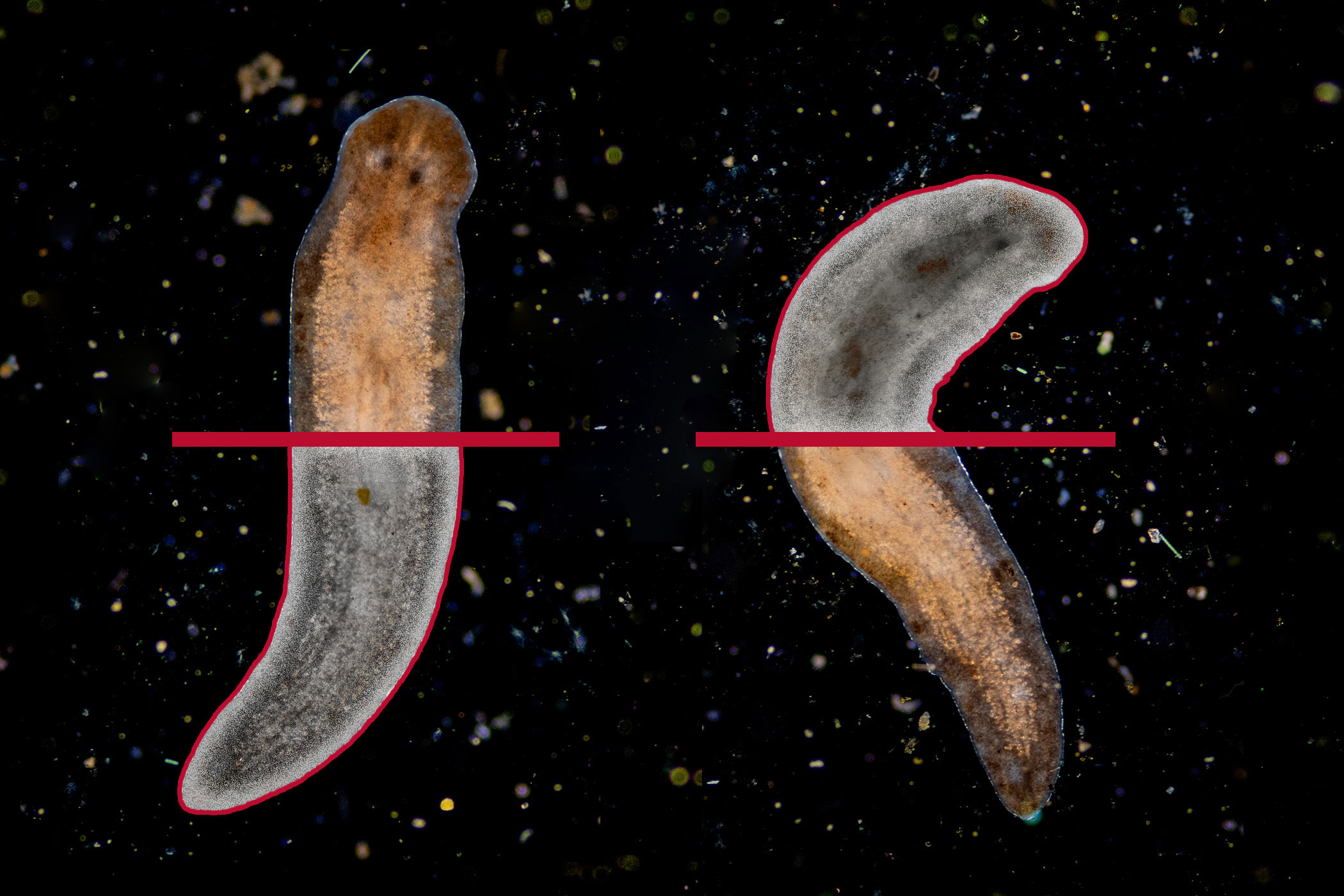
- Planarians carry stem cells that become whatever the animal needs, and from a sliver of tissue they regrow tissues, muscles and a whole brain.
Compiled by The ScientistSomething wrong?How this is made
Why it matters
- capability Cell-therapy protocols get a second variable they can specify alongside transmitter output: where the new neurons end up, instructed by factors the worm coordinates with identity.
- constraint Position in a planarian is defined against planarian anatomy, so a program aiming at the human substantia nigra inherits a design principle here and still has to find its own coordinates.
- contradiction Readers who take "almost a dozen genes" from the press accounts will assume more functional evidence than the paper's ten-identified, six-characterized wording supports.
The team chose a single cell type on purpose. The authors wrote that "the full pathway from pluripotent stem cell to mature neuron has not been determined for any cell type in the planarian nervous system," and they worked on dopaminergic neurons because the type is conserved. That choice also buys a behavioral readout, since dopamine helps control movement.
The result in the paper's title is combinatorial. "Our results demonstrate that planarian neurogenesis requires coordination of factors that initiate neurotransmitter choice and regional location," the authors wrote. Their characterized set contains factors that regulate neurotransmitter identity and factors that regulate cellular location. For a transplant program those are two distinct requirements. A graft that releases dopamine can still sit in the wrong region, and the planarian factors reach both.
The gene count differs between the press accounts and the paper. Neuroscience News, GEN and Phys.org each describe almost a dozen genes. The paper's own summary, quoted by GEN, is narrower: "Altogether, we identified ten genes and characterized six genes critical for specifying mature dopaminergic neurons throughout the planarian nervous system, identifying factors that regulate both neurotransmitter identity and cellular location." Ten is two short of a dozen, and four of the ten sit outside the characterized six.
Knocking out some of the genes did two things at once. The worms struggled to make new dopamine-producing neurons, and their movement slowed in a way the three accounts compare to low dopamine in people and other mammals. Neuroscience News goes further, describing the slowing as mimicking motor symptoms seen in Parkinson's disease. In people, it is the progressive degeneration of dopamine-producing neurons in the substantia nigra that produces resting tremor, rigidity and bradykinesia, while the planarian factors specify dopaminergic neurons throughout that animal's nervous system. None of the three accounts lists the identities of the ten genes or the number of animals tested.
Human neural progenitors do not differentiate and integrate into existing circuits well enough to heal substantial damage. "It's not an inherent property of brains that makes them bad at regeneration. It's something specific to humans," said Rachel Roberts-Galbraith, the study's senior and corresponding author. The paper's translational line is written as a suggestion: "Our work suggests that combinatorial instruction of cell type and spatial identity could improve exogenous stem cell therapies aimed at precisely replacing neurons after localized injuries." Roberts-Galbraith was plainer about the hope. "We're hoping this work helps others figure out how to create dopamine-producing neurons from stem cells that can be more effectively transplanted into patients," she said.
What to watch
- Whether mammalian orthologs of the six characterized factors do the same job in human stem-cell-derived dopaminergic neurons.
- Whether adding the positional factors changes where grafted dopamine neurons settle in a lesioned rodent brain.
- Whether a follow-up characterizes the four identified genes left outside the functional set of six.