Science1 distinct publisher2 min readPublished
FLARE keeps memory inside the optical layer, holds state for 7.45 seconds, and reports a system-level energy figure that inverts to about 16 peta-ops per watt. The operation itself is undefined.
The Scientist · Science desk

Compiled by The ScientistSomething wrong?How this is made
Invert the headline figure and it becomes easier to hold: 61.87 attojoules per operation is about 1.62 x 10^16 operations per joule, roughly 16 peta-ops per watt measured at system level [5][1]. How much that means depends on what counts as an operation, and the abstract does not say [11].
The retention spec is the part that is hard to get any other way. Gigahertz short-term dynamics alongside 7.45 seconds of long-term retention puts about ten orders of magnitude between the two timescales: one cycle of a 1 GHz process lasts a nanosecond, and 7.45 seconds is 7.45 billion of them [3][2]. The authors' own framing is that the architecture exists to attack the tradeoffs among speed, efficiency and scalability [8].
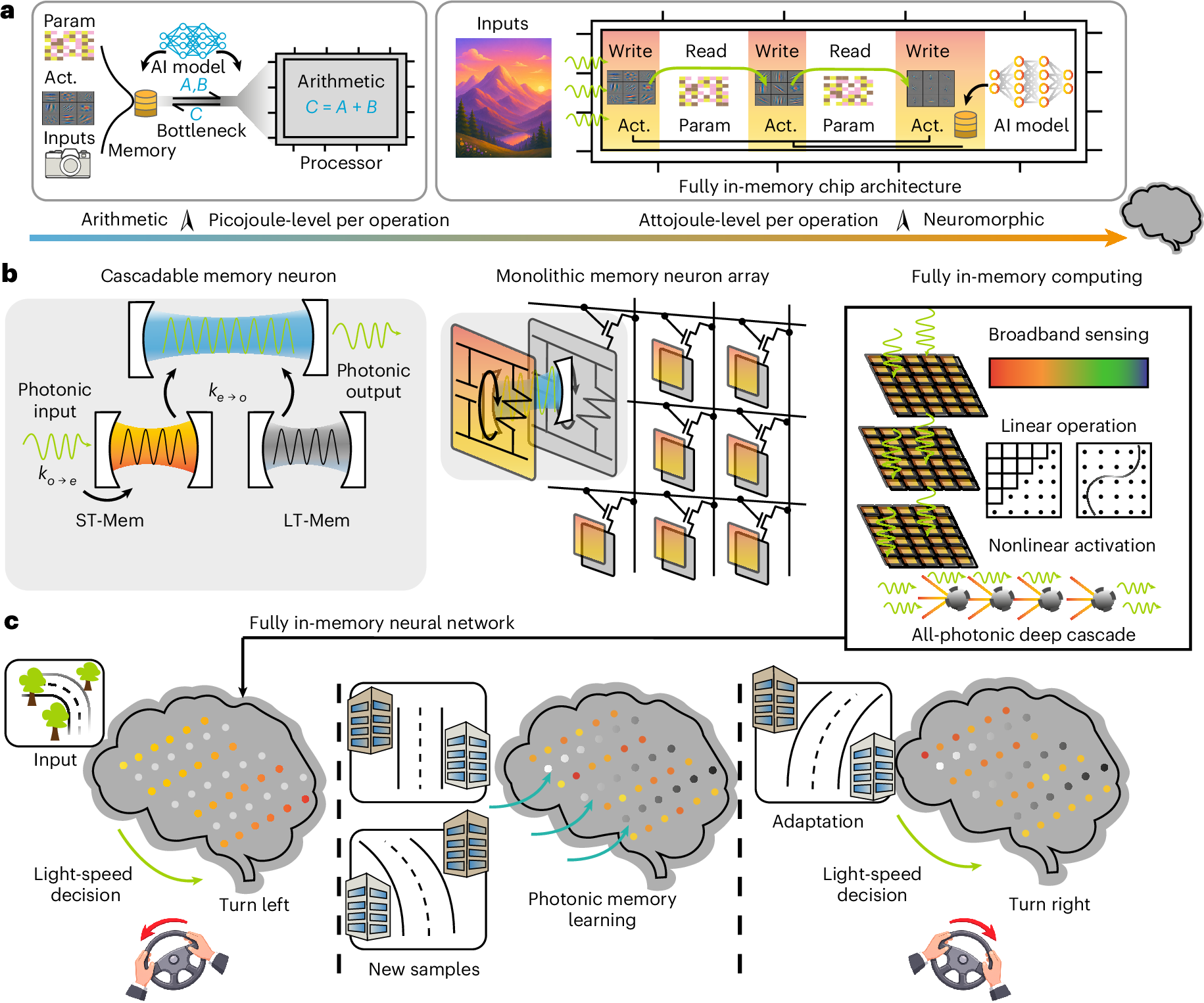
The construction described is a coupling of photonic and electronic mechanisms into reconfigurable neurons that carry both memory timescales [1]. The word "fully" is doing specific work there. It does not claim photons alone store everything; it claims the external digital memory that normally holds sensory inputs and intermediate activations, which the authors call throughput-limited and efficiency-constrained, is out of the loop [7].
What the drone result establishes is narrower than the number suggests. The abstract reports sensing, exploration and adaptation for autonomous racing-drone navigation [4] without saying whether a physical aircraft flew [12], and it does not state how the ten-core multilayer system relates to the 7,378-neuron chip, nor how many neurons sit in each core [13][2]. The full text costs $39.95, or $119 for a year of the journal [6], so for most readers the checkable record is one paragraph.
The reference list is candid about the setting. It cites Horowitz's 2014 accounting of computing's energy problem [10], which is where the case for in-memory anything starts: shifting data costs more than operating on it. It also cites a 2026 Nature Photonics commentary on the thin line optical neural networks must walk toward broad practical relevance [9]. A group that cites that commentary and then reports a navigation task with adaptation in it is answering the charge rather than dodging it.
So the attojoule figure is internally consistent rather than comparable. Nobody outside the author list can yet multiply it by an operation count and get the energy of one flight, which is the quantity a system designer would budget against. That is a limit of what has been published, not necessarily of the hardware.
Ranked by verification strength, evidence, and original report placement.
FLARE is described as a fully in-memory large-scale photonic computing architecture that couples photonic and electronic mechanisms to realize reconfigurable photonic neurons with long- and short-term memory, enabling integrated sensing, processing and memory in a deep nonlinear neural network.
The authors demonstrate a monolithic 7,378-neuron multicore chip.
The chip achieves 7.45-s long-term memory retention while preserving GHz short-term dynamics.
On the basis of a ten-core multilayer FLARE system, the authors demonstrate sensing, exploration and adaptation for autonomous racing-drone navigation.
The reported system-level energy cost for that demonstration is 61.87 attojoules per operation.
The article page offers the paper for USD 39.95, or a journal subscription at $119.00 per year for 12 digital issues and online access.
Follow any of these and your For You feed starts watching them — no settings page required.
Evidence-backed comparisons of source perspectives and observed adoption signals. Read the methodology
Which Builder, Operator, and Investor concerns the observed source mix emphasized—not a truth score.
Evidence, demonstrated adoption, hype gap, incentives, and confidence are assessed independently, each on its own current evidence. How these are measured.
Primary peer-reviewed source, abstract-only visibility
The claims come directly from a peer-reviewed journal paper rather than a vendor announcement, which is a strong provenance floor. But only the abstract, access block and reference list are accessible: the definition of an 'operation', the measurement methodology, the drone-demonstration setup and the relationship between the ten-core system and the 7,378-neuron chip are all absent from the readable text, and there is no second source or independent replication in the cluster.
No adoption signal beyond the authors' own demonstration
The supplied material contains only self-reported laboratory results from the originating team. There is no release, availability, deployment, third-party usage disclosure or independent benchmark of FLARE in the cluster, so adoption cannot be scored without inference.
Precise numbers outrunning the accessible record
The framing is comparatively restrained for the genre -- the paper claims a 'pathway towards' brain-like perception rather than a finished product, and its reference list includes a critique of optical neural networks' practical relevance. The overstatement sits in the numbers: a four-significant-figure energy metric with an undefined denominator and no digital baseline, and a drone-navigation result whose physical scope is unstated, invite far stronger comparative conclusions than the accessible text can support.
Publication and paywall incentives, no vendor commercial stake visible
Incentives are academic and editorial rather than commercial: authors and journal both benefit from headline-grade figures in a high-visibility venue, and the publisher charges USD 39.95 per article or $119.00 per year for the methods that would substantiate them. The supplied material discloses no vendor, funding or product interest, so no stronger distortion pressure can be evidenced.
Moderate-low: one publisher, self-reported, partly readable
Confidence is limited by a single-source, single-publisher cluster in which the only readable text is the originating team's own abstract. What is stated is stated clearly and is peer-reviewed, so the existence of the claims is certain; their interpretation, comparability and real-world scope are not.
science
A parameter-free tree replaces UMAP, and turns up an NK cell subtype from the myeloid lineage1 distinct publisher
build
Two vendor counters, no benchmark: 1,816 parcels an hour is not a procurement number1 distinct publisher
science
A compact Fanzor2 editor beats Cas12f 2.6-fold, which puts the class average near 13%1 distinct publisher
science
Nature Perspective: patching one fact into a model leaves the reasoning around it broken1 distinct publisher
Distinct publishers with included, body-backed reporting in this cluster.
1 article · August 26, 2026