Loading today’s stories
Science1 distinct publisher2 min readUpdated
A compact Fanzor2 editor beats Cas12f 2.6-fold, which puts the class average near 13%
EvoMax, a sparse-data model loop, produced FanzMAX v3-hLa at roughly 33% mean editing across 19 loci. The headline 97% is one locus, and the mouse work arrives without a number.
The Scientist · Science desk
What happened
- Fanzor2 (Fz2) nucleases are RNA-guided DNA endonucleases encoded in eukaryotic genomes, typically under 500 amino acids, and are described as well suited for single-AAV delivery.
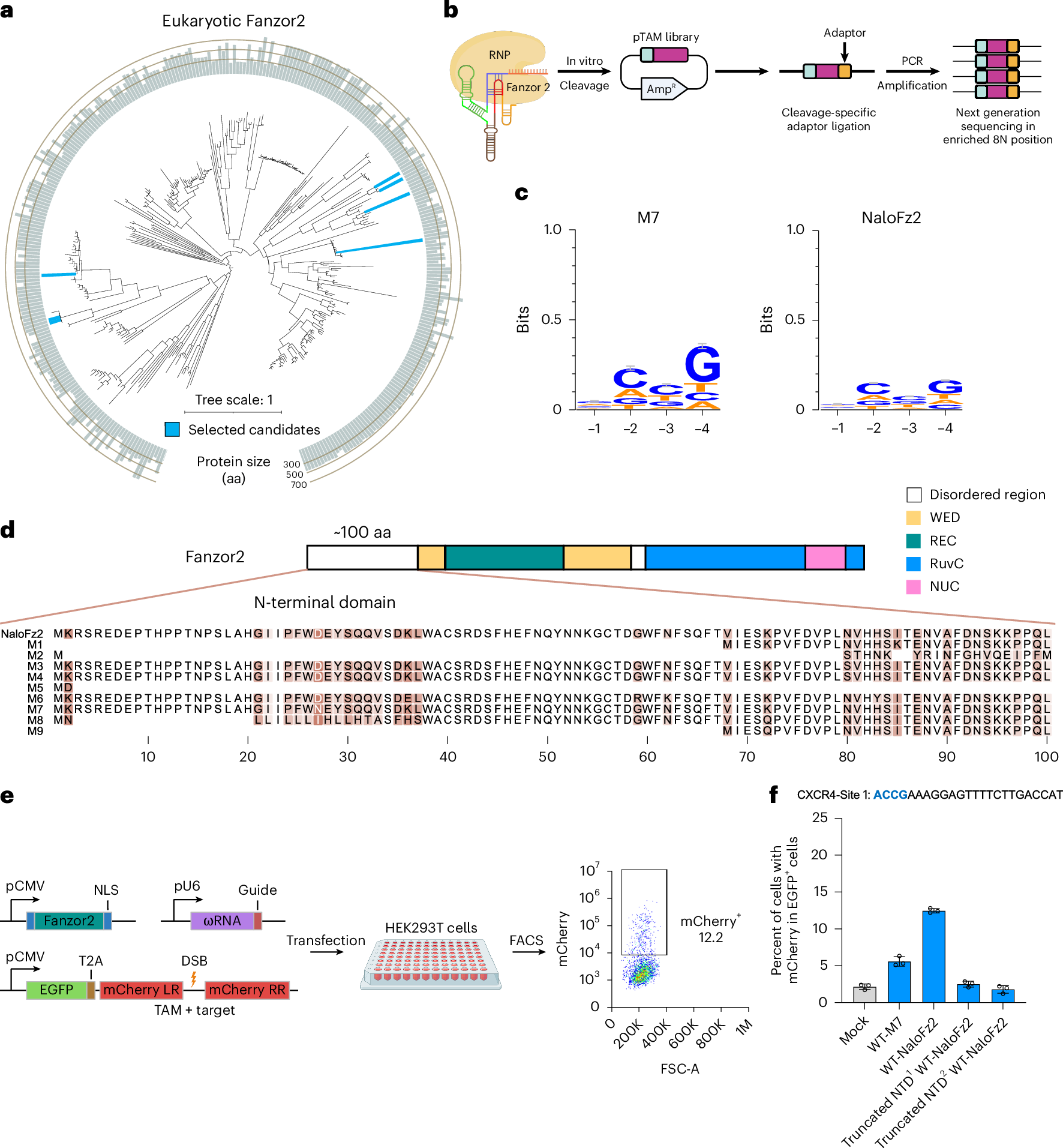
- The authors computationally prioritized and experimentally validated several active eukaryotic Fz2 orthologs from a pool of over 1,600 candidates.
- EvoMax is a model-guided prioritization pipeline that integrates iterative experimental profiling with transfer-learning Gaussian process regression, a protein language model (ESM-2) and an inverse folding model (ESM-IF) to prioritize candidate mutations.
- FanzMAX v3-hLa achieved up to 97% editing efficiency at its best-performing endogenous locus.
- FanzMAX v3-hLa achieved a mean editing efficiency of about 33% across 19 endogenous loci.
Compiled by The ScientistSomething wrong?How this is made
Why it matters
Work the margin backwards and the compact-editor field looks thinner than the press language around it. If the claimed 2.6-fold advantage is measured on the panel mean of about 33% [5][6], the engineered incumbents enNlovFz2 and enCnCas12f1 were sitting near 13% on the same 19 loci [13]. That is the number the paper does not print, and it is the one that decides whether a delivery-limited program has been waiting for a better small nuclease or for a different modality entirely.
The 97% figure is one locus, the best-performing one [4], and it sits about 2.9 times above the panel average [14]. Locus-to-locus spread that wide is the normal condition for compact nucleases, which the authors themselves describe as hard to push to consistently high activity in bulk mammalian cells [12]. So the useful read of FanzMAX v3-hLa is not the maximum but the shape: a family that was previously characterized well enough to publish and not well enough to engineer [12] now has a member with a usable mean.
There is an attribution problem in the gain. The reported roughly tenfold improvement in endogenous editing came from optimizing the effector in combination with parallel engineering of the omegaRNA scaffold [8][9], and the same paper faults earlier Fanzor2 work for leaning on scaffold-specific strategies [11]. From what is visible, you cannot apportion the tenfold between the protein loop and the RNA. Anyone hoping to point EvoMax at the next freshly mined nuclease family and have the model half carry the result is extrapolating past the evidence.
EvoMax itself is the durable part: transfer-learning Gaussian process regression stacked on ESM-2 and ESM-IF, prioritizing mutations round by round against experimental profiling [3], aimed squarely at the case where a family has no large mutational dataset to train on [10]. The Fanzor2 ortholog pool it worked from was over 1,600 candidates, of which several were experimentally confirmed active [2].
The in vivo result deserves its hedge. Editing of hPCSK9 in humanized mice is reported as supporting translational potential [7], with no efficiency figure in the abstract. That establishes the enzyme cuts in an animal. It does not establish that a single vector dose reaches a therapeutic editing fraction, and the difference between those two statements is most of the development cost.
What has changed is that the compact class has two live engineering lineages instead of one, and the Fanzor branch got there without a deep mutational scan in front of it.
Loading topic controls
Loading related stories