Product1 publisher3 min readPublished
Azora's portable optical receiver latched onto Orion's signal from 240,000 miles
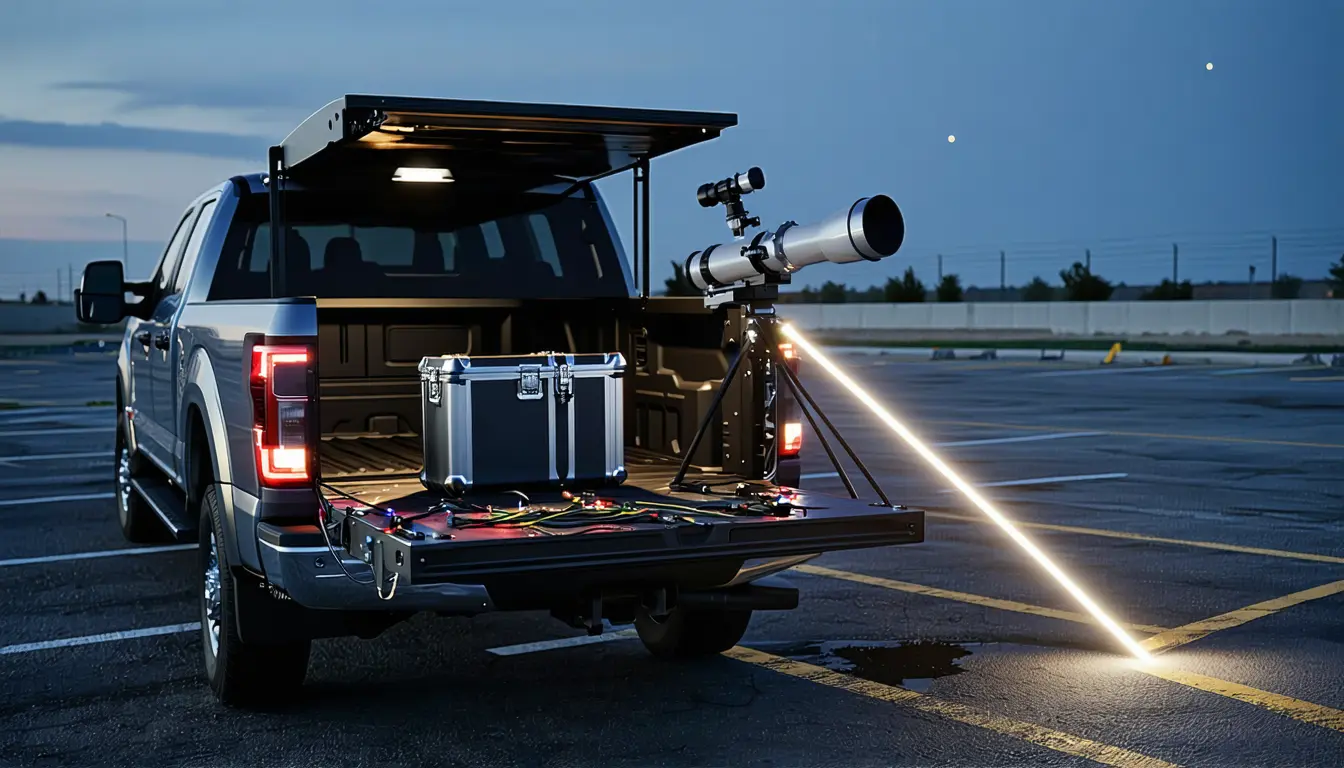
Azora says its portable optical ground receiver latched onto Artemis II's Orion capsule at 240,000 miles, working from a California parking lot. The result shows a drivable terminal can pick up a signal at lunar range, though buyers will want its data rate and price before signing up for a pilot.
The Product Desk · Product desk
What happened
- The receiver was conceived during a two-week sprint and had previously been tested successfully only on a link to a geostationary satellite about 22,000 miles away.
- Azora's team drove about 600 miles from its Phoenix base to a spot next to NASA's Optical Communications Laboratory outside Los Angeles to make the attempt.
- DCD reports that the live high-definition video Artemis II sent back over ten days would not have been feasible over a traditional radio link.
- The University of Suffolk in the UK has set up a laboratory as a testbed for developing more reliable laser beams for space communication.
Compiled by The Product DeskSomething wrong?How this is made
Why it matters
- decision Any pilot decision now weighs Azora's distance result against the data rates incumbents publish, and it cannot be settled until Azora states a sustained throughput for its link.
- constraint Weather still decides whether a portable terminal can see its spacecraft on a given night, so an optical ground link's availability depends on site and sky as much as on the hardware.
- capability Defense operators working under radio jamming are the clearest customers for a road-portable optical terminal, provided Lavery's jam-resistance claim holds up in a test the Orion lock did not include.
At 2:50am, as Orion came out from behind the Moon, the receiver in the parking lot locked onto its signal [4]. The capsule was about 11 times farther away than the geostationary satellite in the receiver's only earlier successful test [1].
The pitch is cost-effective optical communication between space and Earth [3], and Azora says the lock proves its system can support an optical link at 240,000 miles [5]. That night, a new receiver found a signal at lunar distance and locked onto it [4]. The published account of the test does not include a data rate for the link or a price for the receiver.
A ground-station team needs those two figures before it can defend a pilot budget. Honeywell supplies one of them for its own product. It says its Transportable Optical Ground Station, a shipping container with a retractable telescope, provides a 1Gbps link to low Earth orbit satellites [13]. Honeywell's figure is a data rate to low orbit, while Azora's headline figure is a distance to the Moon. The Honeywell station also supports the BB84 quantum key distribution standard [14], and UK startup Archangel Lightworks has built a station that is a lot smaller [15].
Azora's work is aimed at cost and deployability [17]. Optical signals can still be disrupted by adverse weather [8].
Azora's CTO describes a military buyer. "RF denial is a big problem," said Martin Lavery, who is also professor of optics at the University of Glasgow [10] [12]. "It's likely any future conflicts will involve some form of RF denial, because that in turn hits GPS, and our communication with satellites and other units," he said [16]. Of a laser link, he said, "The only way to stop it is to stand right in the middle of the beam" [11]. He is describing a product category his own company sells [12].
For a team making the choice, the case sorts on two axes. The first is whether radio is the bottleneck, either on volume or because someone can jam it. The second is whether the operation can wait out a cloudy night. If radio is not the bottleneck, stay on RF, whatever distance the demo reached. If it is and the operation can wait, a portable optical terminal is a reasonable pilot, priced against Honeywell's container once Azora states a sustained data rate. If it is and the operation cannot wait, the plan needs more than one site or an RF fallback, and portability should be judged by how quickly a terminal can be moved.
I'd put Azora in the pilot box. The tradeoff is early access to hardware with one deep-space result behind it, set against waiting for the throughput number that would let anyone compare it with the alternatives.
What to watch
- Azora publishing a sustained data rate and unit price for the receiver, the figures needed to compare it with Honeywell's 1Gbps station.
- Results from the University of Suffolk testbed on laser beams that stay reliable in adverse weather.
- A defense pilot that tests Lavery's claim that an optical link can only be stopped by standing in the beam.