Science1 distinct publisher3 min readPublished
Ohio State researchers filmed sooty mangabeys in Ivory Coast and measured midfoot flexion that matches a climbing chimpanzee's ankle, which means a fossil foot that looks monkey-like cannot by itself rule out vertical climbing.
The Scientist · Science desk

Compiled by The ScientistSomething wrong?How this is made
Follow any of these and your For You feed starts watching them — no settings page required.
product
Geologic hydrogen's firmest numbers come from mine vents, not reservoirs1 distinct publisher
science
Two Neanderthal pelvises suggest the strange hip belongs to the modern human male1 distinct publisher
science
Simulations show the fastest earthquake ruptures shake harder than hazard models assume1 distinct publisher
science
Odor mixtures get a benchmark: 0.08 median error, 0.57 correlation, 96 pairs of evidence1 distinct publisher
The two figures come from different joints. That difference is the entire argument. In a climbing chimpanzee, the upward flexion of roughly 45 degrees happens at the ankle [4]. In a sooty mangabey, whose ankle lacks that mobility, it happens further forward: Luke Fannin measured as much as 46 degrees in the midfoot as the animals went up narrow trunks [6][7].
The one-degree difference between those two numbers [16] should not be read as the monkey winning. Both are maxima, both come from animals moving in different bodies, and the honest reading is the one Fannin gives, which is functional equivalence rather than superiority [9]. Set against a human ankle's roughly 20 degrees [5], the mangabey midfoot bends about 2.3 times as far [15].
What this does to paleoanthropology is narrower than a reconstruction. It is also more useful. The inference under pressure has the logical form of a necessary condition: some accounts hold that an ape-like foot was required for effective vertical climbing, while others allow a more monkey-like ancestor [12]. A single living animal doing the thing without the trait is enough to retire the requirement. It is not evidence about what the last common ancestor did, only the removal of one reason to say what it could not have done, and that distinction matters most precisely when a fossil foot is the only foot available.
This measurement leaves open how often, or at what cost. A peak joint angle during a successful climb measures none of force, tendon stress, energetic expense, or margin for error; reaching 46 degrees of midfoot flexion shows only that the movement is possible, not that it is as economical or as safe as a chimpanzee's climb. The Ohio State release also does not give the number of animals or climbing bouts behind the measurement [17], so the shape of the distribution behind that maximum is not yet public. Those are questions for the paper in the Proceedings of the National Academy of Sciences [3], not objections to it.
The design deserves credit on its own terms. These were wild animals climbing for their own reasons, foraging, hiding, or heading for a sleeping site [13], filmed at the Taï Forest Monkey Project field station in Ivory Coast [2]. Senior author W. Scott McGraw's point is that the video resolves what the joint is actually doing under load, where before the field had hunches [10]. Monkeys had long been cast as arm-driven climbers [11], and that assumption was doing quiet work in arguments about a divergence 6 to 7 million years old [8] and about how habitual bipedalism, which only humans practice regularly, got started [14]. My view: the necessary-condition claim is spent. The positive case for a vertical-climbing ancestor stands exactly where it stood yesterday.
Ranked by verification strength, evidence, and original report placement.
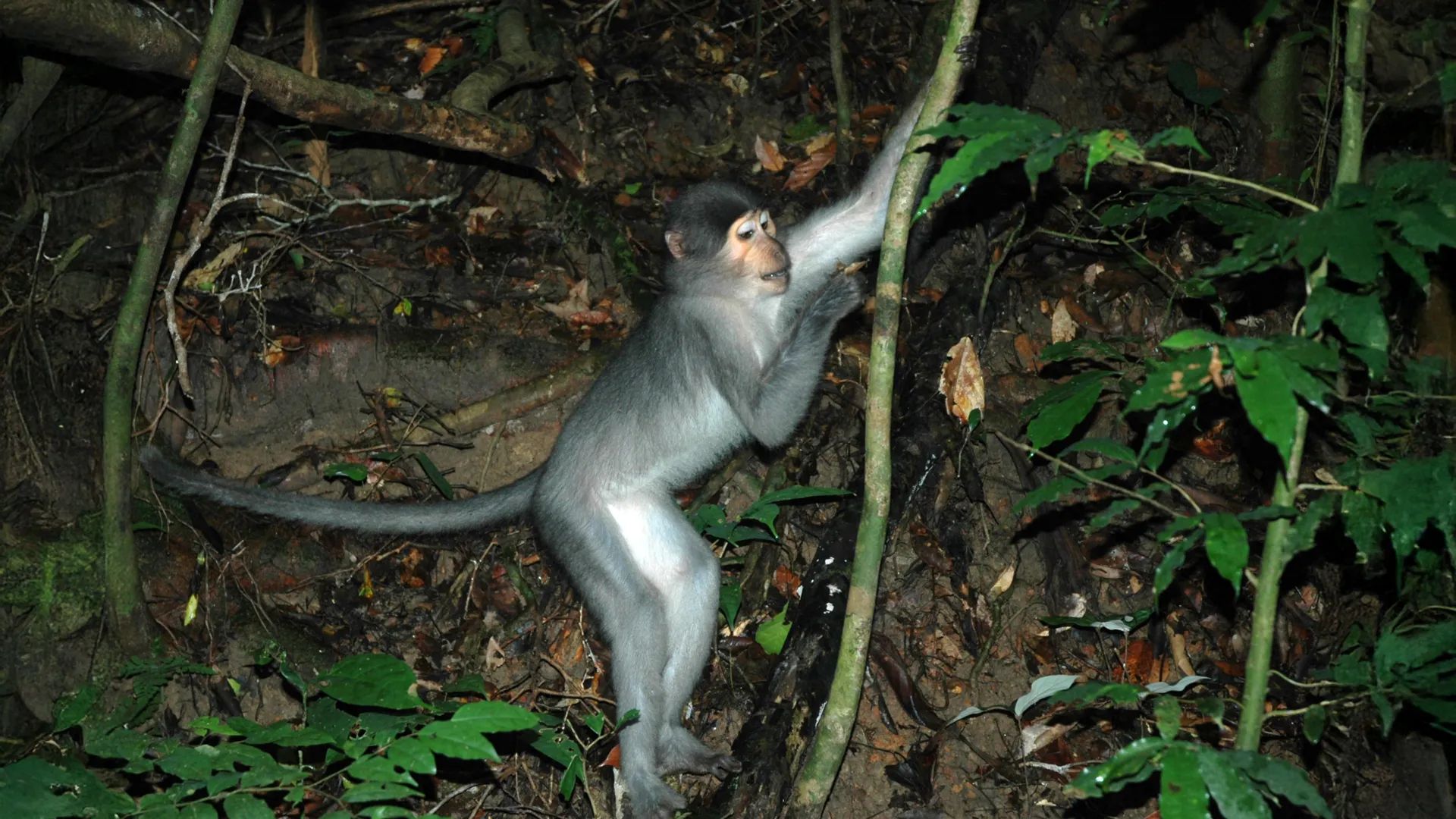
Researchers from The Ohio State University studied wild sooty mangabey monkeys in West Africa and found the animals can bend parts of their feet enough to climb narrow vertical tree trunks.
First author Luke Fannin, assistant professor of anthropology at Ohio State, collected video of wild mangabeys at the Tai Forest Monkey Project field station in Ivory Coast.
The research appears in Proceedings of the National Academy of Sciences, according to an Ohio State University release dated August 31, 2026.
During a tree climb, a chimpanzee ankle can flex upward by about 45 degrees.
Fannin measured as much as 46 degrees of flexion in the mangabeys' midfoot while they climbed vertically.
Distinct publishers with included, body-backed reporting in this cluster.
1 article · August 31, 2026
Evidence-backed comparisons of source perspectives and observed adoption signals. Read the methodology
Which Builder, Operator, and Investor concerns the observed source mix emphasized—not a truth score.
Evidence, demonstrated adoption, hype gap, incentives, and confidence are assessed independently, each on its own current evidence. How these are measured.
Peer-reviewed paper, single promotional account
Every figure in play — 46 degrees at the mangabey midfoot, about 45 at a climbing chimpanzee ankle, roughly 20 at a human one — reaches readers through Ohio State's own announcement, which ScienceDaily reprints. PNAS review sits behind the work, which counts for something. What is missing is small and decisive: no number of animals, no number of climbs, no range around that 46. A peak with no denominator can be true and still not bear the weight put on it.
Nothing yet showing the field move
A publication notice is not uptake. Nobody in our sourcing cites the paper, reanalyses a fossil foot in light of it, or says on the record that it changes how they read one, so there is no honest number to put here.
Headline outruns the measurement
"Fossil feet may be misleading scientists about human evolution" is a large sentence to hang on one peak angle from an undisclosed sample, and the 46-versus-45 arithmetic invites a reading — monkeys beat apes — that the researchers never make. The overreach is in the packaging rather than the science: McGraw's line that the paper "adds clarity, but it also makes the broader picture more fuzzy" survives in the text and is the more accurate headline.
University press office to wire, unbroken
A communications office is writing about its own department chair and one of its assistant professors, and the story travels through a service that republishes such releases with the source credit attached. That is a normal and useful route for research to reach readers. It also means no one between the field station and the reader had any reason to ask how many monkeys were filmed.
Direction credible, detail loose
Named researchers on the record, a peer-reviewed venue and a specific field site pull this upward. A single promotional origin, no outside expert, and no reported sample pull it back. Our read: the argument that a monkey-like foot cannot by itself rule out vertical climbing is likely to hold; the tidy 46-against-45 comparison is the part to hold loosely.