Science1 distinct publisher3 min readPublished
A Caltech dynamic rupture model finds sustained supershear earthquakes shake harder and longer than comparable subshear ones, a difference the ground-motion equations behind infrastructure codes do not contain.
The Scientist · Science desk

Compiled by The ScientistSomething wrong?How this is made
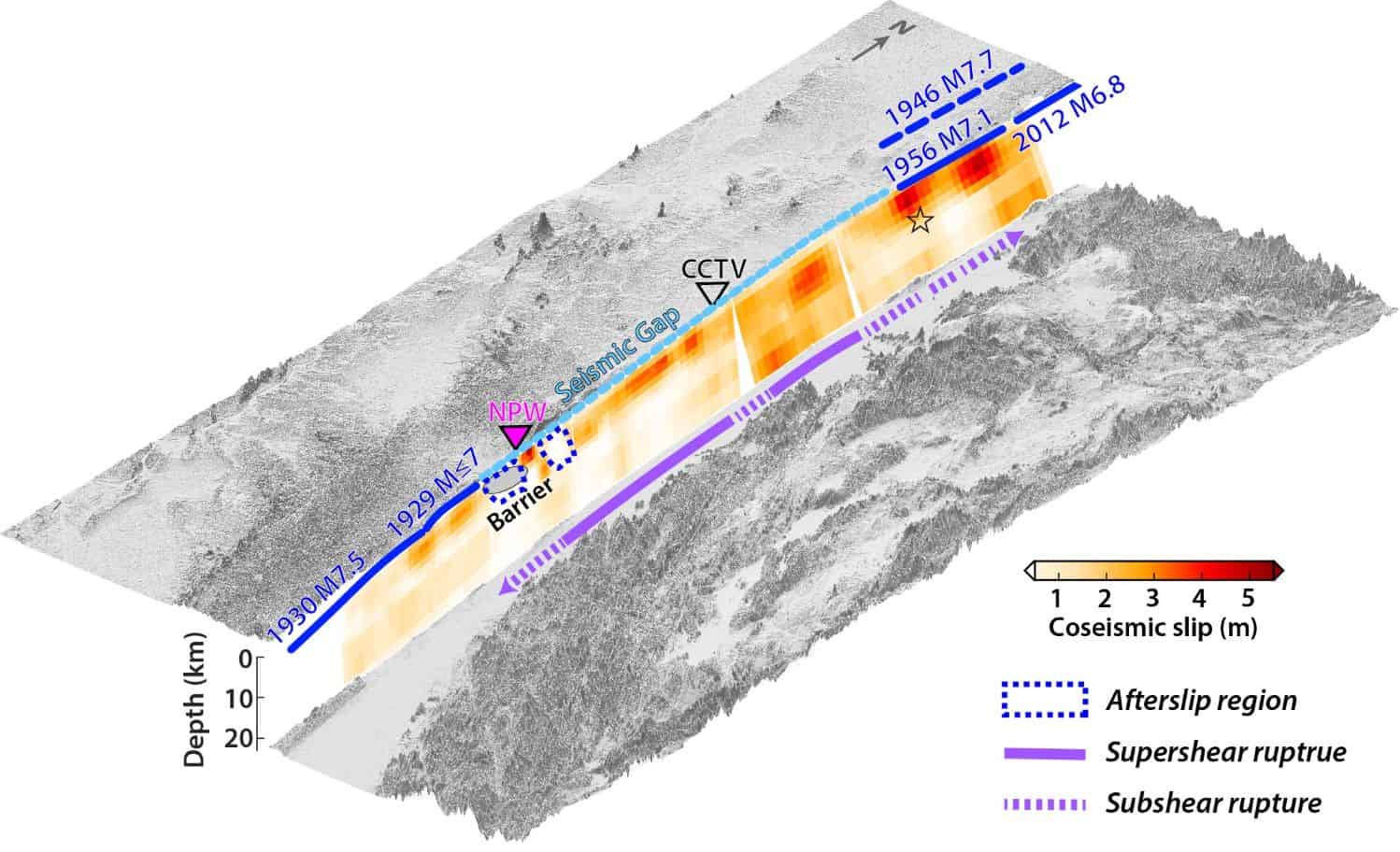
The friction sits inside the same body of work. Abdelmeguid's model separates two behaviours rather than one: prolonged supershear propagation, which leaves what the authors call a distinct spatial pattern of stronger and longer-duration shaking, and episodic supershear, where the rupture flickers above and below the shear-wave speed and the resulting ground motion resembles an ordinary subshear event [2][3]. Ye's group, reconstructing the 2025 Sagaing rupture from satellite observations, teleseismic records, CCTV footage and whatever near-fault instruments Myanmar had, reports the flickering kind [13][14]. Myanmar is also the event held up as the reason hazard models need revising, because many areas shook harder than expected [10][6]. Both readings can stand; reconciling them is the actual work.
That changes how the 36% should be read. It counts strike-slip earthquakes over the past 15 years that contained supershear rupture, roughly one in three by that tally [7][19]. Containing a supershear segment is not the same as sustaining supershear along the fault, and sustained propagation is the condition the model ties to amplified, extended shaking [2][3]. The Sagaing rupture Ye's team resolved covered about 38% of that fault's mapped 1200 km length [18], long enough for the distinction to matter, and earlier studies still could not agree on which it was [11].
Simulations are being used here precisely because some supershear scenarios are thin in the observational record, and that record is the material from which ground-motion models are built [8]. A correction argued from physics will therefore be slow to confirm against data, which is an argument for doing the physics, not against it.
This does not produce a number to put in a code, an amplitude factor or added seconds of strong motion that an engineer could fold into a design spectrum. What the modelling identifies instead is a class of event that current equations treat as interchangeable with slower ruptures, when it is not [1][6]. Supershear has been theoretically expected since the 1970s and observed in the laboratory and the field, with most prior work chasing the mechanism and the subshear-to-supershear transition rather than the shaking that results [16].
My reading, with its conditions attached: treat sustained supershear as a genuine gap in ground-motion prediction, and treat it as a segment-level geometry question rather than a blanket uplift on strike-slip hazard. Fault irregularity appears to govern rupture speed [17], and Ye's team computed a fault misalignment parameter from an existing fault model [15], which is the kind of quantity you can map before an earthquake rather than infer after one. If most supershear runs turn out episodic, the correction is small and local. If geometry reliably marks the segments that can sustain it, the correction belongs on those segments specifically.
Ranked by verification strength, evidence, and original report placement.
Models of ground motion that underpin infrastructure standards do not account for the supershear effect, so these models may need to be updated to describe hazards such as the 2025 Myanmar earthquake, which produced supershear ruptures in both directions.
Using physics-based models, Mohamed Abdelmeguid and colleagues at the California Institute of Technology showed that supershear ruptures produce stronger and longer-duration ground motion than equivalent subshear ruptures.
The team's dynamic rupture model found that prolonged supershear propagation produces what they term "a distinct spatial pattern of stronger and longer-duration shaking".
Episodic supershear segments, where rupture speed intermittently changes between supershear and subshear, produce ground motion similar to subshear ruptures.
The Caltech study appears in the Bulletin of the Seismological Society of America.
A rupture travelling faster than the shear-wave velocity of the surrounding ground is termed supershear; otherwise it is subshear.
Distinct publishers with included, body-backed reporting in this cluster.
1 article · August 28, 2026
Follow any of these and your For You feed starts watching them — no settings page required.
science
Caltech model says fast-dividing tissue may be proofreading, not just accumulating risk1 distinct publisher
product
Geologic hydrogen's firmest numbers come from mine vents, not reservoirs1 distinct publisher
build
Accelerated Understanding bets against the transformer. Simulation teams have nothing to test yet.3 distinct publishers
science
A new dish at Goldstone buys NASA about nine percent more mid-size aperture1 distinct publisher
Evidence-backed comparisons of source perspectives and observed adoption signals. Read the methodology
Which Builder, Operator, and Investor concerns the observed source mix emphasized—not a truth score.
Evidence, demonstrated adoption, hype gap, incentives, and confidence are assessed independently, each on its own current evidence. How these are measured.
Two peer-reviewed papers, one reporter
Two refereed studies sit under this — Caltech's in the Bulletin of the Seismological Society of America and Ye's in PNAS — and the Myanmar reconstruction leans on unusually varied inputs, including satellite observation, teleseismic records, CCTV footage and whatever near-fault instruments existed. The ceiling comes from three things: the amplification result is simulated rather than measured, the number doing the most persuasive work (36% of strike-slip quakes over 15 years) arrives as a bare quote, and Physics World is the only account we have of either paper.
Nothing has reached a code yet
The only concrete events are two papers appearing in print. No building code, national hazard map or ground-motion prediction equation is described as absorbing a supershear term — Abdelmeguid's whole point is that they have not. Even the instrumentation that would let engineers confirm the effect locally is reported as absent outside a handful of countries, so the practical uptake here is close to zero and the story is honest about that.
The showcase quake undercuts the headline
The promise — the fastest ruptures shake harder than hazard models assume — is exactly what the Caltech simulations found, for sustained supershear. But the case study carrying the piece's emotional weight is the other kind: Ye's reconstruction has Myanmar flipping in and out of supershear across some 460 km, and Caltech's own result says episodic supershear shakes about like subshear. The deadliest earthquake in the story is therefore weak support for the code-revision argument stacked on top of it. The overreach is in the assembly, not in either paper.
Every voice here is an author
Both quoted scientists are authors of the work being described, and one is arguing that the models everyone else relies on should be changed to include his effect. That is an ordinary scientific position, not a disinterested one, and Physics World brings in no engineer or rival modeller to press on it. There is no sign of commercial stake anywhere — the pull is professional and disciplinary rather than financial, which keeps this in the middle of the range rather than high.
Old physics, single witness
Direction of travel is credible: supershear was predicted in the 1970s, has been produced in the laboratory and seen in the field, and faster rupture shaking harder is not a surprising result. What limits us is arithmetic rather than doubt — one outlet, two papers we cannot read here, and every quantitative detail (36%, 460 km, 80 km north and 380 km south) unchecked by a second account.