Science1 publisher2 min readPublished
Sugar-binding fluorescent probes pick out insulin-deficient zebrafish from healthy siblings
University of Bath researchers' boronic-acid probes detected glucose changes in living zebrafish and told insulin-deficient fish from healthy siblings. The work shows sugar can be read optically in a live vertebrate, though the clinical uses the team describes are still untested.
The Scientist · Science desk
What happened
- The probes pair boronic acids, which selectively bind sugars, with multiphoton fluorescence lifetime imaging microscopy.
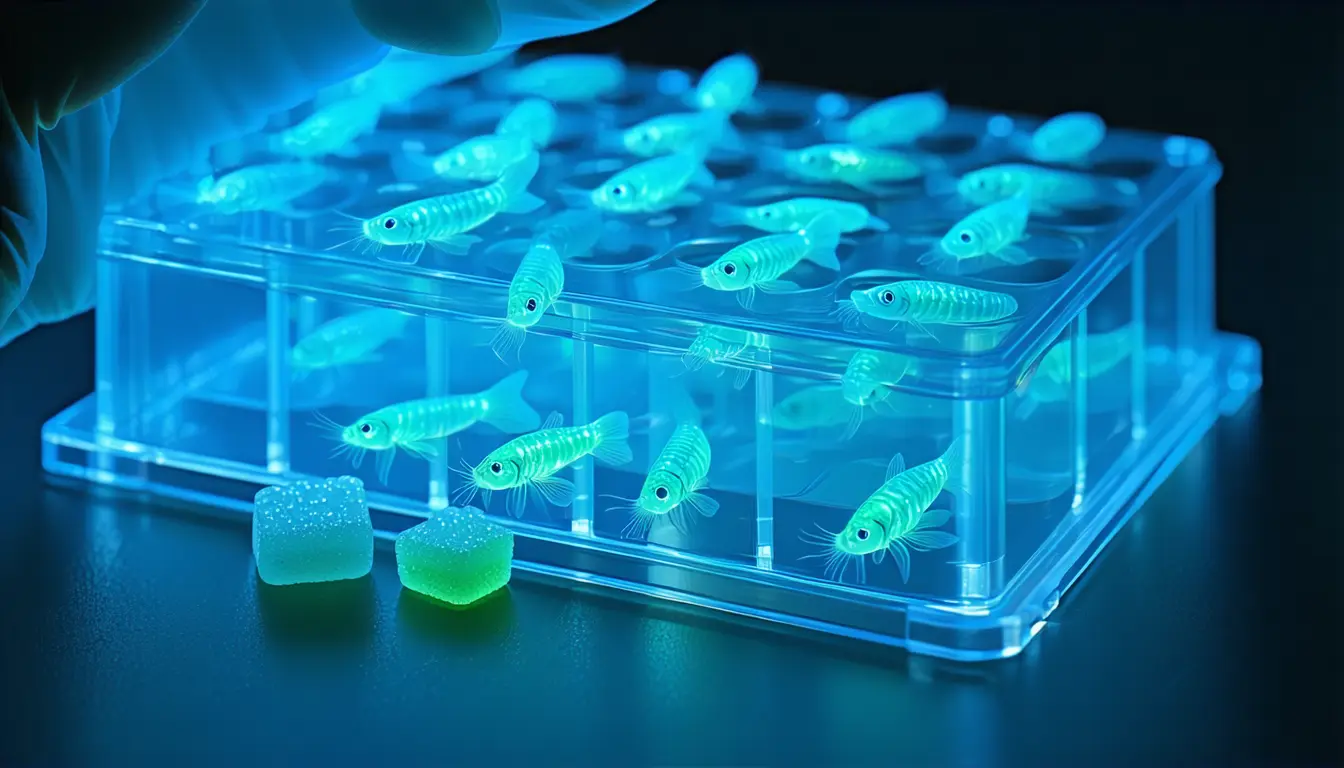
- In zebrafish larvae several probes gathered strongly in the digestive system, where their fluorescence changed after an external glucose challenge.
- Fish carrying the diabetes-like mutation showed significantly reduced fluorescence, a drop the team attributes to their elevated glucose.
- The work involved Bath, Birmingham, Universidad Autonoma de Madrid, Spain's CSIC and the STFC Rutherford Appleton Laboratory.
Compiled by The ScientistSomething wrong?How this is made
Why it matters
- constraint The readout depends on multiphoton lifetime microscopy, so a lab that wants to use the probes needs that instrument as well as the chemistry.
- constraint Because the probe dims as glucose rises, other causes of a dimmer signal in a sick fish could pass for high sugar until the team shows they are ruled out.
- decision Groups weighing the probes for the drug-screening use the Bath team is exploring will want cohort sizes and effect sizes before building assays around them.
Comparing mutant fish with their own healthy siblings [6] is the control I would look for first in a genetic disease model. The Bath team ran it alongside a second, separate test. In the first, the sugar came from outside the animal [5]. In the second, nothing was added, and the difference came from a mutation that leaves the fish short of insulin [6]. "Our results show that synthetic boronic acid-based fluorescent probes can report on glucose fluctuations caused by both external sugar exposure and insulin deficiency in a living organism," said Dr. David Gurevich, a corresponding author and Sir Henry Dale Wellcome Trust research fellow in Bath's Department of Life Sciences [8].
The signal moves in the opposite direction to the sugar. In the mutants, higher glucose came with lower fluorescence [7]. A dimmer probe in a sick animal can have more than one cause, so it matters exactly what was measured. MP-FLIM reads how long the fluorescence lasts instead of how bright it is [3]. The release does not say whether the diabetic drop showed up in lifetime or in brightness, how many fish were imaged, or how large the drop was beyond calling it significant [7].
The evidence covers cultured cells and zebrafish [4], a species widely used in metabolic research [16]. I think the sibling comparison is the part of this work a zebrafish diabetes lab can build on now. Diagnosis in people is further off. The probes would first have to work in mammals.
The researchers believe the platform could be adapted to detect other carbohydrates and metabolic markers, and could eventually support earlier diagnosis, drug discovery and personalized treatment [13]. "This represents an important step toward next-generation tools for investigating metabolic disorders and developing precision diagnostic technologies," said Professor Sofia I. Pascu of Bath's Department of Chemistry, a corresponding author [12]. Professor Tony D. James, a co-corresponding author, said the group is "now exploring how these technologies might be developed further for theranostic applications and future drug-screening tools" [14].
The paper, first-authored by Haobo Ge, is published in Advanced Science [9]. The team included the late Professor John S. Fossey of the University of Birmingham, a leading figure in boronic acid chemistry and molecular recognition [15].
What to watch
- Cohort sizes and effect sizes in the full Advanced Science paper for the mutant-versus-sibling comparison.
- Whether the diabetic difference holds in the fluorescence lifetime channel, separate from any change in brightness.
- A first test of the probes in a mammal, or in the drug-screening format Tony D. James says the group is exploring.