Product1 publisher2 min readPublished
Australia's first sodium-sulfur battery clears grid connection with 5.8 hours of rated duration
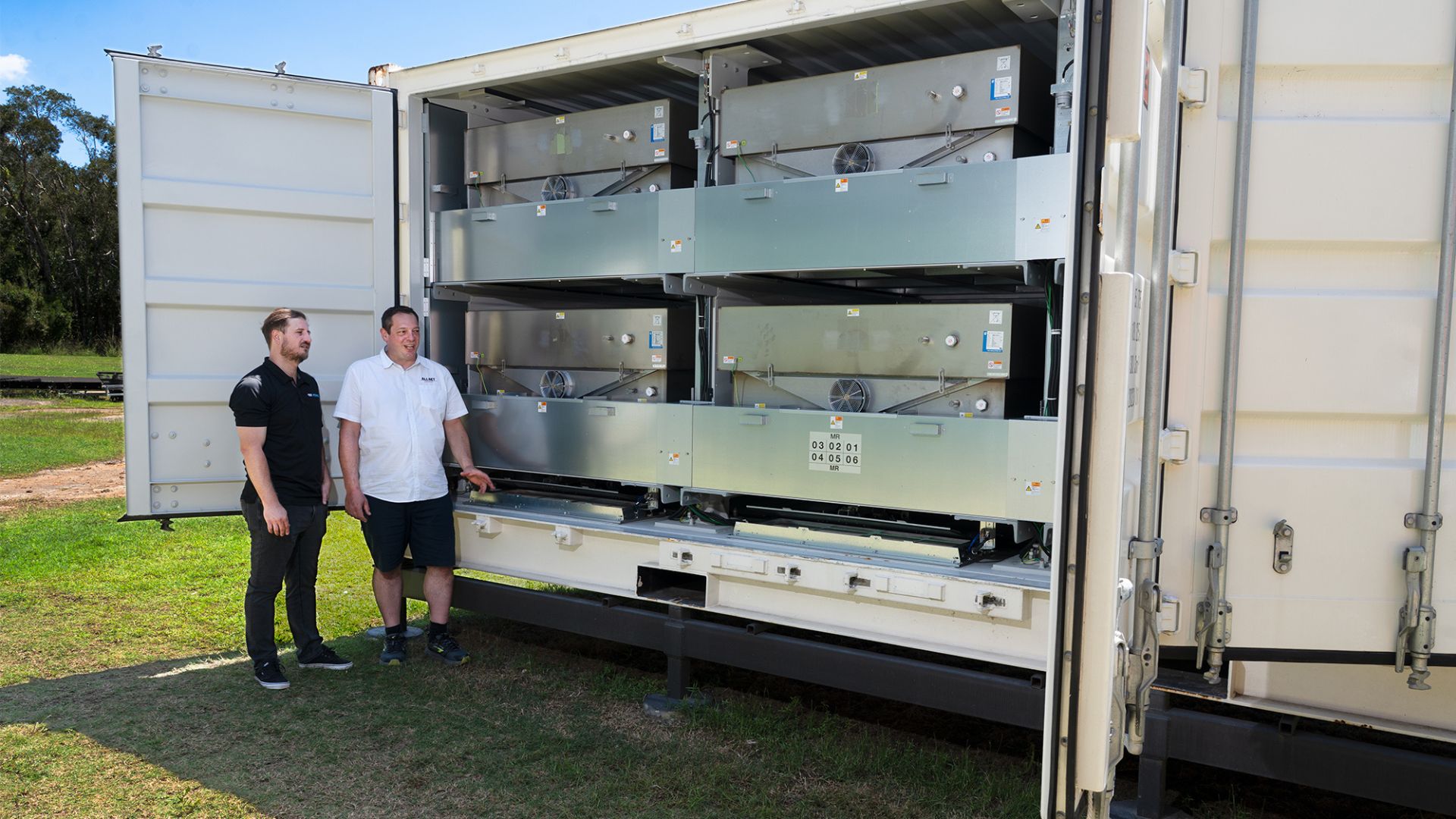
NGK Insulators' 250kW/1.45MWh unit is running behind a 200kW solar array at Lava Blue's minerals site in Brisbane. It is the first sodium-sulfur system on the National Electricity Market.
The Product Desk · Product desk
What happened
- A 250kW/1.45MWh sodium-sulfur battery has been commissioned at Lava Blue's PRiSM minerals facility in Brisbane, the first of its chemistry to be grid-connected in Australia's National Electricity Market.
- The unit was built by Japan's NGK Insulators and sits alongside an existing 200 kW solar array, physically connected to Energex's local distribution grid.
- Allset Energy led the installation and Queensland-based Advanced Converter Solutions developed custom DC-DC converters to link the battery to the NEM.
- Lava Blue also swapped sulfuric acid, a byproduct of petroleum refining, for hydrochloric acid, and runs its processing microgrid on solar backed by the battery.
- Separately, the 180MW/360MWh Noblevale lithium-ion battery near Ipswich cleared a referral decision under the EPBC Act, with construction planned for September 2027.
Compiled by The Product DeskSomething wrong?How this is made
Why it matters
- capability A buyer arguing a sodium-sulfur system past an Australian distribution network can now cite a live NEM connection instead of overseas installations.
- constraint A procurement team cannot run NaS against lithium on dollars without an installed cost, an efficiency or a cycle life to work from, so the case has to rest on duration and site fit.
- decision The 5.8-hour rated duration puts the choice squarely on whether a load genuinely needs more than the two to four hours lithium usually covers.
- precedent Because the converters and control unit were purpose-built for this site, the next Australian NaS project has to budget for custom integration engineering.
Divide 1.45MWh by 250kW and you get 5.8 hours at full rated output [15]. Interesting Engineering describes sodium-sulfur systems as capable of six hours or more of continuous discharge [4]; run flat out, this one stops a little short. Draw less than 250kW and it lasts longer, so 5.8 is the floor for a process that has to finish a batch after the array quits. The battery can also push 250kW while the solar is rated at 200kW [6], 25 percent more power than the site can generate [20].
The open question was the connection. Sodium-sulfur has decades of proven commercial use overseas, and it was getting it into an Australian grid that needed local work [9]. The converters and the control unit were built for this connection [8], so a second Australian buyer commissions that engineering again.
Scale is where the reference thins out. Noblevale, the lithium-ion project in the same state, stores about 248 times the energy of the Brisbane unit [17] and runs two hours at rated power [16]. Two hours falls inside the two-to-four-hour band the report gives for lithium [3].
Lava Blue's own claim is about emissions. PRiSM refines critical minerals used in semiconductors, advanced manufacturing and electric vehicles [13]. "With the commissioning of our microgrid, the lifecycle emissions intensity of our high-purity materials are further reduced," Managing Director Michael McCann said [11]. Professor Joshua Watts, director of QUT's Queensland Energy Storage Technology Hub, called the commissioning "an important milestone for Queensland's battery industry" [19]. The report does not include an installed cost, a round-trip efficiency or a cycle life for the system [18].
This is for the light-industrial site that already has a distribution connection and a process that cannot stop when the sun does. Lava Blue is the first solar-powered light-industrial facility in Australia [12]. The population of sites with a local example stays very small. Two numbers decide the next one. The first is how many hours the load has to run unsupported, measured against 5.8. The second is installed dollars per kWh, and a buyer has to get that from NGK Insulators [5]. A two-hour need is already served by the lithium market. A six-hour need now has one Australian example, 1.45MWh of it, in Brisbane.
What to watch
- Whether NGK Insulators or Lava Blue publishes installed cost per kWh, round-trip efficiency or cycle life for the Brisbane unit.
- Whether a second Australian site orders a NaS system, and whether it reuses the ACS converter and control-unit design or pays for a new one.
- Noblevale's September 2027 construction start, and whether the two-hour lithium build holds that schedule.