Invest1 publisher2 min readPublished
Jefferson pitches the Fed's discount window rebuild as Treasury market plumbing
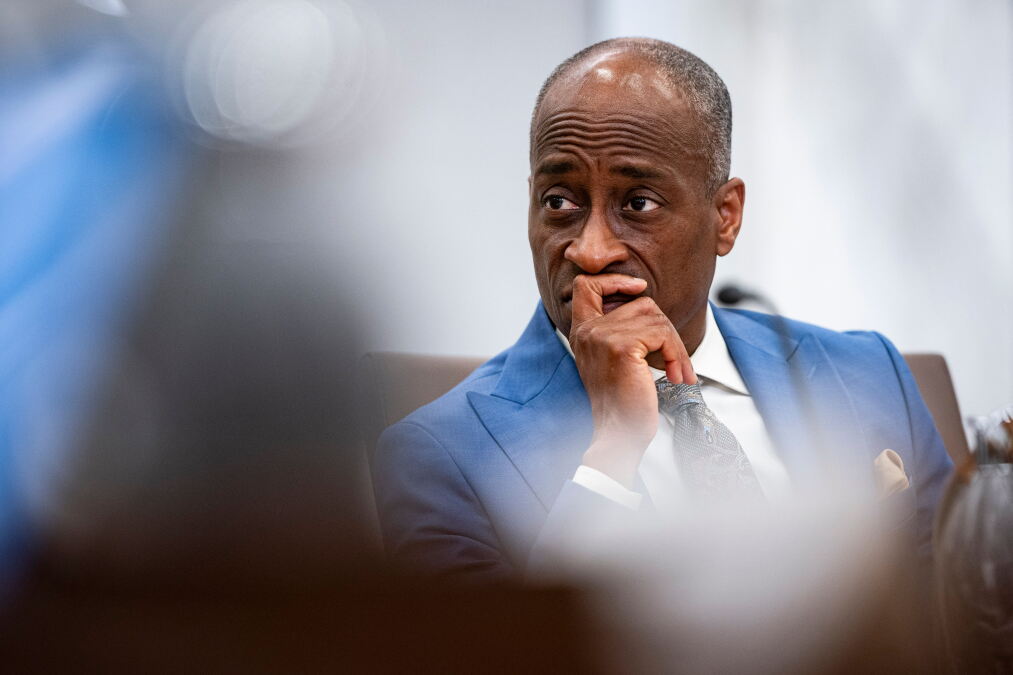
At the New York Fed's annual Treasury market conference, the vice chair tied three years of operational fixes to the market that prices every other asset, while calling the collateral handoff with the Federal Home Loan Banks unfinished work.
The Investor · Invest desk
What happened
- Fed Vice Chair Philip Jefferson, who oversees the discount window overhaul, told the New York Fed's annual U.S. Treasury Market Conference on Tuesday morning that the work bears on financial stability broadly.
- He sorted three years of changes into three categories: standardized operations across the Federal Reserve System, technology updates, and closer collaboration with the Federal Home Loan Banks.
- All 12 reserve banks now run one collateral framework with common loan valuation models and processing technology, alongside electronic signatures, simpler forms and automated pledged loan lists.
- Troubled institutions could not shift collateral from the FHLBs to the Fed in 2023, and Jefferson said the central bank has been working to smooth that handoff since.
Compiled by The InvestorSomething wrong?How this is made
Why it matters
- constraint With the pledgable-collateral work between the Fed and the FHLBs still open, a liquidity plan that counts the same loan pool as available at both systems is counting it once too often.
- decision Banks that leaned harder on FHLB advances in the second quarter, when borrowing rose 20%, now have to decide how much of that pledged collateral they want reachable at the Fed instead.
- contradiction Reviews found neither failed bank could have been saved by borrowing from the Fed, so the return on this rebuild has to come from healthy banks using the window earlier, not from rescues.
A Treasury security pledged at the discount window takes only a minimal haircut. The government backs it and it presents no credit risk, so a bank can borrow close to its full value against it [16]. Jefferson built the case for the rebuild on that fact, in front of an audience that trades the collateral in question. The Treasury market "serves as the foundation for pricing risk across all asset classes, facilitating the efficient allocation of capital throughout our economy," he said. He added that "in this context, the discount window supports Treasury market resilience in important ways" [2][3].
Sixty percent of discount window borrowing now goes through Discount Window Direct, the channel the Fed put in place in 2024 so banks could pledge collateral online and message reserve bank officials instead of telephoning them [8][9]. Four loans in ten are still arranged some other way [10]. I'd take the residual as friction that has not been removed. It is also possible that the holdouts are large, frequent borrowers who prefer a relationship call, in which case the 40% tells you nothing about frictions at all.
The Federal Home Loan Banks supply day-to-day liquidity against collateral they underwrite less scrupulously than the Fed does, according to American Banker [13]. "We and our FHLB partners believe our ongoing efforts and continued commitment to this coordination put us in a much better position than three years ago," Jefferson said, "by meaningfully improving our processes and strengthening relationships and engagement between the two systems" [15]. American Banker's account of the speech does not specify a timetable or terms for the pledgable-collateral work [22].
Jefferson chairs the Federal Reserve Board's committee on Economic and Monetary Affairs, and said the reform effort has been shaped by feedback from banks and other financial institutions [19][20]. The aim he stated is behavioural. "These improvements, I believe, help reduce the frictions that may make banks hesitant to use the window when they are healthy," he said, "and reinforce overall confidence in the banking system" [11]. "Our work is not done, but I remain committed to working with my colleagues throughout the Federal Reserve System to do just that" [12].
What to watch
- Whether the Fed publishes terms, and any haircut treatment, for moving pledged collateral from an FHLB to a reserve bank.
- The next quarterly figure for FHLB advances after the 20% second-quarter rise.
- Whether the Discount Window Direct share moves above 60% the next time Jefferson updates it.