Leadership1 distinct publisher3 min readPublished
Videos of collapsing sprinters travelled further than the entry list, though it is the entry list an automation roadmap has to price, with 12,800 Chinese-built humanoids behind it last year, about nine in ten worldwide.
The Board Room · Leadership desk

Compiled by The Board RoomSomething wrong?How this is made
Take the production share and run it backwards. If 12,800 units were about nine tenths of world output last year, per the Mercator Institute for Chinese Studies, the global figure sits near 14,200 and everywhere else together accounts for roughly 1,400 machines [5][12]. A capital plan that assumes a competitive multi-region market for humanoid hardware is assuming something the production data does not show.
The entry list carries a second ratio worth more than any single machine: about three humanoids per builder, on average, across the field in Beijing [13]. That spread is the supply-chain signal. It means several hundred firms can each get working hardware built and delivered to a venue by a fixed date, which is a different capability from one national champion shipping a hero unit. Beijing has been seeding hundreds of companies on purpose, and the games gave all of them the same deadline to show measurable progress [10].
A machine that comes apart at the end of a sprint is not a machine anyone puts on a line, and that objection holds as far as it goes [3]. But units built and units that run well are separate counts, and the 12,800 is the first one [5]. The same class of hardware the clips mocked was also judged worth restricting on cyber and national security grounds [6]. Regulators judged that hardware serious enough to restrict on security terms, not on how it performed at a sprint.
What the record does not give is operating economics. No cost per unit, no duty cycle, no mean time between failures, no hours logged in a working facility. International experts on site described the engineering progress as advancing faster than expected [4], while the same coverage recorded relief that the disintegrating robots were not ready to run anything [11]. That gap, between the rapid-engineering read and the relief read, is the number a Western operator needs and cannot yet obtain.
The simple version, that China leads humanoids so a buyer should buy Chinese or wait, misses on both counts. US buyers no longer have the first option [6], and waiting is a bet against a five-year plan approved in March that pledges to accelerate the practical application of humanoid robots and to explore embodied AI in roles with labour shortages or high-risk environments [7]. Those are the roles a Western labour-cost case names too, which is why the state's stated motives, including a looming labour-market demographic crunch, map onto commercial demand rather than diverging from it [14].
So this quarter's decision is narrow: which body a pilot runs on, and whether the software stack above it assumes hardware that may not clear customs. Next quarter's consequence is wider, because Musk's Optimus is reported to have entered production this month [8], which will produce the first non-Chinese unit count anyone can hold against the 12,800. A pilot built on a fixed supplier map gets re-tooled when that count lands low; a pilot designed to swap the body under the stack does not.
Ranked by verification strength, evidence, and original report placement.
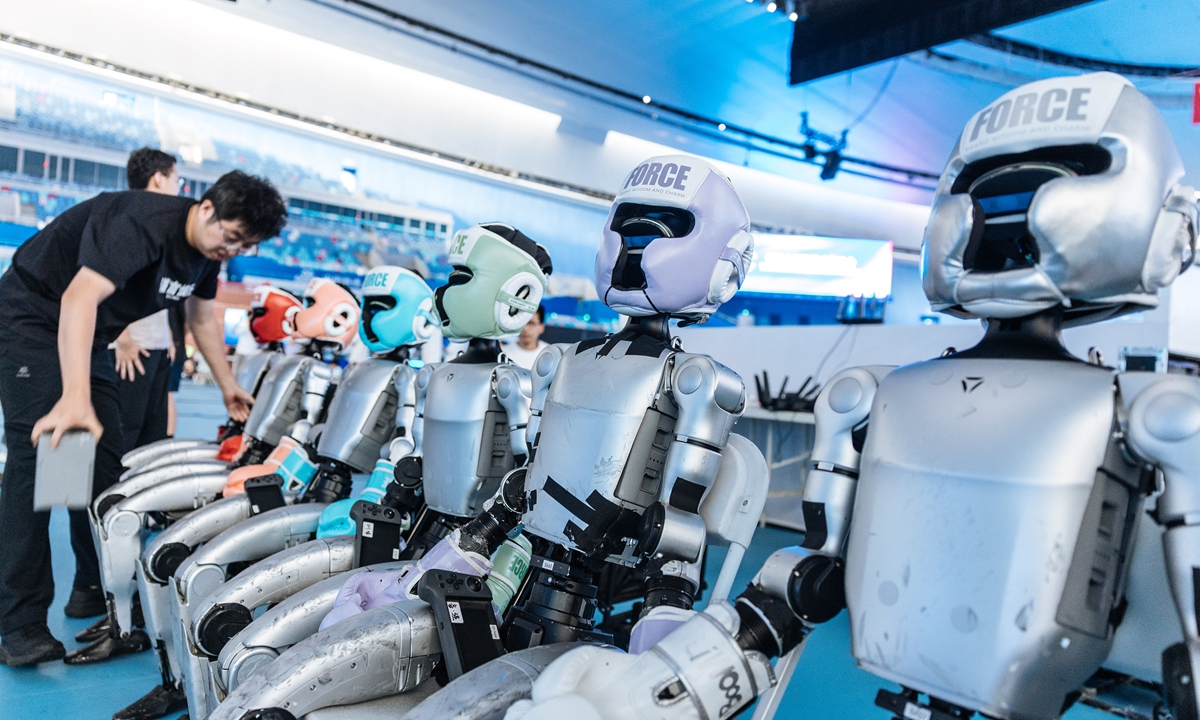
The World Humanoid Robot Games in Beijing was a five-day showcase that staked out China's claim to leadership in humanoid robotics.
Onlooking international experts described China's engineering progress on display at the games as "staggering".
Beijing is fuelling a competitive robot industry by seeding hundreds of companies to create a survival-of-the-fittest dynamic, with the games creating a hard deadline for competitors to deliver measurable progress.
The Guardian reported the games gripped the world with a mixture of hilarity, trepidation and relief, including comfort that the disintegrating robots might not yet be ready to become humanity's overlords.
For the Chinese Communist party, humanoids are a high priority, offering solutions to a looming demographic crunch in the labour market, rising military ambitions and the state's desire to tighten its surveillance web.
The games involved over 2,000 humanoids built by more than 660 mostly domestic technology companies, in events including boxing and breakdancing.
Distinct publishers with included, body-backed reporting in this cluster.
1 article · August 28, 2026
Follow any of these and your For You feed starts watching them — no settings page required.
invest
Washington puts Chinese humanoids on the restricted list, and robot sourcing inherits car risk1 distinct publisher
leadership
A humanoid beat Bolt's 100m time. Then the stretcher team came out.2 distinct publishers
product
Beijing's robot games: the tweezers matter more than the 8.86-second 100 metres1 distinct publisher
science
Hammering nails exposed the gripper limit that Beijing's 8.64-second sprint hid2 distinct publishers
Evidence-backed comparisons of source perspectives and observed adoption signals. Read the methodology
Which Builder, Operator, and Investor concerns the observed source mix emphasized—not a truth score.
Evidence, demonstrated adoption, hype gap, incentives, and confidence are assessed independently, each on its own current evidence. How these are measured.
Firsthand in the arena, secondhand outside it
Everything inside the speed-skating rink is strong: the Guardian watched the 100m end against the wall, and two named academics — Imperial College London's Thrishantha Nanayakkara and the National Robotarium's Ingo Keller — put figures and caveats on the year-on-year jump. Step outside the venue and the sourcing thins fast. The 12,800-unit share is one think tank's count passed through once, the import ban comes without its instrument, and the Optimus production line names nobody.
Units built, no shift worked
Real volume exists: 12,800 machines a year, 660-plus firms, and a competition that functioned as a delivery deadline those firms actually met. But production is not deployment, and this reporting shows no humanoid earning its keep anywhere — the fastest one destroyed itself on a padded wall, and the experts quoted say the entrants are specialists, so the case for putting them to work is unchanged.
The pratfall outran the entry list
Two things are mispriced in opposite directions here. 'Undisputed leadership' overshoots machines that can sprint or box but not both — that part is inflated. Yet the durable number went nowhere: 660 builders and 12,800 units a year is what an automation plan actually has to price, and it reached the world's screens folded inside a ten-second crash clip. Netted out, the substance is slightly undersold rather than oversold.
Everyone in frame is selling something
Beijing scheduled this weeks before Xi walks into a Washington summit where tech supremacy leads the agenda, and was confident enough in a 90% production share to broadcast its own bloopers. Washington had banned the same class of hardware a month earlier. Musk's Optimus is the commercial answer the billboard was aimed at. And the Guardian's own reach on this story depends on the funniest ten seconds of it, which is worth remembering when reading the top half.
One outlet, vividly present
Firm where a reporter stood and an academic measured; soft the moment the story leaves the building. With no second publisher on this event, the two facts a decision would rest on — the production share and whether Optimus is really building units — cannot be tested by a reader at all.