Science1 publisher2 min readPublished
Macron's Paris space summit makes European sovereignty a purchasing question
Delegations from about 120 countries came to Paris to talk business, with SpaceX and Blue Origin absent. What Europe wants to own is the imaging and connectivity it currently buys from American firms.
The Scientist · Science desk
What happened
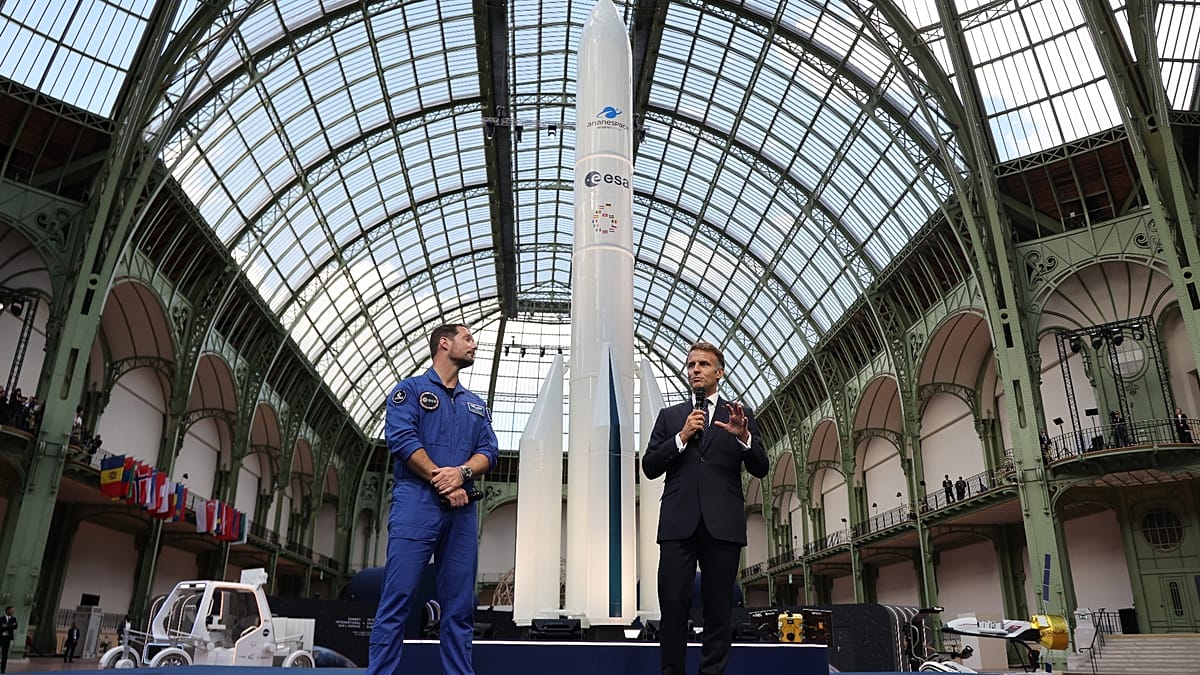
- A two-day International Space Summit opened Wednesday in Paris, drawing officials, astronauts, researchers and industry leaders from about 120 countries, with pursuing business deals part of the agenda.
- SpaceX and Blue Origin canceled plans to attend, and Politico reported that the White House had urged US space companies to stay away because attending could look like support for EU policies.
- Iris2, the EU's sovereign constellation intended to rival Starlink for secure communications across the 27-nation bloc, is not expected to be fully operational until 2030.
- US imaging firms Planet Labs and Vantor began withholding pictures of the Middle East conflict region after the Iran war broke out this year, apparently to keep adversaries from attacking the US and allies.
- Europe's most powerful rocket, the Ariane 64, has placed 100 Amazon Leo satellites in orbit across three launches since January, under a contract covering 18 launches in total.
Compiled by The ScientistSomething wrong?How this is made
Why it matters
- constraint Until Iris2 is in service, every EU requirement for secure satellite communications has to be met on capacity that someone outside the bloc owns and can decline to supply.
- decision A government that wants sovereign imagery this year must choose between funding a national programme and buying finished spacecraft from a commercial supplier, and Portugal's two-satellite order shows which route signs faster.
- exposure A commercial imagery subscription conveys no guarantee of coverage during a war, because the supplier's own security calculus can close the tap without any hardware failing.
- contradiction Part of Ariane's commercial revenue comes from lofting an American broadband constellation, so Europe's sovereign launch capacity and its sovereign services are separate accounts that the summit's language merges.
The date that governs this meeting is 2030, and the useful question is where you measure from. European governments began treating sovereign space capability as urgent in 2022, when Russia's full-scale invasion of Ukraine made Starlink both a critical partner for Kyiv and a potential vulnerability [4]. Reports at the time, cited by phys.org, said Musk refused to let Starlink be used to support an attack on a Russian naval base [5]. Measured from that year to the remedy being fully in service, the gap is eight years [1].
The imaging case is the sharper example because the supply stopped by decision, not by failure, and decisions can be repeated. Satellogic's chief executive, Emiliano Kargieman, says the Middle East conflict raised demand from countries for their own imaging capability [8], and his company sold Portugal two high-resolution satellites earlier this year [9]. Owning two spacecraft buys pictures on demand, but not the factory or the launcher behind them.
Europe's launcher business complicates the framing. Ariane carries Galileo, Copernicus and military and scientific payloads, and it also flies commercial missions [17]. At the rate observed so far, about 33 satellites per launch, the full Amazon Leo contract works out to roughly 600 spacecraft [2], near 19 percent of the more than 3,200 satellites Amazon says it plans to deploy [13][3]. The account does not say who launches the other four fifths or what the contract is worth.
For a summit about buying capability, prices are scarce. A French presidential official, speaking anonymously in keeping with the presidency's practice, said Europe has strengths but that things are accelerating and much more money is needed [16], and no figure is attached to Iris2 or to Europe's launch cadence. ESA's director general, Josef Aschbacher, describes satellites as critical infrastructure used day in and day out [10], which sets the stakes without sizing the gap. The American lead as the account describes it has two components, NASA's Artemis programme and the launch economics SpaceX changed by making reusable rockets operational [11][12], and neither is what Paris is shopping for.
That two American companies stayed home under Washington's discouragement, while Macron used the week to say Europe is taking its destiny into its own hands [2], suggests both capitals now handle European space procurement as trade policy. On this evidence the summit is best judged by contracts signed and dates held. Portugal's two satellites are countable this year, while 2030 remains a target date, not yet a delivered capability.
What to watch
- Whether Iris2 milestones hold or slip past 2030, the only date in this story with a service promise attached to it.
- Whether other European governments follow Portugal in buying finished imaging satellites instead of funding domestic builds.
- Whether Planet Labs or Vantor publish the conditions under which conflict imagery is withheld, which is what a subscription actually guarantees.