Product1 publisher3 min readPublished
The second flight of Spectrum put satellites into orbit from northern Norway, four days before Macron's sovereignty summit in Paris. For anyone shopping non-US small lift, the constraint is now a manifest described as full to 2028.
The Product Desk · Product desk

Compiled by The Product DeskSomething wrong?How this is made
Somewhere there is a mission manager with a finished satellite and a grant that expires, still watching a launch options list whose non-US column has stayed blank for years. For that person the useful detail from Andoya is that Isar's manifest is described as full to 2028 [18], and that the satellites deployed on Saturday were Microlauncher Competition winners rather than customers who paid [7].
Procurement decks tend to treat a first orbital success as the moment a launcher joins the supplier list. What buyers actually do is ask for a date attached to their own mass and their own orbit, then ask what happens to that date if the next flight fails.
Spectrum is 28 metres tall and lifts 1,000 kilograms to low Earth orbit [12]. The factory near Munich is meant to build up to 40 rockets a year [17]. Isar has flown twice, counting the March attempt that ended after roughly 30 seconds [5][2]. Forty divided by two is twenty, so the production target is twenty times the company's entire flight history [1]. That gap is the distance a buyer underwrites when quoting a 2027 slot to their own board.
The capital behind it is specific. The EUR 270M round closed this year [14] plus the roughly EUR 200M European Space Agency contract signed in August under the European Launcher Challenge [15] comes to EUR 470M standing behind one orbital success [2]. Defence customers are about 60% of orders at a company that began with civilian launches [16]. For a university group, that share is the queue discipline: most of the book has sovereign urgency attached, and sovereign urgency does not wait behind a cubesat.
The sovereignty language around Wednesday's summit in Paris [10] deserves the same separation between the thing being pitched and the thing being done. Europe had sovereign access to space before Saturday, through Ariane 6 from French Guiana [19]. What it lacked was a commercial rocket reaching orbit from European soil, and five companies are competing to do that repeatedly [20]. Chief executive Daniel Metzler's line that launch is the largest bottleneck in the global space industry [8] is a supply claim, and naming a slot is a separate matter.
The grid worth drawing has two axes: whether the vehicle has reached orbit, and whether the vendor will name a date inside your window. Most non-US small lift sat in the corner where both answers were no. Isar has moved one axis and only one. Until a paying payload flies on Spectrum, the honest line item is a queue position bounded by 2028, which is still a better line item than the blank one it replaces.
Ranked by verification strength, evidence, and original report placement.
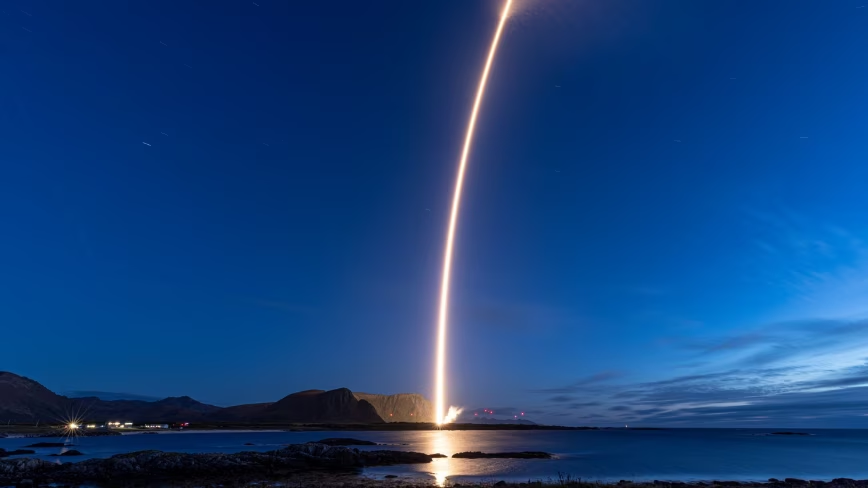
Isar Aerospace's Spectrum rocket reached orbit and deployed satellites after lifting off from Andoya in northern Norway on Saturday night.
Isar Aerospace, a German company, says it is the first commercial space firm in Europe to put satellites into orbit, and did so on its second flight.
The rocket left the pad at 22:12 CEST on a mission the company called Onward and Upward.
Spectrum reached orbit about four minutes after lift-off, in what Bloomberg reported as the first private space mission to reach orbit from continental Europe.
Isar's first launch attempt, in March last year, lasted roughly 30 seconds before crashing.
This year's launch attempts were held up by weather, technical faults and a boat straying into the range.
Follow any of these and your For You feed starts watching them — no settings page required.
Evidence-backed comparisons of source perspectives and observed adoption signals. Read the methodology
Which Builder, Operator, and Investor concerns the observed source mix emphasized—not a truth score.
Evidence, demonstrated adoption, hype gap, incentives, and confidence are assessed independently, each on its own current evidence. How these are measured.
Firm on the flight, company-fed on the business
An orbital insertion either happened or it did not, and The Next Web reports this one plainly, with a Bloomberg line quoted for the continental-Europe framing. The commercial half of the piece works differently: order mix, manifest depth and factory rate are Isar's figures, arriving with no contract, filing or customer name to check them against, and no second newsroom in our coverage to repeat them.
Two flights, no paying customer yet
Spectrum has flown twice, and the satellites it delivered rode as prize winners from a German Space Agency competition that ESA paid for. Committed demand does exist in the roughly EUR 200M ESA contract and in a manifest Isar says runs to 2028, but neither comes with a named customer or a mission count, and the 40-rocket factory target sits twenty times above everything flown so far.
"Commercial" is carrying the headline
The European commercial first survives only if commercial describes who built the rocket rather than who paid for the ride, since ESA money put those satellites aboard through a competition. The sovereignty note comes from the Paris calendar rather than from the flight, as The Next Web itself concedes in noting that Ariane 6 already gives Europe its own access to orbit. Meanwhile EUR 470M of round and contract money, a 40-rocket factory and a manifest booked to 2028 all rest on one successful launch.
Company numbers, summit week
Every commercially interesting figure here comes from Isar four days before a Paris summit on European sovereignty in space, an audience for whom a defence-heavy order book and an ESA contract are arguments for more public money. Metzler's line that launch is the industry's largest bottleneck is the pitch as much as the diagnosis, and The Next Web prints it without a rival launcher, a customer or an agency to answer.
Sure about the rocket, unsure about the book
The flight and the summit dates are the sturdy parts, both checkable outside this reporting. Everything an operator or investor would actually decide on comes from one outlet repeating one company: the manifest, the order mix, the factory rate. The four other European contenders go unnamed, so even the competitive context cannot be tested here.
invest
ESA prices three rocket startups on milestones, not flights1 publisher
invest
PLD Space stacked 59% of its lifetime funding into a single Series C1 publisher
science
Isar Aerospace reaches orbit from Norway on Spectrum's second flight1 publisher
invest
A million satellites on paper: read the filings, not Musk's 2029 deadline1 publisher
Publishers with included, body-backed reporting in this cluster.
1 article · September 6, 2026