Build1 publisher3 min readPublished
Energy Vault borrows to hold a 2027 delivery slot for 275 MW of MTU engines
The Eagle Point equipment financing buys deliveries starting in the second half of 2027, which is the one thing a developer can quote when a hyperscaler asks how soon a campus energizes, though neither the principal nor the rate is public.
The Engineer · Build desk
What happened
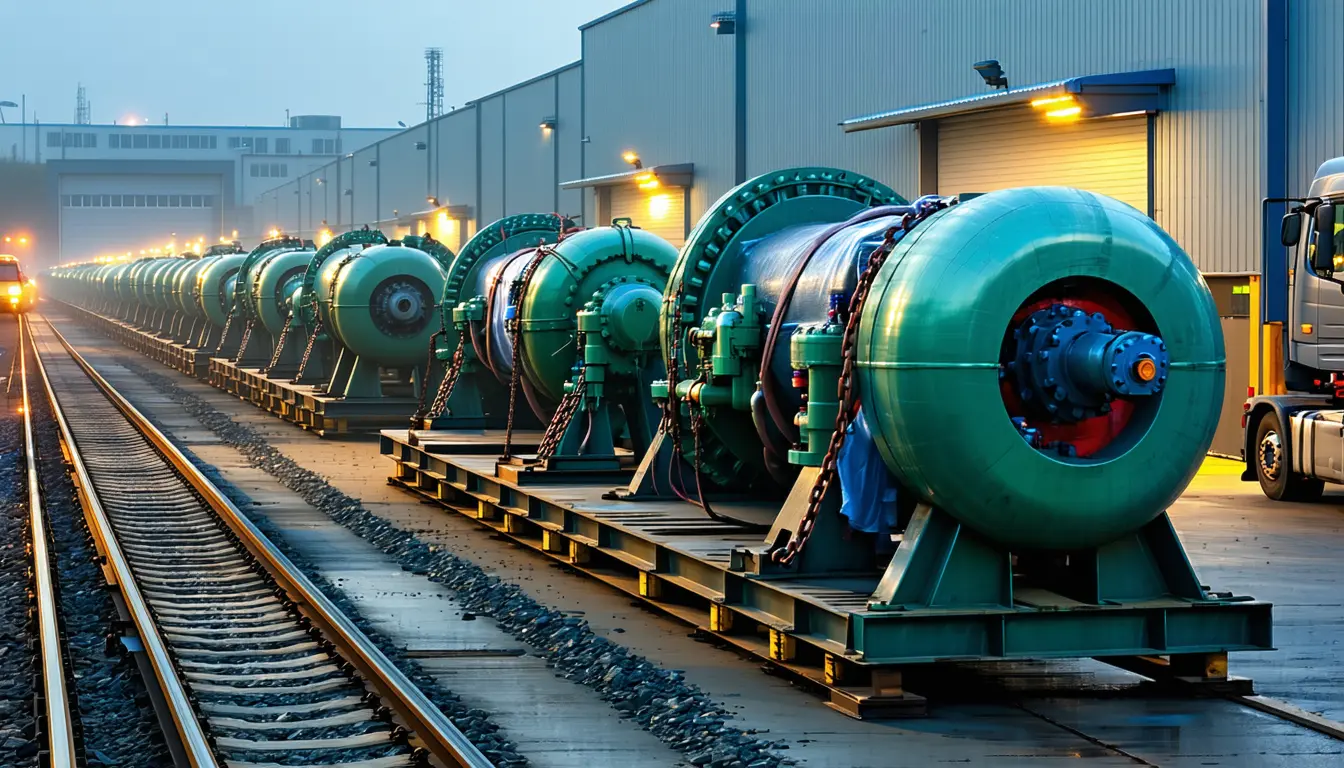
- Energy Vault contracted 275 MW of Rolls-Royce MTU reciprocating-engine generation for future AI and high-performance computing campuses, funded by equipment financing from Eagle Point Credit Management.
- The September 10 announcement puts deliveries in the second half of 2027 running through the first half of 2028, ahead of the hyperscale projects the equipment is meant to serve.
- The International Energy Agency reported that data-center electricity demand grew 17% in 2025, with AI-focused facilities growing faster than that average.
- The announcement omitted the financing principal, interest rate, collateral and repayment structure, and gave no equipment price or contract value.
- Energy Vault's 2025 annual filing reported $203.7 million of revenue, $103.4 million of year-end cash, a $103.6 million net loss and $487.4 million of accumulated losses since inception.
Compiled by The EngineerSomething wrong?How this is made
Why it matters
- capability Holding financed equipment lets Energy Vault answer the energization question with a date rather than a site plan, which is the difference Magnuson describes between controlling availability and hoping for it.
- exposure Because none of the 275 MW is publicly assigned to a campus, conversion risk sits with Energy Vault and with whatever collateral position Eagle Point holds if hyperscale demand lands after the delivery window.
- constraint Once generation sits on a dedicated equipment facility instead of corporate cash, the ceiling on this strategy is what lenders will collateralize, not what the operating business earns.
- contradiction The equipment is pointed at multi-gigawatt conversations while the company's own filing warns that backlog, bookings and pipeline may never produce revenue or may convert on a different schedule.
Energy Vault's order fills over a twelve-month window [1], and reciprocating engines suit that pace because they arrive as modular units, so a campus can energize part of its load and add generation as compute lands [5].
The rest of the package covers what engines do badly. Batteries absorb short-duration fluctuation and power-quality duty while the engines carry sustained output, and plant controls coordinate both assets and their interaction with the grid [6]. Energy Vault calls the bundle Powered Land [6].
The separate financing follows from the balance sheet. Corporate cash at the end of 2025 covered roughly one year at that year's loss rate [3], which is not a base from which to warehouse unassigned generation equipment. A Build, Own & Operate strategy commits capital well before a project produces recurring cash flow [10], and the company says the dedicated facility limits the corporate cash required before equipment is assigned and deployed [10]. Pricing that from outside is not possible: with no principal, interest rate, collateral or repayment structure disclosed [11], carry per MW-month and recourse if the engines sit unassigned are both blank fields.
The scarcity argument is built from a list of equipment categories, not a timeline. The International Energy Agency identified tighter availability for gas turbines, transformers, chips and other equipment, alongside delays in grid connections and regulatory approvals [4]. Nothing in the announcement says how many months an MTU engine slot takes to fill, how that compares with an interconnection date at the same site, or what a slot costs to hold. Land has not stopped mattering on Energy Vault's own account either, since the stated ambition is to develop, finance, build, own and operate the whole thing: land, grid access, onsite generation, batteries, power conversion equipment and controls [15].
Read against the pitch, the reserved volume is small. 275 MW is 27.5% of a single gigawatt [2], and Energy Vault says the contracted equipment will support multi-gigawatt discussions with hyperscale customers [7]. The backlog has a similar shape: roughly $810 million of the $1.3 billion booked at the end of 2025 is non-contingent, with the other 38% sitting in contingent option bookings [4].
Energy Vault made its name raising and lowering concrete blocks [16]. The item it has on order now is a reserved place in line. Runtimewire.com, whose account draws on Financial Times reporting, framed the delivery dates as the point of the transaction: long-lead hardware reserved while the hyperscale projects are still being assembled, so that Piconi has something concrete to sell when a customer asks how soon a campus can be energized [17]. Eagle Point's collateral is equipment with no end user attached. What the borrower gets in return is a delivery date.
What to watch
- Whether any of the 275 MW gets attached to a named campus before deliveries open in the second half of 2027.
- Disclosure of the Eagle Point terms in a later filing: principal, rate, collateral and recourse are what make the carry priceable.
- Whether the contingent option bookings inside the backlog convert or lapse, since roughly $490 million of $1.3 billion sits there.