Product1 publisher3 min readPublished
A$1.2bn later, Supernode shows phased gigawatt-hour storage is bankable in tranches
Quinbrook closed A$469 million of debt for Stage 3 of its Brendale battery campus in the same week Stage 2 entered commercial operation. The pattern matters more than the megawatts.
The Product Desk · Product desk
Drafted by a language model from the sources cited here and checked against its claim ledger before publication. How we use AISend a correction
What happened
- Quinbrook's Supernode battery energy storage project has reached financial close on A$469 million in debt financing for Stage 3.
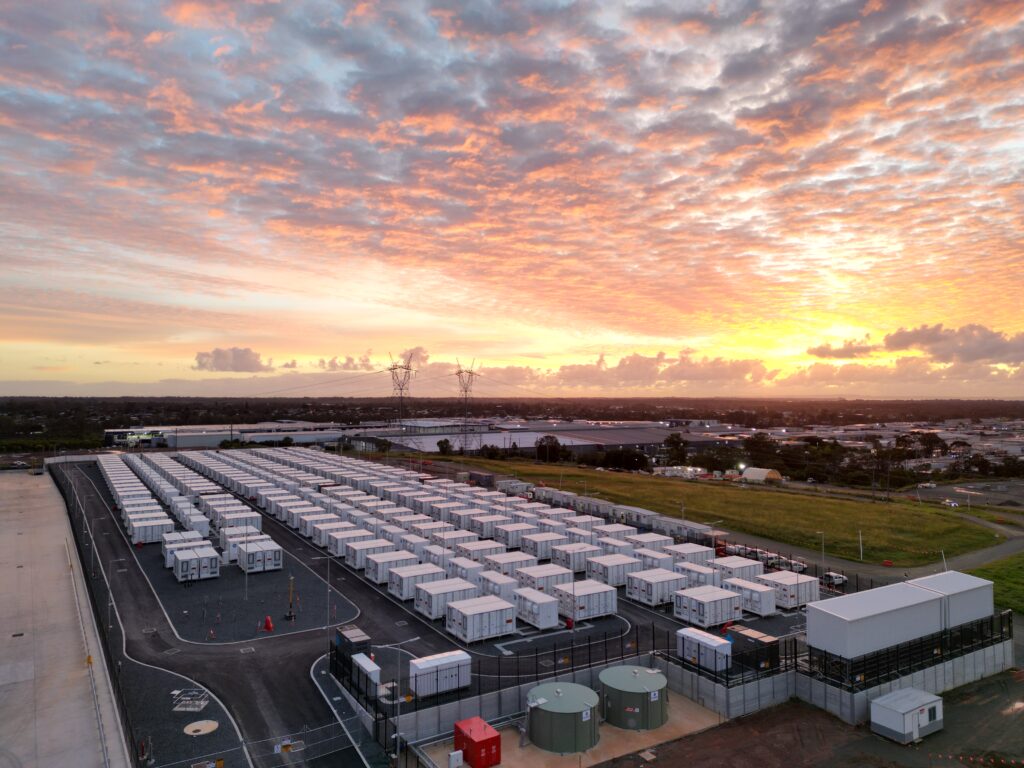
- Supernode is located at Brendale, north of Brisbane, and is described as Australia's largest operational BESS campus, developed in phases.
- Across its first three stages, Supernode is set to reach 780MW / 3,074MWh.
- Total project financing across Supernode Stages 1, 2 and 3 is approximately A$1.2 billion.
- About A$731 million of the approximately A$1.2 billion total financing relates to Stages 1 and 2.
Compiled by The Product DeskSomething wrong?How this is made
Why it matters
Quinbrook has reached financial close on A$469 million of debt for Stage 3 of its Supernode battery campus at Brendale, north of Brisbane, while Stage 2 has entered commercial operation [1][2][9]. The pairing is the point: lenders funded the next tranche of a gigawatt-hour campus at the moment the previous tranche started earning, on a site where the grid connection was already in hand.
Across the first three stages Supernode is set to reach 780MW / 3,074MWh, with total project financing of roughly A$1.2 billion [3][4]. That implies about A$731 million raised for Stages 1 and 2 [5], an average of roughly A$390,000 per MWh of installed energy across the campus [6], and an average duration of about 3.9 hours [7]. Capacity across all three stages is contracted under long-term offtake arrangements [8].
The siting is doing a lot of the work. Supernode sits adjacent to the South Pine substation, described as a key hub in the Queensland power system and the regional reference node for marginal loss factors, which gives the project a favourable MLF position and around 4,000MW of available connection capacity for phased expansion [10]. The 780MW committed so far is under a fifth of that headroom [11]. Connection queues, not cells, are the binding constraint on most Australian storage; buying optionality on an existing node is what makes a stage-by-stage financing plan credible to a bank.
The second repeated variable is the supplier. CATL is the core energy storage system supplier for all three stages, providing EnerC Plus for Stages 1 and 2 and TENER S for Stage 3, which the release frames as a consistent technology platform across the campus [12][13]. According to the release, CATL supported project-specific design optimisation for high-density deployment on constrained industrial land, with EnerC Plus supporting back-to-back installation that cuts the required footprint by about 20 per cent versus EnerC, and integrated liquid cooling that holds the internal container temperature differential within 5C over a design life of 20 years [14][15][16]. Those are vendor figures, and the release itself concedes the obvious: long-term value depends on the continued availability, operational efficiency, safety and reliability of the storage systems [17].
Quinbrook's Tim Hornemand said reaching commercial operations for Stage 2 means both Origin-contracted stages were delivered on schedule, and that bank support for Stage 3 reflects confidence in the project and its delivery track record [18][19]. CATL's Tan Libin offered that storage is "evolving from a standalone technology deployment into a strategic energy asset" [20], which is the sort of sentence that survives translation into any procurement deck without changing a buyer's decision.
Three things to watch. First, the offtake structure for Stage 3: the material names Origin only in connection with Stages 1 and 2 while stating all three stages are contracted, so the Stage 3 counterparty is unstated [21]. Second, whether the mid-campus switch from EnerC Plus to TENER S introduces commissioning variance that the first two stages avoided, given the on-schedule record Hornemand is claiming [13][18]. Third, how much of the remaining connection headroom at South Pine Quinbrook converts into Stage 4 and beyond, and how the MLF position at that node behaves as more storage arrives [10][11].