ScienceNot yet confirmed elsewhere1 publisher3 min readPublished
Oxygen vacancies decide which phase hafnia-zirconia lands in during the anneal
A Seoul National University team varied the ozone dose during deposition, then watched 10-nanometre films crystallize under synchrotron X-rays, and the vacancy-rich ones crystallized later while holding on to the nonferroelectric phase.
The Scientist · Science desk
What happened
- A Seoul National University group led by Min Hyuk Park, working with Sungkyunkwan University, Chonnam National University and the Pohang Accelerator Laboratory, watched hafnia-zirconia form its ferroelectric phase during heat treatment.
- They built 10-nanometre HZO films with deliberately different oxygen-vacancy concentrations by changing how much ozone was supplied during atomic layer deposition, then compared their crystallization pathways.
- Synchrotron grazing-incidence wide-angle X-ray scattering at Pohang followed each film continuously from amorphous through crystallization on heating and into its final structure on cooling.
Why it matters
- decision Oxidant dose and anneal temperature stop being independent process choices: pick one and you have constrained the other, because the vacancies set at deposition decide how hot the furnace must get.
- constraint Any ceiling on peak anneal temperature now implies a ceiling on tolerable vacancy concentration, since a vacancy-rich film simply will not have started crystallizing where a cleaner one has finished.
- capability Reading the film while it crystallizes gives process engineers a way to separate nucleation onset from later phase selection, which the researchers say before-and-after inspection blurs together.
- exposure Anyone tempted to write a recipe from this account is working off direction without magnitude, since no onset temperature or vacancy concentration is given to anchor a process window.
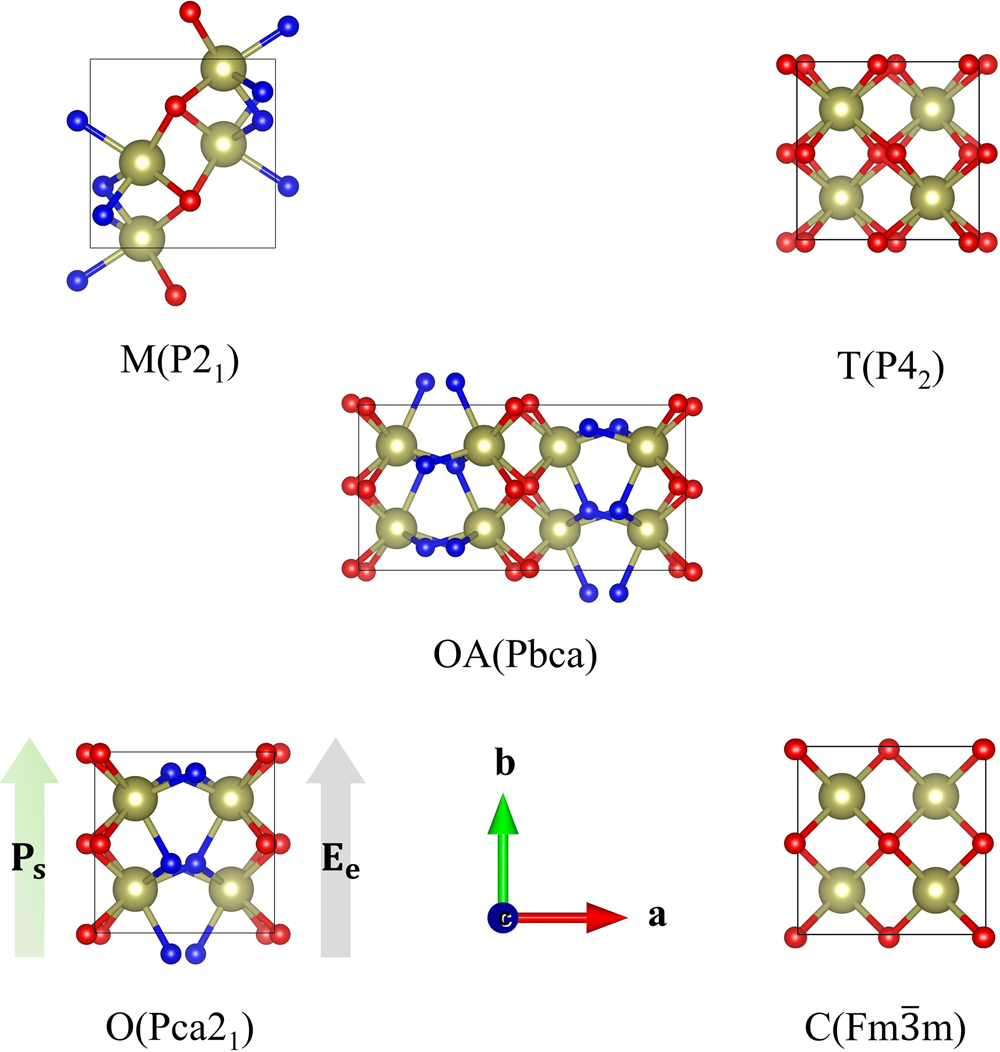
The mechanism on offer is a barrier argument. An amorphous film has to rearrange its atoms before a crystal nucleus can form at all. In the films carrying more oxygen vacancies, that rearrangement and the earliest nuclei were hindered, so crystallization only began at higher temperatures [8]. Once it did begin, lateral grain growth stayed suppressed and the tetragonal phase, which produces no polarization, hung on relatively longer than the ferroelectric orthorhombic phase [9]. Fewer vacancies meant a lower barrier and grain growth that proceeded more freely, according to the team [3].
The team ran the experiment live because the orthorhombic phase is metastable, held in place only by the processing conditions, and HZO has no ferroelectricity when it is deposited [10]. Looking at a film before and after the furnace makes the onset of crystallization hard to separate from the later business of phase selection, the researchers note [13]. So they read the films continuously with grazing-incidence wide-angle X-ray scattering at the Pohang Accelerator Laboratory, through the heat and back down through the cool [7], and paired that with lattice spacing, residual strain, grain size, growth orientation and phase fractions [2].
The part with practical teeth is where those measurements land. The knob the team turned was the ozone dose during atomic layer deposition [6], which means the vacancy population is fixed at deposition while the phase is chosen in the anneal. Those two windows are therefore coupled: at any fixed peak anneal temperature, the low-vacancy film will have travelled further toward the ferroelectric phase than the vacancy-rich one [14]. An oxidant-dose change that looks harmless on its own can quietly move the thermal budget a wafer needs.
The release stops short of saying how much. It reports directions of change, not magnitudes; there are no crystallization onset temperatures, no vacancy concentrations, no polarization or endurance figures, and the only dimensional number in it is the 10-nanometre film thickness [16]. Nor was the electrical claim quantified: the team says vacancy concentration produced substantial differences in storage performance [1], but the chain from nucleation to phase fraction to a device number is asserted here rather than shown. And 10 nanometres is a comfortable thickness for scattering work, while the same source notes hafnia-based ferroelectrics stay ferroelectric down to a few nanometres [11]; whether the vacancy-versus-temperature relationship survives that thinning is not tested [15].
This is a credible causal story about phase selection: a single deposition variable was moved while the material system was held fixed, and the outcome was watched as it happened. It is not a finished process spec. If the Advanced Functional Materials paper [5] carries onset temperatures against measured vacancy concentrations, an integration engineer has something to fit an anneal recipe to. Without those, what remains is a good reason to stop treating oxidant dose and thermal budget as separate tickets, in a material whose whole appeal is that it fits existing silicon lines and works at a few nanometres [11].
What to watch
- Whether the Advanced Functional Materials paper reports onset temperatures against measured vacancy concentrations, which is what an anneal recipe would be fitted to.
- Whether the same vacancy-versus-crystallization behaviour holds in films thinner than 10 nanometres, closer to high-density device thicknesses.
- Whether oxidant schemes other than ozone dosing reproduce the phase-selection effect in an inline production tool.
Clarity's read
What the record supports and how the coverage leans. The claims behind it follow.
Reality
- Evidence58
- Adoption
- Insufficient
- Hype gap+12
- Incentives58
- Confidence55
Claim ledger
Ranked by verification strength, evidence, and original report placement.
- [1]
The researchers found that oxygen-vacancy concentration changes both the crystallization temperature and the final crystalline phase of HZO, resulting in substantial differences in memory storage performance.
- [2]
The researchers separately analysed temperature-dependent lattice spacing and residual strain remaining in the films after heat treatment, and compared grain size, growth orientation and the relative proportions of different crystalline phases.
- [3]
In films with fewer oxygen vacancies, the energy barrier required for crystallization was lowered and grain growth proceeded; the published source text is cut off mid-sentence at this point.
- [4]
A team led by Professor Min Hyuk Park of Seoul National University's Department of Materials Science and Engineering, with Professor Yunseok Kim of Sungkyunkwan University, Professor Younghwan Lee of Chonnam National University and Dr Tae-Yeol Jeon of the Pohang Accelerator Laboratory, tracked in real time the process by which a ferroelectric phase forms during heat treatment of hafnia-zirconia (HZO).
- [5]
The work is published in the journal Advanced Functional Materials.
- [6]
The team fabricated 10-nanometre-thick HZO films with different oxygen-vacancy concentrations by varying the amount of ozone supplied during atomic layer deposition, then compared how their crystallization pathways changed with vacancy concentration.
- [7]
Using synchrotron radiation at the Pohang Accelerator Laboratory, the team performed real-time grazing-incidence wide-angle X-ray scattering (GIWAXS), continuously tracking the films from amorphous through crystallization during heating and stabilization into final structures during cooling.
- [8]
Higher oxygen-vacancy concentrations delayed HZO crystallization: rearrangement of the atomic structure and the initial formation of crystal nuclei were hindered, so crystallization began only at higher temperatures.
- [9]
In vacancy-rich films, lateral grain growth was suppressed after crystallization began, and the nonferroelectric tetragonal phase, which generates no electrical polarization, persisted relatively longer than the ferroelectric orthorhombic phase.
- [10]
HZO does not possess ferroelectric properties from the outset; the orthorhombic phase responsible for its ferroelectricity has an asymmetric atomic arrangement and is a metastable crystalline phase that can be maintained only under specific processing conditions.
- [11]
Hafnia-based ferroelectrics are highly compatible with conventional silicon semiconductor fabrication and can exhibit ferroelectricity at thicknesses of only a few nanometres.
- [12]
Ferroelectrics retain their electrical state after power is turned off, making them candidates for nonvolatile memory and low-power semiconductor devices.
- [13]
According to the researchers, changes of this kind have been difficult to distinguish accurately using conventional analyses performed only before and after heat treatment.
- [14]
Because the vacancy population is fixed by the ozone dose at deposition while phase selection happens during the anneal, the deposition and anneal windows are coupled: at a fixed peak anneal temperature a low-vacancy film will have progressed further toward the ferroelectric orthorhombic phase than a vacancy-rich one.
- [15]
The experiment was run at 10 nanometres, while the same source notes hafnia-based ferroelectrics can be ferroelectric at a few nanometres, so the vacancy-to-crystallization relationship is untested at the thinner end of the device range.
- [16]
The published account reports directions of change without magnitudes: it gives no crystallization onset temperatures, no oxygen-vacancy concentrations and no polarization or endurance values, and its only dimensional figure is the 10-nanometre film thickness.
Sources
1 independent publisher whose own reporting we read for this story.
- phys.orgTiny oxygen gaps may determine whether next-generation memory films store data well
1 article · August 27, 2026
Topics and entities
Follow any of these and your For You feed starts watching them — no settings page required.
Topics
Entities
- Min Hyuk ParkFollow
- Yunseok KimFollow
- Younghwan LeeFollow
- Tae-Yeol JeonFollow
- Seoul National University College of EngineeringFollow
- Sungkyunkwan UniversityFollow
- Chonnam National UniversityFollow
- Pohang Accelerator LaboratoryFollow
- Hafnia-zirconia (HZO)Follow
- Grazing-incidence wide-angle X-ray scattering (GIWAXS)Follow
- Advanced Functional MaterialsFollow
- Atomic layer depositionFollow