Science1 distinct publisher3 min readPublished
Donor overhangs of about 30 nucleotides, matched to a pair of overhang-complementary pegRNAs, were enough to move exon-sized cargo without a double-strand break. That ceiling is worth knowing even though the public abstract reports no efficiencies.
The Scientist · Science desk

Compiled by The ScientistSomething wrong?How this is made
The design puts almost all of its specificity into two short stretches of sequence. A pair of overhang-complementary prime editing guide RNAs works alongside a double-stranded donor that arrives bearing 3' single-stranded overhangs, with the PE2* editor writing the genomic sequence those overhangs were built to find [1]. Roughly 30 nucleotides per end is enough to hold the join [3]. On a 12.5 kb insert, that is 30 divided by 12,500, or about a quarter of one per cent of the cargo [13]. The cargo, in other words, is inert as far as targeting goes, and the annealing region does not have to grow when the payload does.
That is also what makes the library half of the work the more interesting half. A single opegRNA pair covered a scanned window of EGFP, with the variants living in donor pools built from synthesized single-stranded oligonucleotides and read out at both amino acid and nucleotide resolution [4]. The authors call this in situ saturation mutagenesis [4]: the scan happens at the target sequence in the genome, and its scale is set by how many oligos you can afford rather than by how many guides you can design.
The PRKCSH work makes a different argument. Swapping out a whole mutant exon, individually or several at once, corrects distinct alleles uniformly, which is what mutation-agnostic means here: one donor covers every mutation that falls inside the exon it replaces [5]. That was shown in vitro [5], and the distance between corrected cells and a corrected animal is the usual long one.
There is a tidy irony in the lineage. Prime editing entered the literature in 2019 as search-and-replace editing without double-strand breaks or donor DNA [15]. DoPE keeps the first clause and gives back the second, on the grounds that avoiding the break is the part that matters. The authors' own reference list is the case for that priority: repair of Cas9-induced breaks has been reported to yield large deletions and complex rearrangements [10], to trigger a p53-mediated damage response [11], and to leave heritable impairment to genome function [12]. Existing precise-insertion methods that dodge breaks, they argue, pay for it in throughput or in extra editing steps [2]; this one is described as one-step, library-compatible, and free of recombinases and transposases [6].
What the abstract does not tell you is the yield. As supplied, it reports sizes and applications with no insertion efficiency, no named cell background, and no indel or off-target accounting [14]; the full text sits behind access options that include a $39.95 article purchase [7]. So 12.5 kb is a demonstrated ceiling, not a rate. A knock-in pipeline is planned around an efficiency-versus-length curve, and around whether a 12.5 kb double-stranded donor can be delivered at all into the cells you actually care about. Neither of those is in the abstract.
My read, with its conditions stated: for reporter lines, tagged alleles and variant scans in workhorse cell lines, this is worth designing into next quarter's plans on the strength of the size range and the single-guide-pair library trick [3][4]. For anything therapeutic, it stays a research result until someone publishes length-resolved efficiencies and integration purity in primary cells.
Ranked by verification strength, evidence, and original report placement.
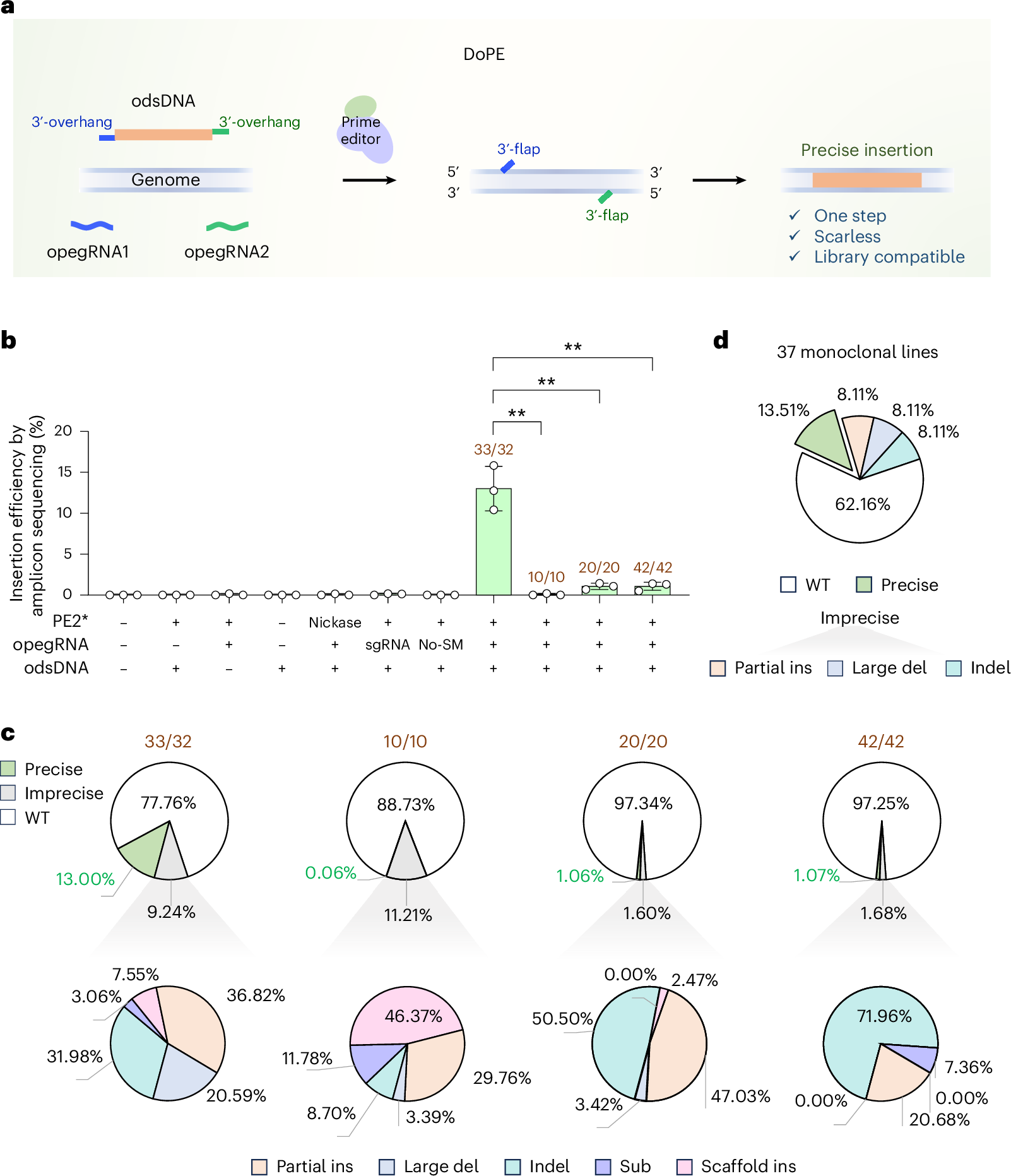
Donor-complementary prime editing (DoPE) combines a 3'-overhang double-stranded DNA (odsDNA) donor with a pair of overhang-complementary prime editing guide RNAs (opegRNAs) and a PE2* prime editor to achieve precise insertion of DNA sequences up to 12.5 kilobases.
The authors state that existing methods for precise genomic DNA insertion that avoid double-strand breaks are constrained by limited throughput or by the need for multistep editing.
DoPE employing short overhangs of approximately 30 nucleotides supports various insertions ranging from small fragments to those exceeding 10 kb.
Using one opegRNA pair and donor pools constructed from synthesized single-stranded oligonucleotides, the authors demonstrate in situ saturation mutagenesis across a targeted EGFP region at both amino acid and nucleotide resolutions.
The authors replace mutant exons of PRKCSH, either individually or simultaneously, to correct diverse mutations, establishing a mutation-agnostic approach that corrects distinct alleles uniformly in vitro.
The authors describe DoPE as a one-step, DSB-free and library-compatible method for precise insertion of large DNA fragments without requiring recombinases or transposases.
Distinct publishers with included, body-backed reporting in this cluster.
1 article · August 27, 2026
Follow any of these and your For You feed starts watching them — no settings page required.
science
Nature Perspective: autonomous agents need internal states they must keep in range1 distinct publisher
science
A phage kinase with no target list: EMBL finds one enzyme that breaks several bacterial defences1 distinct publisher
science
Ammonia from untreated seawater and air at room temperature, with the numbers attached1 distinct publisher
science
A gene switch wired to a magnetic field turns off within a day of the coil going quiet2 distinct publishers
Evidence-backed comparisons of source perspectives and observed adoption signals. Read the methodology
Which Builder, Operator, and Investor concerns the observed source mix emphasized—not a truth score.
Evidence, demonstrated adoption, hype gap, incentives, and confidence are assessed independently, each on its own current evidence. How these are measured.
Peer-reviewed, but the quantitation is behind the paywall
Everything a reader can check sits in one free paragraph, and that paragraph states capabilities without a single rate: 12.5 kb as a ceiling, ~30 nucleotides of overhang, two demonstrations, no efficiency, no cell background, no indel or off-target count. What raises the floor is real — the work cleared review at a Nature Portfolio methods journal and the raw reads are lodged under a genuine SRA accession, so the analysis is auditable by anyone willing to pull it. What holds the score down is that the numbers deciding whether DoPE is a technique or a curiosity cost USD 39.95 to see.
Availability, not uptake
Nothing in this reporting shows anyone outside the originating lab running DoPE. A deposited accession and plasmids obtainable under a material transfer agreement describe how a second lab could start, not that one has; the therapeutic demonstration is confined to in vitro exon replacement. Uptake for a method published this recently would take months to surface, and we will not manufacture it from a publication date.
A ceiling quoted without a rate
'Up to 12.5 kilobases' is the paper's own headline framing, and 'up to' is doing work: with no efficiency reported, a reader cannot tell whether the largest insertion happened in a workable fraction of cells or in a handful. Our own summary line names that hole rather than papering over it, which keeps the gap small. The overstatement risk lies less in what Nature wrote than in how a cargo ceiling travels once it leaves the abstract.
The claimants control the means of testing the claim
The people describing DoPE also decide who gets the plasmids — request to the lead contact, scientific review, executed MTA — and the journal publishing them charges USD 39.95 for the data underneath the claim. That is not misconduct; it is the ordinary arrangement of academic methods publishing. It does mean every incentive here points one way: nobody on that page is positioned to argue against DoPE, and no cost falls on the authors if the efficiency figures disappoint the readers who paid to see them.
Trustworthy source, single voice, unfinished record
Half-confidence is the honest number. The provenance is as good as a single source gets — a primary, peer-reviewed methods paper with reads in a public archive — so the facts we state about what was reported are firm. What we cannot yet say is whether DoPE works at a useful rate, in which cells, with what off-target cost, or whether anyone else can reproduce it. A second lab's attempt, or simply a look at the paper's own figures, would move this materially in either direction.