Science1 publisher2 min readPublished
One chiral catalyst ran both an asymmetric allylation and a Mukaiyama aldol at Sungkyunkwan
Do Hyun Ryu's group at Sungkyunkwan University published two asymmetric catalysis papers in Angewandte Chemie, one running two carbon-carbon bond formations off a single catalyst and one building tetrahydrofuran rings from achiral inputs.
The Scientist · Science desk
What happened
- Do Hyun Ryu's group at Sungkyunkwan University reported two new asymmetric catalytic methods built on chiral organic catalysts, both published in Angewandte Chemie International Edition.
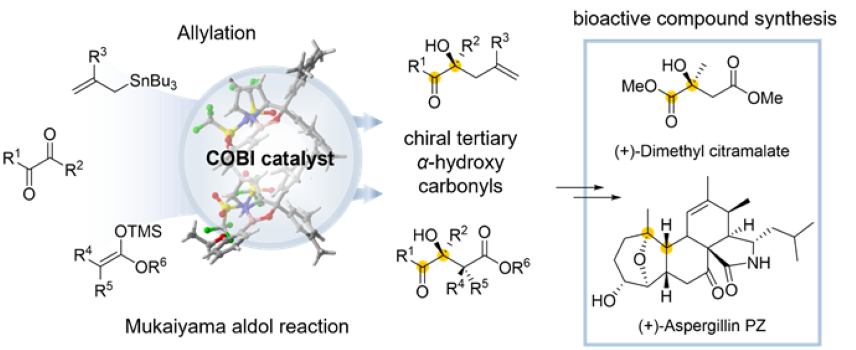
- In work with Hyunwoo Kim's team at KAIST, a single chiral catalyst ran an asymmetric allylation that had previously resisted control, and then ran an aldol reaction.
- The second paper assembles tetrahydrofuran rings bearing multiple stereocenters using a chiral organic catalyst on starting materials that contain no stereocenters of their own.
- Products from the first study went into (+)-dimethyl citramalate, and the second study's chemistry reached a synthetic intermediate for (+)-altholactone, a natural product with anticancer activity.
Compiled by The ScientistSomething wrong?How this is made
Why it matters
- capability Chirality is installed by the catalyst here, so a route to these oxygen-containing rings can begin with material that has no stereocenters in it.
- constraint The dual-use catalyst was shown on 1,2-dicarbonyl substrates, so a synthesis only collects the one-catalyst saving if it passes through that chemistry.
- decision Anyone weighing these methods against an established route has to go to the two papers themselves, since the public summary rates the selectivity only as high.
The hard part in the first paper is picking which carbon reacts. Its substrates are 1,2-dicarbonyl compounds [6], which put two carbonyl groups on adjacent carbons, so a nucleophile has to be delivered to one of the two and then onto one face of that one [9]. Sungkyunkwan's account of the work says the catalyst does both jobs, activating the intended site and setting the three-dimensional arrangement of the product [7]. Doing those two things simultaneously is what the group describes as a standing challenge in organic synthesis [8].
Density functional theory calculations supplied the explanation of how the catalyst controls the site and the product geometry [10]. The selectivity is an experimental result; the DFT is a model of why it happens, and it carries the assumptions of the functional and the structures fed into it.
The second paper assembles tetrahydrofuran, a five-membered ring with one oxygen in it, a framework found in many biologically active natural products and pharmaceuticals [13]. The route the authors report is a formal [3+2] cycloaddition of allylsilanes under a chiral Lewis acid catalyst [17]. Frameworks like this have often been made from starting materials that already contained the specific stereochemical arrangement the target needed [14].
Ryu said the two studies "demonstrate new possibilities for building complex molecular structures more precisely and efficiently" and that his group expects the approaches "to be extended to a wider range of asymmetric reactions and provide useful strategies for the efficient synthesis of valuable compounds, including pharmaceuticals and natural products" [18]. Chiral organic catalysts feature in both studies [1], though the account does not disclose whether the same one served in each [21]. A shared catalyst across two reaction types inside one paper is a narrower result than a single catalyst spanning both papers. Only the first is on the record here [4].
What to watch
- Whether an independent group runs the allylation on substrates outside the 1,2-dicarbonyl class.
- Whether the (+)-altholactone intermediate is carried through to the natural product itself.
- A DFT re-examination by another group, testing whether the computed site selectivity survives a different functional.