Science1 publisher3 min readPublished
A layered crystal admits carbon dioxide by pushing its own sheets apart
A team at Shibaura Institute of Technology reports carbon dioxide uptake at 2.0 pascals at 195 kelvin and separation from nitrogen and methane in humid gas at 303 kelvin, with electrostatic complementarity as the selection rule.
The Scientist · Science desk
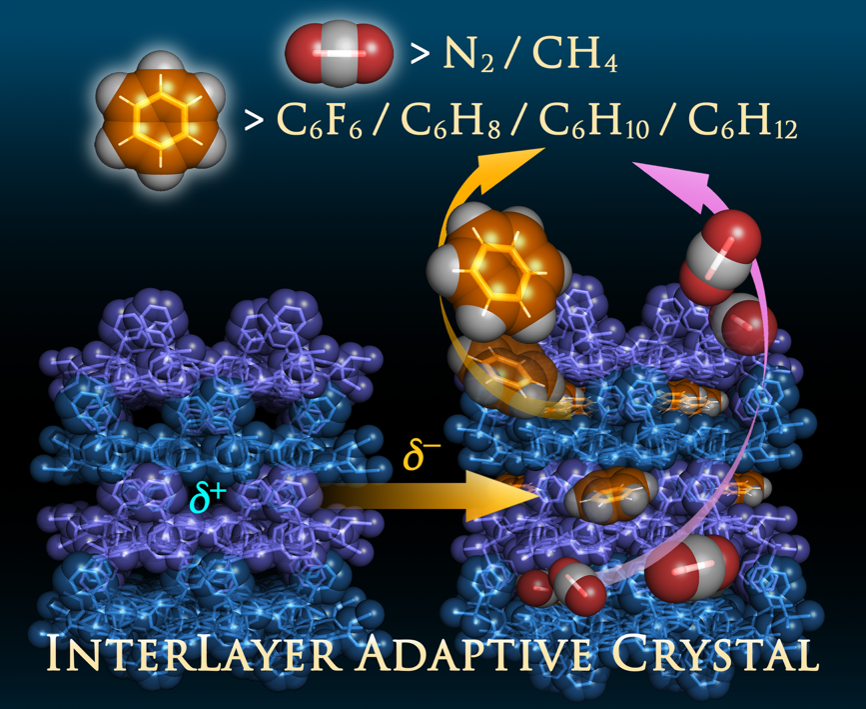
What happened
- A team led by Akiko Hori at Shibaura Institute of Technology, with Ryotaro Matsuda of Nagoya University, built a layered crystal whose sheets move apart when a suitable guest molecule approaches.
- With no guest inside, the crystal's pores are about 2.6 angstroms across, too narrow to act as a carbon dioxide pathway, so they work instead as triggers that open the layers.
- At 195 kelvin, about 78 degrees Celsius below the freezing point of water, the crystal took up carbon dioxide at pressures as low as 2.0 pascals.
- In dry breakthrough runs at 303 kelvin, carbon dioxide came off the column about 60 seconds later than nitrogen and 52 seconds later than methane.
- Benzene, about 5.9 angstroms across and more than twice the guest-free spacing, still entered the crystal once the layers had opened.
Compiled by The ScientistSomething wrong?How this is made
Why it matters
- capability Selecting by charge distribution gives materials chemists a handle on molecules of nearly identical size, the case where sieving by pore diameter breaks down.
- constraint The strongest affinity figure was taken at 195 kelvin, which limits what this work supports about a capture duty running near ambient temperature.
- decision Feasibility against existing capture processes turns on regeneration energy and cycle life; this study reports uptake and retention, so a shortlist decision still needs the desorption side measured.
- precedent A head-to-head test against a near-identical partner molecule is the bar other adaptive-pore claims will now be measured against.
The crystal selects on charge distribution. CO2 has a negative quadrupole moment, and the fluorinated aromatic surfaces lining the layers present positively polarized regions, so a guest with the complementary charge pattern is favored at the entrance, and the layers then move apart to let it in [5]. "Rather than relying only on molecular size, we focused on the characteristic negative quadrupole moment of CO2 and sought to use electrostatic complementarity as a new principle for selective separation," Hori said [1]. "The layered crystal unexpectedly showed that its interlayer space could expand in response to guest molecules," she said [2]. Taking up CO2 expanded the lattice reversibly along its a-axis. That expansion is the evidence that the gas was not simply filling the original ultramicropores [9]. The work is in Angewandte Chemie International Edition [3].
The two loading figures come from different temperatures. At 195 K the crystal holds about 2.0 CO2 molecules per [Zn(L)Py]2 unit near 98 kPa [7]. At 298 K, near the same pressure, it holds 0.58 [8]. On the reported units, that is about 29% of the cold loading [1]. The bottom of the cold isotherm is steep: going from 26 Pa to 98 kPa, roughly a 3,800-fold rise in pressure, raises loading only tenfold, from 0.2 to 2.0 molecules per unit [2].
The mixed-gas demonstration is a breakthrough experiment. Dry, at 303 K, CO2 emerged from the column about 60 seconds after nitrogen and 52 seconds after methane [10]. In a laboratory column, a delay of that size shows the crystal binds CO2 more tightly than either gas at room temperature.
The humid runs are the ones closest to a real duty. Under highly humid conditions the crystal took up 0.25 mol of CO2 per mol of unit from a CO2/nitrogen stream and 0.21 from CO2/methane [11]. Both came from flowing mixtures at 303 K, so neither is comparable with the 0.58 figure from a single-gas isotherm [8][11].
The organic test shows the principle more cleanly than the gas work does. Offered an equimolar mixture of benzene and hexafluorobenzene, the crystal took up benzene almost quantitatively, to about 97% of its benzene-inclusion capacity, with no evidence of hexafluorobenzene insertion [13]. Benzene also beat cyclohexane and cyclohexene in competition, which the authors attribute to electrostatic complementarity and not to size [14]. Conventional porous materials lean on pore size and adsorption strength, which struggle with molecules of similar dimensions [16].
The energy framing around the work is broad: separation processes such as distillation are estimated to account for 10 to 15% of global energy consumption [15]. What has been measured is static uptake and small-column breakthrough on a laboratory crystal [7][10]. Hori said the adaptive mechanism "could provide a route toward more energy-efficient CO2 capture and the separation of closely related organic compounds that are difficult to distinguish by conventional methods" [4].
What to watch
- Whether the group reports the same low-pressure carbon dioxide affinity at 298 kelvin, where a capture duty would actually run.
- Multi-cycle packed-bed data, with the heat needed to release the carbon dioxide and capacity quoted per kilogram of crystal.
- Whether repeated wet-dry cycling leaves the layer spacing and the humid uptake figures intact.