Science1 distinct publisher3 min readPublished
Star formation has fallen to under half its rate of 4.5 billion years ago, but a FAST and DESI measurement finds the atomic hydrogen reservoir down only about a third, which moves the bottleneck downstream.
The Scientist · Science desk

Compiled by The ScientistSomething wrong?How this is made
The arithmetic is where this gets interesting. A factor of 2.5 in star formation means the present rate is 40 percent of the rate 4.5 billion years ago, a fall of about 60 percent [1]. A factor of 1.4 in atomic hydrogen density means the present reservoir is about 71 percent of the old one, a fall of about 29 percent [2]. Divide one by the other and you get the quantity doing the work here: stars formed per unit of atomic hydrogen has dropped to roughly 56 percent of its earlier value [3]. The looser phrasing in the write-up, that star birth is now less than half what it was, is the same statement as the factor of 2.5 rather than a second finding [4].
The design is what makes those numbers worth arguing about. Neutral hydrogen announces itself mainly through the 21-centimetre line, faint enough that an individual distant galaxy sinks into the background noise [7]. That left the field choosing between depth over a small patch and breadth without sensitivity, so the total HI mass at low and intermediate redshift went effectively unmeasured [8]. Stacking is the way out: with spectroscopic redshifts telling you exactly where each galaxy's line should sit in frequency, you can align and co-add the individually invisible signals and read off the average [5]. The sample runs to about 2.5 million galaxies over nearly a third of the sky [4], and the result was published online in Nature Astronomy on September 1 [3].
The thing this doesn't tell you is where the hydrogen sits. A stack returns a population mean, and a mean is silent on whether the reservoir is spread across galaxies the way it used to be, or has pooled in objects that were never going to form many stars. Nor does it measure the fuel that stars are actually made from: star birth happens in dense molecular clouds, with atomic hydrogen an intermediate stage between the large-scale supply and those clouds [10]. The team's reading, that a weakening inflow from the cosmic web and falling gas densities have cut the efficiency of converting HI into molecular hydrogen, is an inference that fits two declining curves rather than a measured conversion rate [11].
I would take that reading as the best one on offer, on the condition that it is currently supported more by the absence of a rival than by evidence of its own. What the measurement itself settles is narrower and sturdier. Under simple accounting in which star formation tracks its fuel, the reservoir should have drained in step, and the observed depletion is nowhere near steep enough [9]. Hence the authors' framing, that the open question is no longer whether the gas is running out but why abundant hydrogen now yields so few stars [12].
Ranked by verification strength, evidence, and original report placement.
Over the past 4.5 billion years the rate of star birth in the universe has fallen to less than half of what it once was.
An international team led by researchers from the Chinese Academy of Sciences, in collaboration with the Dark Energy Spectroscopic Instrument (DESI) project, used China's Five-hundred-meter Aperture Spherical radio Telescope (FAST) to make high-precision measurements of cosmic neutral atomic hydrogen over the past 4.5 billion years.
The study was published online in Nature Astronomy on September 1.
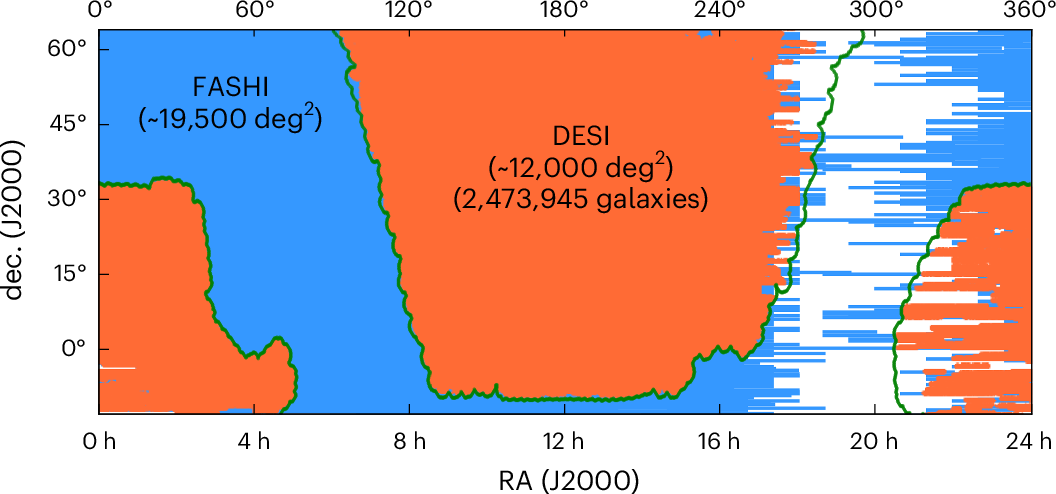
The researchers analysed a sample of about 2.5 million galaxies covering nearly one-third of the sky.
Using an HI spectral stacking technique, the team aligned and stacked faint, otherwise undetectable radio signals on the basis of precise galaxy redshifts, extracting the average HI signal from the noise.
The measurements found that 4.5 billion years ago the cosmic star formation rate was about 2.5 times higher than today, while the corresponding neutral atomic hydrogen density was only about 1.4 times its current level.
Distinct publishers with included, body-backed reporting in this cluster.
phys.org
1 article · September 1, 2026
Follow any of these and your For You feed starts watching them — no settings page required.
build
DiDi routes driverless R2 rides through the app that already matches its human drivers1 distinct publisher
science
The supernova age-bias fight is now about a slope, not a settled error1 distinct publisher
build
A refactoring benchmark stops the best agent at 41.2%, and the tests are the story1 distinct publisher
science
Terrain, not the quake, decides which mountains bleed sediment after a rupture1 distinct publisher
Evidence-backed comparisons of source perspectives and observed adoption signals. Read the methodology
Which Builder, Operator, and Investor concerns the observed source mix emphasized—not a truth score.
Evidence, demonstrated adoption, hype gap, incentives, and confidence are assessed independently, each on its own current evidence. How these are measured.
One peer-reviewed measurement, told only by its authors
The numbers are specific, internally consistent, and now sit behind peer review with a DOI, and the sample — 2.5 million galaxies over nearly a third of the sky — is the kind of scale that makes a stacked average believable. But every figure reaches us through a single institutional announcement, with no uncertainty on the 1.4-fold hydrogen density, no account of how stacking systematics were controlled, and no outside astronomer asked whether the contrast survives them.
Too early to see anyone use it
A paper going online and a write-up appearing the same day tell us the result exists, not that the field has picked it up. There are no citations, no attempted replication, no competing survey checking the stacked signal — and the researchers' own claim to have set a benchmark is an aspiration, not uptake. We decline to score this.
The gap is in the adjectives, not the arithmetic
Called 'barely decreased,' the hydrogen reservoir has in fact dropped something like 29 percent by the account's own factor of 1.4 — a real decline dressed as a non-event to sharpen the contrast with star formation. The measured part is sound; the overreach is the explanation stacked on top of it, where falling atomic-to-molecular conversion efficiency is asserted as the resolution while the word 'likely' does the work and no molecular gas is measured at all.
The instrument's owners are also the narrators
This reaches readers through one channel, and that channel begins with the institutions that built and run FAST and want it seen delivering flagship cosmology. It shows in the tells: a closing section headed 'A new benchmark for galaxy studies,' a nod to the scientific power of the pairing, an institution roll-call. None of that makes the ratio wrong; it does mean the emphasis, the adjectives, and the choice of what went unquantified were all set by an interested party with nobody pushing back.
Firm on the number, thin on the corroboration
We are fairly sure the reporting faithfully conveys what the paper claims: the arithmetic checks out — one over 2.5 is 0.40, comfortably under a half — and peer review plus a DOI anchor it. Our doubt is about breadth rather than substance. A single publisher, an author-sourced account, and a link whose own filing string reads August against a stated 1 September publication leave us without the second look that would raise this score.