Science1 distinct publisher2 min readPublished
If dark matter made the signal, the implied WIMP weighs at least 200 GeV, and LZ says its backgrounds there are very low. But the event came out of re-searching data already collected, so newer exposure has to settle it.
The Scientist · Science desk

Compiled by The ScientistSomething wrong?How this is made
Nearly a century of looking has produced no direct detection of the substance thought to make up about 85% of the matter in the universe [12]. That is the reason a single interaction gets a conference slot.
The event was not found by turning on anything new. LZ examines its results in batches [13], and the 220 live days recorded between March 2023 and April 2024 had already been searched for the simplest WIMP signatures; this pass widened the signal model to interactions that deposit larger amounts of energy in the xenon [3]. The collaboration says it is particularly sensitive in that region, and that the detector's design helps it avoid mistaking ordinary particle interactions for dark matter [4]. Widening a search that way buys coverage of models the first pass skipped. It also adds regions where a rare background can land, so the background estimate beneath the event is the number that actually carries the weight here, and lead author Sam Eriksen of the University of Bristol says the team spent months of additional work on exactly that [8].
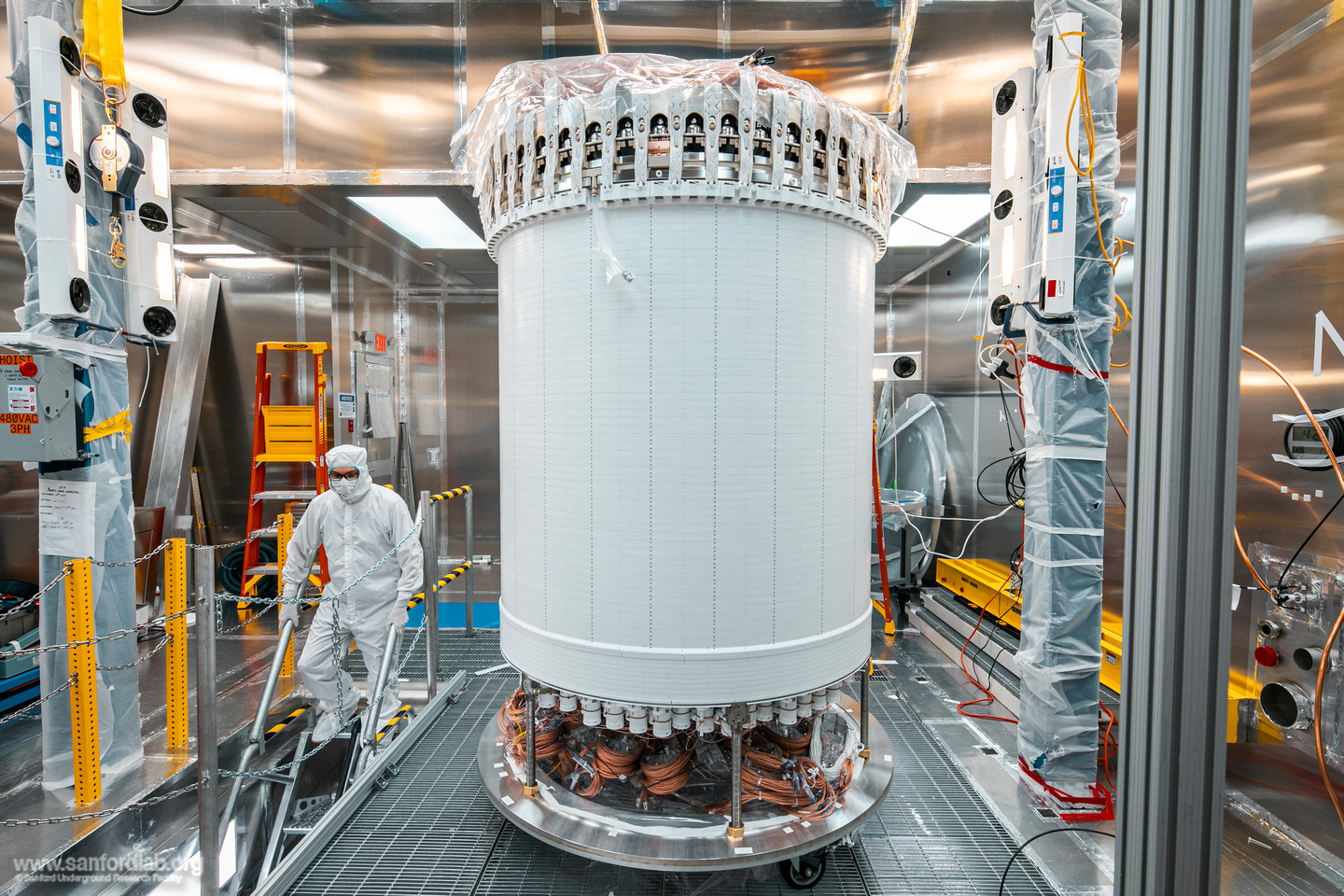
The exposure is worth doing by hand. Ten tonnes of liquid xenon [10] over 220 live days [3] is 2,200 tonne-days nominally, and that figure is a ceiling rather than the analysis exposure, because the release does not state the fiducial mass used for this search [14]. The live time carries its own lesson: March 2023 to April 2024 is roughly 13 to 14 calendar months, so 220 live days is about half the wall clock [15], and at that rate another 220 live days costs more than a year of calendar time [16].
The mass number needs the same handling. If dark matter produced the signal, LZ puts the responsible WIMP at probably 200 GeV/c2 or more, over 200 proton masses [5]. That figure is an energy-deposit floor rather than a measured value, and one event has no spectrum to fit. The reading also runs through a modelling choice, since the implied coupling sits outside the simplest WIMP-nucleon interactions that these searches normally assume [6]. LZ's own phrase, "difficult to explain with known backgrounds" [1], falls well short of "excluded as background."
Spokesperson Rick Gaitskell of Brown University put it as intrigue rather than discovery, noting the event sits where dark matter is expected and competing backgrounds are very low, and that LZ wants the community's input [7]. On the evidence as published, an unmodelled or fluctuating background is still the likeliest account. A 250-person, 39-institution collaboration working a mile under South Dakota [9] gains nothing from reading it harder than that.
Ranked by verification strength, evidence, and original report placement.
The finding is not statistically strong enough to qualify as a discovery, but researchers say it represents the most compelling potential dark matter signal LZ has reported so far.
For this study scientists analyzed 220 live days of observations gathered between March 2023 and April 2024; researchers had previously searched the same dataset for the faint signatures of the simplest forms of WIMP interactions, and this time expanded the search to a wider variety of possible WIMP interactions capable of depositing larger amounts of energy inside the detector.
The LZ collaboration examines its experimental results in batches.
A new analysis from the LUX-ZEPLIN (LZ) experiment recorded a single particle interaction that has proven difficult to explain using known background signals produced by ordinary matter, and it appeared in the region where dark matter might be expected.
LZ is especially sensitive to events of this higher-energy kind, and its design also helps scientists reduce the chances of mistaking ordinary particle interactions for dark matter.
If dark matter produced the unusual signal, the responsible WIMP would probably have a mass of at least 200 GeV/c2, making it more than 200 times as massive as a proton.
Distinct publishers with included, body-backed reporting in this cluster.
1 article · September 3, 2026
Follow any of these and your For You feed starts watching them — no settings page required.
science
A single 248-keV recoil sends LZ's dark matter search eight times above its usual window5 distinct publishers
science
Oak Ridge hands its nickel-hungry pennycress screen to an agentic co-scientist1 distinct publisher
science
Laser plasma stalls a stellar eruption, and the missing-CME problem gets a mechanism1 distinct publisher
science
A centuries-old Coulomb's law test could out-search accelerators for millicharged particles1 distinct publisher
Evidence-backed comparisons of source perspectives and observed adoption signals. Read the methodology
Which Builder, Operator, and Investor concerns the observed source mix emphasized—not a truth score.
Evidence, demonstrated adoption, hype gap, incentives, and confidence are assessed independently, each on its own current evidence. How these are measured.
One release, paper not yet posted
The single event, the 2.6 sigma, the 0.5% background probability, the 200 GeV/c2 floor — all of it traces to Berkeley Lab's own announcement as ScienceDaily reproduces it. Berkeley Lab manages LZ, so the primary account and the subject are the same body. The write-up is specific and internally consistent, which counts for something, but the paper is promised to arXiv and Physical Review Letters rather than available, so no referee and no unaffiliated physicist has yet examined the background model on which one count's meaning entirely rests.
A talk given, a paper promised
Uptake amounts to one presentation in Japan and an invitation for community input on a result the community cannot yet read. Gaitskell says the collaboration wants outside eyes; the arXiv posting that would enable that is still ahead. Meanwhile the physics itself is unreplicated by construction — one event, in one detector, from a dataset LZ had already worked over.
Headline outruns the sigma
ScienceDaily's headline promises a signal scientists cannot explain and its summary calls it the most promising clue yet; the body beneath is markedly more disciplined — 2.6 sigma against a 5-sigma bar, Gaitskell refusing the discovery claim in as many words. The gap is in framing, not in the physics as stated. The one substantive overreach is temporal: 'more observations will be crucial' reads as imminent, but at roughly half live time, matching this exposure again is a year-plus of calendar, and nobody says so.
The experiment narrating its own anomaly
This is a DOE-funded collaboration of 250 people describing, through its own managing laboratory, the most interesting thing it has found — before publication, and while it continues to seek running time and support at SURF. Those are ordinary but real reasons to put an unexplained count in front of the world. Pulling the other way: the quotes are unusually self-limiting, and disclosing at 2.6 sigma with an explicit request for scrutiny is the behaviour of a group that expects to be checked.
Facts firm, meaning open
We are fairly sure what was said: the numbers, quotes and provenance are unambiguous and mutually consistent. We are far less sure what it amounts to, and with one publisher relaying one institution there is no second account to catch an error in either. Our derived exposure and timing figures follow from stated numbers and hold unless the forthcoming paper reports something the announcement left out — which, on the missing fiducial mass, it certainly will.